If you have ever held a precision-cut aluminum bracket, an aerospace fitting, or a custom stainless steel implant, there is a good chance a CNC machine made it. CNC-обработка is the backbone of modern manufacturing, used in industries from medical devices to automotive components to consumer electronics.
Yet for many engineers, product developers, and buyers encountering the process for the first time, the core question remains: what exactly is CNC machining, and how does it work?
This complete guide answers that question from first principles. By the end, you will understand what computer numerical control means, how raw material becomes a finished part, what tolerances and materials are realistic, and whether Индивидуальная обработка с ЧПУ is the right process for your project.
Что такое ЧПУ?
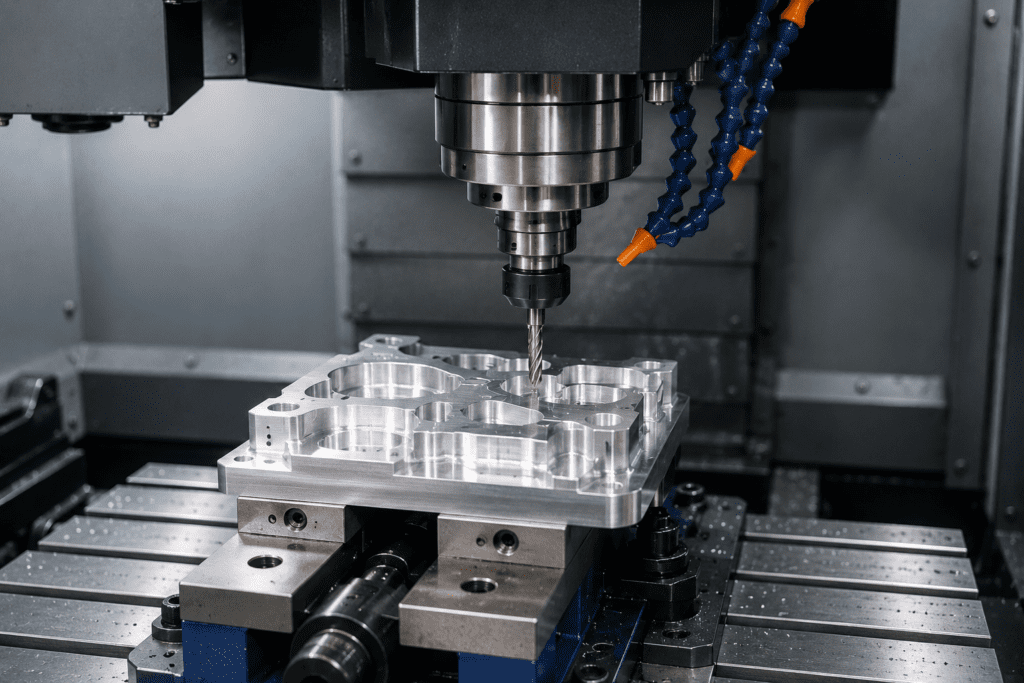
Обработка на станках с ЧПУ — это субтрактивный производственный процесс. in which computer-controlled machines remove material from a solid workpiece to produce a finished part with precise dimensions, features, and surface finishes.
Unlike additive manufacturing (3D printing), which builds parts layer by layer, CNC machining starts with a solid block, bar, or tube of material and cuts away everything that is not the finished part. The result is typically stronger, dimensionally more accurate, and better suited to demanding end-use environments than printed counterparts.
The key differentiator between CNC and older manual machining is контроль. A manual operator turns handwheels and reads dials. A CNC machine reads G-code, a standardized programming language that instructs the spindle, axes, and tooling exactly where to move, at what speed, and with how much force, thousands of times per second.
Краткое определение: CNC machining = computer-directed cutting tools + solid raw material = precise finished parts.
Why CNC Machining Matters in Modern Manufacturing
The global CNC machine tools market was valued at approximately 86.83 млрд долларов США в 2023 году and is projected to grow at a CAGR of 6.8% through 2030, driven by rising demand for precision parts in aerospace, medical, and automotive sectors (Grand View Research).
This growth reflects a fundamental reality: modern products, from smartphones to surgical implants to electric vehicle battery housings require levels of precision and consistency that only computer-controlled manufacturing can reliably deliver.
Что означает ЧПУ?
ЧПУ означает компьютерное числовое управление.
The term precisely describes how the technology works:
- Компьютер — a dedicated microprocessor or industrial PC governs all machine operations
- численный — movements are defined by numerical coordinates (X, Y, Z axes and rotational positions)
- Контролировать — the computer directs every mechanical movement of the machine in real time
What CNC Control Means in Practice
The “numerical” in CNC refers to how machine movements are defined, as precise X, Y, Z coordinates and rotational positions, updated thousands of times per second. The “computer” interprets a program and translates those numbers into electrical signals that drive servo motors with extreme accuracy.
Результат: CNC machining centers routinely hold tolerances of ±0.005 mm (0.0002 inches) and switch between dozens of cutting tools automatically, completing a complex part in a single setup that would take a manual machinist hours of careful, error-prone work.
Как работает станок с ЧПУ?
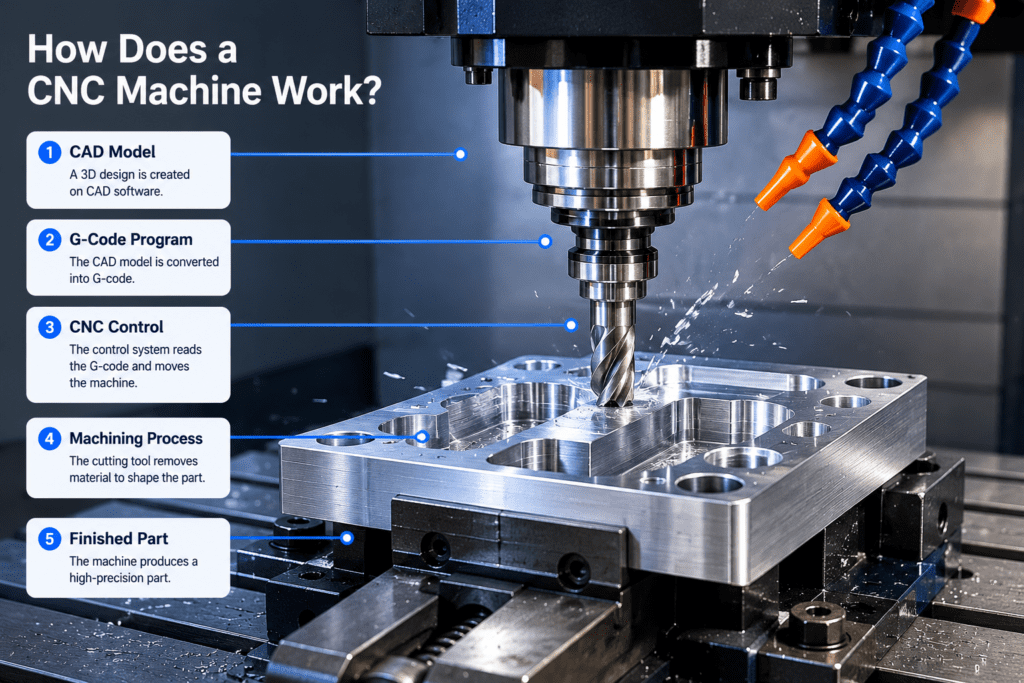 A CNC machine works by following digital instructions to move cutting tools along precise paths, removing material from a workpiece to achieve a specific geometry.[/caption]
Here is the sequence in plain terms:
- A 3D CAD-проектирование defines the part geometry
- CAM программное обеспечение translates the geometry into G-code toolpaths
- Контроллер CNC reads G-code line by line
- Серводвигатели drive ball screws or linear guides along X, Y, Z axes (and rotational axes on multi-axis machines)
- Прецизионные датчики provide real-time feedback, verifying tool position against the digital blueprint
- Высокоскоростные шпиндели rotate cutting tools at thousands of RPM, shearing material away
- Системы охлаждения flush chips and manage heat to protect tool life and dimensional accuracy
Does CNC Machining Use G-Code?
Yes. G-code is the primary programming language for CNC machines. A typical line reads:
G01 X25.400 Y12.700 Z-5.080 F500
This instructs the machine to move linearly (G01) to coordinates X=25.4mm, Y=12.7mm, Z=5.08mm below the surface at a feed rate of 500 mm/min. A complete part program may contain thousands of such lines, each one a precise mechanical instruction.
Должен прочитать: Передовые стратегии высокоточной обработки на станках с ЧПУ.
Основные части станка с ЧПУ
Компонент | Функция |
Шпиндель | Rotates the cutting tool or workpiece at high speed |
Controller (CNC unit) | Interprets G-code and sends signals to drive motors |
Machine bed/frame | Rigid structure that absorbs cutting forces and maintains alignment |
Серводвигатели | Drive linear and rotational axes with precision |
Автоматическая смена инструмента (ATC) | Switches between cutting tools without operator intervention |
Система охлаждающей жидкости | Reduces heat, flushes chips, extends tool life |
Панель управления | Operator interface for program loading, monitoring, and manual overrides |
Процесс обработки на станках с ЧПУ: пошаговое описание
Шаг 1: CAD-дизайн
Все начинается с Модель 3D. Engineers use CAD software, SolidWorks, CATIA, Fusion 360, or AutoCAD — to create a digital representation of the part. The model defines every dimension, feature, hole, thread, and surface finish requirement.
Common file formats: .ШАГ, .IGES, .STL, .DXF
The quality of the CAD model directly determines the quality of the finished part. Features that are geometrically unclear, underspecified, or physically impossible to cut will cause costly problems downstream.
Design for manufacturability (DFM) tip: Parts designed with CNC constraints in mind, avoiding unnecessarily deep cavities, standardizing hole sizes, minimizing setups, cost significantly less to produce.
Шаг 2: Программирование CAM
The CAD file is imported into CAM программное обеспечение, which generates the toolpaths, the precise trajectories the cutting tool follows to remove material. CAM accounts for:
- Machine type and axis count
- Cutting tools available
- Обрабатываемый материал
- Требуемая обработка поверхности
- Optimal sequence of operations to minimize setup changes
На выходе G-код: a text file of precise motion instructions sent to the machine controller.
Skilled CAM programmers optimize toolpaths to minimize machining time, reduce tool wear, and avoid collisions between cutter, workpiece, and fixture. This programming expertise is what separates a 4-hour cycle time from a 1.5-hour cycle time on the same part.
Шаг 3: Настройка машины
Before cutting begins, a machinist prepares the machine:
- Закрепление: Securing raw material in a vise, chuck, fixture, or clamp
- Загрузка инструмента: Installing correct cutters in the spindle or automatic tool changer
- Datum setting: Establishing the zero-point origin for all machine movements (an error of 0.1 mm here affects every feature on the part)
- Проверка материалов: Confirming correct grade, size, and condition of raw stock
Setup time is a significant cost driver, especially for small batches. A well-designed part that machines in a single setup costs less and achieves better accuracy than one requiring multiple repositioning steps.
Шаг 4: Обработка
With setup complete, the operator runs the program. The controller reads G-code line by line and drives servo motors to move the cutting tool through the workpiece with high precision.
Во время резки:
- Охлаждающая жидкость reduces heat, flushes away chips, and extends tool life
- Датчики реального времени monitor cutting forces and tool position
- Замкнутая обратная связь allows the controller to make micro-adjustments if deviations are detected
Modern machining centers can run отбой, unattended, overnight with pallet changers automatically cycling through multiple workpieces.
Шаг 5: Проверка качества
After machining, parts are measured against the engineering drawing or 3D model. Common inspection tools:
- Штангенциркули и микрометры — straightforward dimensional checks
- Координатно-измерительные машины (КИМ) — 3D feature verification
- Surface roughness profilometers — finish verification against Ra requirements
- Резьбовые калибры — checking threaded holes and fastener features
Depending on quality requirements, inspection may be first-article only, statistical sampling, or 100% of every part.
At Обработка на станках с ЧПУ Ruiyi, every order includes dimensional inspection with full documentation. Our ISO 9001:2015 and ISO 13485 certifications govern the quality process from raw material receipt through final shipment.
Step 6: Post-Processing and Surface Treatment
Most machined parts require finishing before use:
- Deburring removes sharp edges and chips
- анодирование improves corrosion resistance and adds color to aluminum parts
- гальванопокрытие adds wear resistance or conductivity
- Порошковое покрытие provides durable decorative finishes
- Термическая обработка increases hardness for steel parts
- Пескоструйная creates uniform matte finishes
Ruiyi’s услуги по обработке поверхности cover all major post-machining finishing options, applied in-house to reduce lead time and handling.
Типы станков с ЧПУ
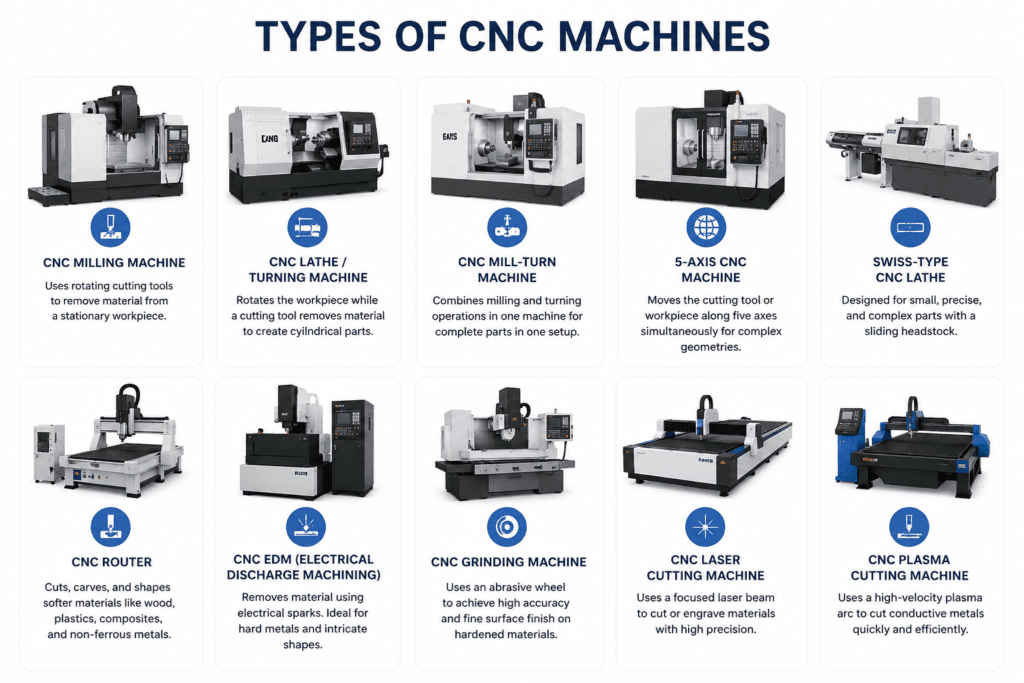
CNC is not a single machine type. Here are the most important categories:
1. Фрезерный станок с ЧПУ
Использует вращающийся многоточечный режущий инструмент that moves across a stationary workpiece. Produces flat surfaces, slots, pockets, contours, and complex 3D shapes.
- 3-осевое фрезерование: Moves in X, Y, and Z — standard for most parts
- 4-осевое фрезерование: Adds rotation around one axis for side features without repositioning
- 5-осевое фрезерование: Two additional rotational axes enable complex aerospace parts, turbine blades, and medical implants in a single setup
Ruiyi operates dedicated 4-осевая обработка с ЧПУ и Услуги 5-осевой обработки с ЧПУ for geometries that 3-axis setups cannot reach efficiently.
2. CNC Lathe / Turning Machine
Вращает заготовку while a stationary cutting tool removes material. Produces shafts, pins, bushings, threads, and flanges. Modern turning centers include live tooling for drilling and milling operations in the same setup.
Изучите наши Токарные услуги с ЧПУ for the full scope of lathe-based capabilities.
3. CNC Milling and Turning Machine (Mill-Turn)
Combines milling and turning in a single machine, reducing setups and improving accuracy for complex prismatic-plus-rotational parts.
4. 5-Axis CNC Machine
Operates along five axes simultaneously — three linear (X, Y, Z) and two rotational (A and B or C). Essential for complex aerospace components, impellers, and medical implants where traditional 3-axis setups require multiple operations.
5. Токарный станок с ЧПУ швейцарского типа
Uses a sliding headstock and guide bushing to support the workpiece very close to the cutting tool during rotation. Produces small, long, slender parts — watch components, medical pins, dental screws — with exceptional precision.
6. Фрезерный станок с ЧПУ
Cuts, carves, and shapes softer materials — wood, plastic, non-ferrous metals, foam, composites. Widely used in woodworking, signage, and prototyping.
7. Электроэрозионная обработка на станках с ЧПУ (электроэрозионная обработка)
Removes material using controlled электрические искры between an electrode and the workpiece. Used for hardened metals and complex geometries such as sharp internal corners and narrow slots that cutting tools cannot reach. See our guide on what EDM is для подробного объяснения.
8. Шлифовальный станок с ЧПУ
Uses an abrasive wheel to achieve extremely tight tolerances and fine surface finishes on hardened materials. Used for precision bearing surfaces, cutting tool blanks, and hardened steel components.
9. Станок лазерной резки с ЧПУ
Focuses a laser beam to cut or engrave with high precision. Produces clean edges with minimal material waste. Suitable for thin metals, acrylic, and composites.
10. Машина плазменной резки с ЧПУ
Uses a high-velocity plasma arc to cut electrically conductive materials. Ideal for cutting thick steel, aluminum, and other metals quickly and economically.
Complete CNC Machine Types Reference Table
Тип станка с ЧПУ | Основное использование | Типичные отрасли |
Фрезерование с ЧПУ (3 оси) | Flat surfaces, slots, contours | General manufacturing, tooling |
Фрезерование с ЧПУ (5 оси) | Complex geometries, single-setup | аэрокосмическая, медицинская, энергетическая отрасли |
CNC Lathe / Turning | Цилиндрические детали, валы, резьбы | Автомобилестроение, общее машиностроение |
Токарный станок с ЧПУ швейцарского типа | Мелкие прецизионные детали | Medical, watchmaking, electronics |
Токарно-фрезерный центр | Prismatic + rotational combined | Aerospace, energy, general |
станок чпу по дереву | Wood, plastic, composites | Furniture, signage, prototyping |
Электроэрозионный станок с ЧПУ | Hard metals, intricate cavities | Tooling, mold making |
Шлифование с чпу | Fine finish, tight tolerance | Tooling, bearings, hardened parts |
Лазерная резка с ЧПУ | Thin materials, clean edges | Electronics, sheet metal |
Плазменная резка с ЧПУ | Толстые проводящие металлы | Construction, heavy fabrication |
Гидроабразивная резка с ЧПУ | Термочувствительные материалы | Composites, ceramics, stone |
Типы процессов обработки на станках с ЧПУ
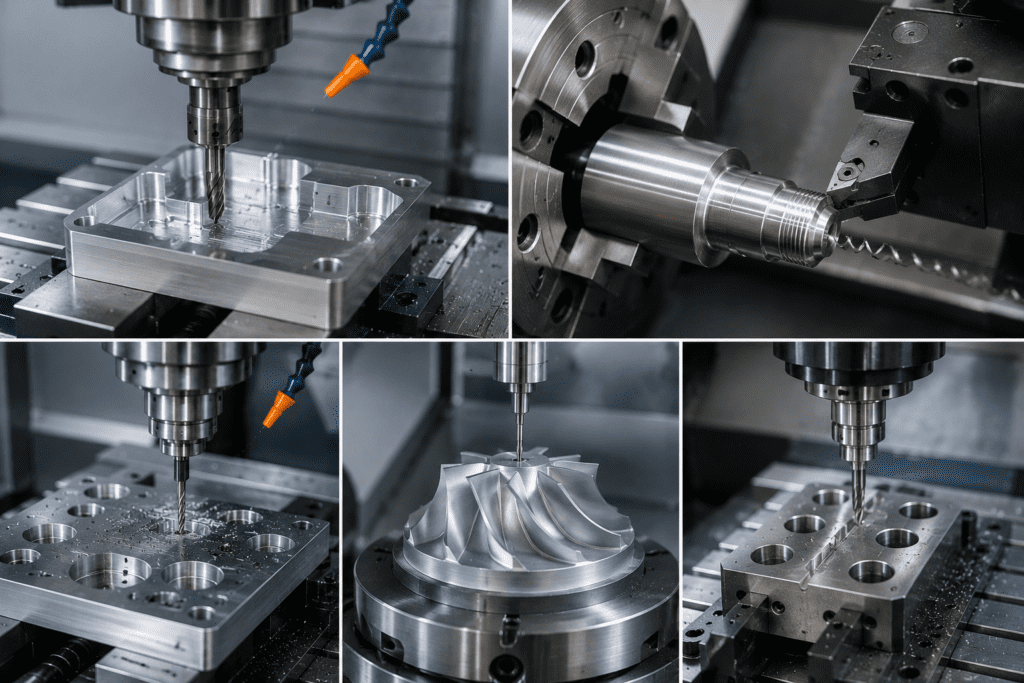
1. Поворот
токарный станок вращает заготовку while a cutting tool removes material to create cylindrical features — shafts, rods, threads, and flanges. High precision and smooth finishes characterize well-executed turning operations.
2. Фрезерование
A rotating multi-point cutter removes material from a fixed workpiece. Produces slots, pockets, flat surfaces, contours, and complex 3D shapes. The most versatile CNC process.
3. Бурение
A вращающееся сверло cuts round holes into solid material with precise depth and diameter control. Often the first operation before tapping or remaining.
4. Нажатие
A tap tool creates internal threads inside a drilled hole — either by cutting material or by displacing it. CNC machines synchronize spindle speed and Z-axis feed to achieve correct thread pitch every time.
5. Скучно
A single-point cutting tool enlarges an existing hole to a precise diameter with superior straightness and finish compared to drilling alone. Used for engine bores, bearing housings, and precision fits.
6. Расширение
A reamer refines a drilled hole to an exact diameter and superior surface finish. Used for dowel pin holes and close-tolerance fits where drilling alone is insufficient.
7. Шлифование
A rotating abrasive wheel removes small amounts of material to achieve tight tolerances and fine surface finishes. Essential for hardened parts and bearing surfaces.
8. Протяжка
A toothed tool moves across or through a workpiece to remove material in stages. Used for keyways, splines, and internal profiles. Very fast for high-volume production.
9. EDM (электроэрозионная обработка)
Управляется электрические искры remove material from conductive metals without mechanical contact. Used for complex mold cavities, narrow slots, and materials too hard to cut conventionally.
10. Гидроабразивная резка
A high-pressure stream of water (often with abrasive particles) cuts through material without generating heat. Preserves material properties in heat-sensitive applications — composites, ceramics, tempered glass.
What Materials Can CNC Machines Cut?
One of the great strengths of CNC machining is универсальность материала. The process is compatible with virtually any engineering material.
Драгоценные металлы
Материал | Ключевые свойства | Типичные применения |
Алюминий 6061 | Excellent machinability, good strength-to-weight ratio | Aerospace frames, automotive brackets, electronics housings |
Алюминий 7075 | Higher strength than 6061, good fatigue resistance | Aircraft structural components, high-performance parts |
Нержавеющая сталь 304 | Corrosion resistant, food-safe | Medical equipment, food processing, marine |
Нержавеющая сталь 316 | Превосходная коррозионная стойкость, особенно к хлоридам | Морская, фармацевтическая, химическая промышленность |
Мягкая сталь 1018 | Easily machinable, weldable | Structural parts, machine bases, fixtures |
Легированная сталь 4140 | Высокая прочность, хорошая твердость | Gears, shafts, high-stress components |
Титан (класс 5) | Biocompatible, high strength-to-weight | Аэрокосмическая отрасль, медицинские имплантаты, автоспорт |
Медь | Отличная электропроводность | Electrical connectors, bus bars, heat sinks |
Латунь | Easy to machine, corrosion resistant | Fittings, valves, decorative parts, plumbing |
Inconel 718 | Прочность при высоких температурах | Jet engine components, gas turbine parts |
Aluminum is the most frequently machined metal in CNC shops worldwide. It offers excellent machinability, low weight, good strength, and responds well to anodizing for corrosion protection and color.
Инженерные пластмассы
Материал | Ключевые свойства | Типичные применения |
Делрин (ацеталь/ПОМ) | Низкое трение, отличная размерная стабильность | Gears, bushings, mechanical parts |
PEEK | Устойчивость к высоким температурам, биосовместимость | Medical devices, aerospace, chemical handling |
Нейлон (ПА6/ПА66) | Прочный, износостойкий | Structural components, gears, housings |
ABS | Легко обрабатывается, хорошая отделка поверхности | Prototypes, enclosures, consumer products |
Поликарбонат (ПК): | Прозрачный, ударопрочный | Оптические компоненты, защитные кожухи |
PTFE (тефлон) | Chemical resistant, very low friction | Seals, gaskets, chemical handling |
СВМПЭ | Исключительная износостойкость | Conveyor components, bearing pads |
композиты
- Carbon fiber reinforced polymer (CFRP): CNC routed for aerospace and sports equipment panels. Requires diamond-coated tooling and dust extraction.
- G10/FR4 fiberglass: Used for electrical insulation and circuit board machining.
CNC Machining Tolerances and Accuracy
Accuracy is one of the defining advantages of CNC machining over manual methods.
Standard Achievable Tolerances
Характеристика | Стандартный допуск | Жесткая терпимость |
Линейные размеры | ±0.127 мм (±0.005 дюйма) | ±0.025 мм (±0.001 дюйма) |
Диаметр отверстия | ±0.05 мм | ±0.005 мм |
Чистота поверхности (Ra) | От 1.6 до 3.2 мкм | 0.4 мкм или лучше |
Шаг резьбы | ISO 6H/6g | Пользовательский класс |
Плоскость | 0.05 мм | 0.010 мм |
круглость | 0.010 мм | 0.002 мм |
Is CNC Machining More Accurate Than Manual Machining?
Yes, by a significant margin. Here is why:
- Sensors monitor tool position up to 100 times per second, continuously verifying location against the digital blueprint
- High-precision ball screws with backlash compensation maintain positioning that manual equipment physically cannot match
- Human eyes cannot reliably detect deviations below 0.1 mm during a manual cut; CNC systems routinely hold ±0.005 mm
- Термическое расширение is managed through automated coolant and temperature compensation software
- Fatigue does not affect a CNC machine: the 1,000th part is as accurate as the first
For medical implants, aerospace structural components, and precision instruments, this level of accuracy is not optional, it is the minimum acceptable standard.
Обработка на станках с ЧПУ против ручной обработки
фактор | Обработка CNC | Ручная обработка |
Точность | От ±0.005 мм до ±0.025 мм | ±0.1 мм типично |
Повторяемость | Identical parts every cycle | Varies with operator skill and fatigue |
скорость производства | High, especially for complex parts | Slow for complex features |
Требования к рабочей силе | 1 оператор может управлять несколькими машинами | 1 operator per machine, continuous attention |
Сложная геометрия | Handles intricate 3D shapes | Limited to simpler features |
Время установки | Higher for first part | Lower for simple one-off parts |
Лучше всего | Batches of 1–100,000+ | Simple repairs, single one-off simple parts |
Стоимость по объему | Низкая стоимость за деталь | High cost per part |
Manual machining remains useful for simple one-off repairs and basic mechanical parts where precision requirements are relaxed. For anything requiring consistency, complexity, or production volume, CNC is the standard.
Обработка на станках с ЧПУ против других производственных процессов.
Обработка с ЧПУ против 3D-печати
Обработка CNC | 3D печать | |
Прочность детали | Full material strength | Anisotropic, often weaker |
Допуски | ±0.025 мм или лучше | ±0.2 мм типично |
Чистота поверхности | Отлично (Ra 0.4–3.2 мкм) | Требуется постобработка |
Ассортимент материалов | Металлы, пластмассы, композиты | Пластмассы, некоторые металлы |
Лучше всего | Functional end-use parts, metal parts | Early-stage prototypes, complex internals |
Стоимость при малом объеме | Higher per part setup | Lower for first prototype |
Для пакетов functional parts in metal or engineering plastics, CNC machining wins on mechanical performance. 3D printing excels for geometry validation of early-stage prototypes.
Обработка на станках с ЧПУ против литья под давлением
Обработка CNC | Литье под давлением | |
Стоимость оснастки | Ничто | $5,000–$100,000+ for mold |
Стоимость за деталь | Higher at high volume | Very low at high volume (50,000+) |
Лучший объем | 1 to ~5,000 parts | 10,000+ деталей |
время | 3–14 дней | 4–12 weeks for tooling |
Изменения в дизайне | Easy, no tooling to modify | Expensive if mold needs recutting |
CNC machining is also used to manufacture the injection molds themselves.
Обработка на станках с ЧПУ против литья под давлением
Die casting produces complex internal shapes and thin walls efficiently at high volume. However, cast parts typically require secondary CNC machining for tight-tolerance features — so the two processes are often used together.
Applications of CNC Machining by Industry
Аэрокосмическая промышленность:
Aerospace is among the most demanding applications for CNC machining. Components include structural airframe brackets, engine mounts, landing gear parts, and satellite housings. Materials are typically aluminum alloys, titanium, and nickel superalloys (Inconel). Tolerances are extremely tight and full material traceability is mandatory.
5-axis machining is essential here : turbine blades, impellers, and complex structural castings cannot be produced efficiently any other way.
Автомобильная промышленность:
Automotive manufacturers machine engine blocks, cylinder heads, transmission housings, brake caliper bodies, and EV battery enclosures. High-volume production demands consistent quality across thousands of identical parts. CNC automation supports both prototype development and full-scale production.
Медицинская промышленность:
Medical device manufacturing imposes strict requirements: specific surface roughness values for biocompatibility, full material traceability, and compliance with ISO 13485. CNC machines produce surgical instruments, orthopedic implants, spinal components, and diagnostic device housings from stainless steel, titanium, and medical-grade PEEK.
Руйи держит Сертификация ISO 13485, enabling us to serve medical device manufacturers with the documentation and quality standards their customers require.
Электронная промышленность
Electronics manufacturers machine heat sinks, antenna mounts, connector housings, and structural chassis for industrial electronics. Aluminum and copper parts require clean, precise cuts that CNC delivers consistently. Compact product designs demand tight tolerances on every feature.
Оборонная промышленность
Defense contractors produce firearm components, armored vehicle parts, and communication hardware. Durable materials (hardened steel, titanium, aluminum alloys) require stable, controlled cutting parameters. Dimensional consistency is non-negotiable for mission-critical equipment.
Энергетический сектор
Energy companies machine turbine shafts, valve bodies, pump impellers, and drilling components from nickel superalloys, stainless steel, and alloy steels. Heavy-duty materials demand rigid machining setups. Both renewable energy (wind turbine hubs) and conventional energy (oil/gas wellhead components) depend on precision CNC machining.
Робототехника и автоматизированное оборудование
Ruiyi serves engineering teams developing robotic systems and automation hardware, structural frames, actuator housings, precision gear blanks, and gripper components. Tight tolerances ensure correct alignment and smooth mechanical interaction between assemblies.
Быстрое прототипирование и разработка продукта
Engineering teams use CNC machining to convert CAD models into functional physical parts quickly for design validation, fit checking, and performance testing. CNC prototyping bridges the gap between digital design and production-ready parts without committing to expensive tooling.
Ruiyi’s услуги быстрого прототипирования are specifically structured for accelerated development cycles, with standard lead times of 3–7 days.
Преимущества обработки с ЧПУ
- Более высокая точность
CNC machines follow exact programmed coordinates during every operation. The system maintains tight tolerances across large production batches without deviation caused by human positioning errors.
2. Отличная повторяемость
CNC programs repeat identical toolpaths for every unit produced. The 1,000th part is dimensionally identical to the first — a consistency that manual methods simply cannot achieve.
3. Greater Production Speed
Automated tool changes, continuous operation, and optimized toolpaths allow CNC machines to produce complex parts in minutes rather than hours. Shops complete more parts within the same timeframe at lower labor cost.
4. Возможность создания сложной геометрии
CNC machines, especially 5-axis centers manage multi-axis simultaneous movement, enabling intricate 3D shapes, internal cavities, and compound angles that manual methods cannot produce at all.
5. Сокращение человеческого фактора
Computer-guided instructions control feed rates, depth of cut, and positioning. The system eliminates common measurement errors, alignment mistakes, and calculation errors.
6. Более безопасная работа
Enclosed machine designs contain chips and debris during cutting. Operators interact with control panels rather than active cutting zones, dramatically reducing exposure to rotating tools and coolant spray.
7. Масштабируемость
CNC machining scales from a single prototype to thousands of production parts using the same digital program. No tooling investment is required to change quantities.
8. Более эффективное использование материалов
CAM software calculates efficient cutting paths before production begins. Controlled machining limits unnecessary material removal and reduces scrap rates.
How to Choose a CNC Machining Partner
When selecting a CNC machining supplier, particularly for outsourcing to a precision manufacturer — evaluate these criteria:
Возможности оборудования: Do they have the axis count, work envelope, and machine types your parts require? 5-axis capability matters for complex parts.
Материальный опыт: Have they machined the specific alloy or plastic your application requires? Material-specific expertise affects surface finish, tool selection, and dimensional stability.
Допустимая толерантность: Can they consistently hold the tolerances on your engineering drawing? Ask for documented evidence, not just claims.
Система качества: Do they hold ISO 9001:2015? ISO 13485 for medical? Can they provide CMM inspection reports, material certificates, and first-article documentation?
Отзывы о DFM: Will they flag design-for-manufacturability issues before cutting, or simply make what is on the drawing regardless of cost efficiency?
Коммуникабельность и оперативность: For international buyers, clear English communication, fast quote turnaround, and proactive updates on production status matter as much as machining quality.
Zero-risk policy: At Ruiyi, we operate a “Check First, Pay After” policy, no upfront payment is required. You inspect the parts on receipt and pay only after confirming quality. This removes purchasing risk entirely for new customers.
Why Source CNC Machining from Ruiyi?
Промышленный производитель Ruiyi is an ISO 9001:2015 and ISO 13485 certified precision CNC machining facility based in Dongguan, Guangdong, China, serving clients in the USA, Europe, Canada, and worldwide.
Наши возможности включают в себя:
- фрезерные с ЧПУ (3-осевой, 4-осевой, 5-осевой)
- Токарный станок с ЧПУ с использованием инструментов в реальном времени
- Изготовление листового металла
- Производство пресс-форм
- Быстрое прототипирование (3–7 day lead time)
- Full surface treatment: anodizing, electroplating, sandblasting, powder coating
Наша фабрика покрывает 10,000 квадратных метров с более чем 200 современных станков с ЧПУ, including 5-axis machining centers and turning-milling composite machines. We serve over 1,500 customers annually across telecommunications, robotics, medical devices, automotive, and automation equipment.
Резюме
CNC machining is a computer-controlled subtractive manufacturing process that converts raw material into precision parts by removing material with cutting tools under numerical program control.
Key facts to remember:
- ЧПУ означает Компьютерное числовое управление
- Основные процессы: milling, turning, drilling, EDM, and grinding
- Standard tolerances reach ±0.127 мм; precision tolerances reach ±0.025 мм или лучше
- Machinable materials include most metals and engineering plastics
- CNC machining is most cost-effective for низкие и средние объемы производства требующий высокой точности
- Процесс начинается с CAD-модель и заканчивается dimensionally verified, finished part
Understanding these fundamentals puts you in a stronger position whether you are designing parts for manufacture, evaluating CNC machining service providers, or managing procurement for precision components.
Ruiyi CNC Machining provides precision CNC milling, turning, rapid prototyping, sheet metal fabrication, and mold-making services from our facility in Dongguan, China, to clients across the USA, Europe, Canada, and worldwide. Свяжитесь с нами для получения дополнительной информации on your next project