
CNC Machining Cost Calculator : How to Accurately Estimate Your Part Price
Instant Estimate
CNC Machining Cost Calculator
Get an instant ballpark estimate for your custom parts. Exact pricing requires a full RFQ review.
Affects machining time and setup requirements.
Larger volumes reduce per-unit cost significantly.
Estimated Unit Price
—
Estimated Total
—
* This estimate is for budgeting reference only and excludes tooling design, DFM review, and shipping. Actual pricing depends on your 3D drawing and full RFQ review. Contact us for a binding quote.
You submit a drawing. The quote comes back. You stare at the number and wonder: is this right? That uncertainty is almost universal among procurement engineers and product developers who work with custom CNC machined parts and it exists because most buyers don’t have a reliable mental model for how machining costs actually assemble. This guide changes that.
A CNC machining cost calculator is only as useful as your understanding of the inputs it depends on. Feed it bad assumptions and you get a misleading number. Feed it accurate data and it becomes a powerful tool for budgeting, supplier negotiation, and design optimization. This article walks through every variable in the calculation, step by step with real price data, worked examples, and context you can use the moment you close the tab.
The global CNC machine market was valued at approximately USD 109.46 billion in 2025 and is projected to reach USD 177.63 billion by 2035, growing at a CAGR of 4.96% (Precedence Research). Asia Pacific alone holds over 55% of that market, making China the dominant sourcing region for precision custom parts. |
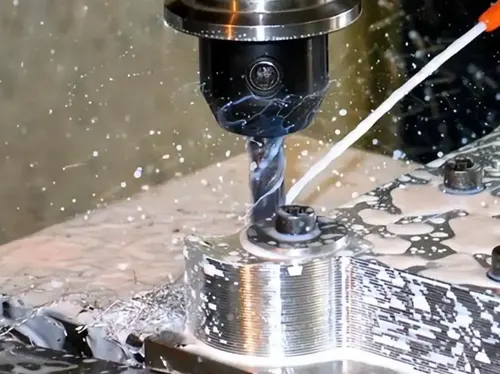
About the CNC Calculator and Why It Matters
A CNC machining cost calculator is a structured framework or a digital tool, that aggregates all the cost variables in a machining project to produce an estimated price per part and total order cost. The output is never a fixed figure. It is always a range, because CNC pricing is inherently probabilistic: two shops looking at the same drawing will price it differently based on their machine pool, overhead structure, and current capacity.
What a calculator actually does is force discipline. It makes you declare your inputs – material, quantity, complexity, finish, lead time, and shows you exactly which variables are driving cost. That clarity is worth more than any number the tool outputs. Once you know a titanium grade change is responsible for 40% of your unit price, you can evaluate whether the application genuinely requires it.
For procurement teams working with overseas manufacturers, particularly in China, this calculation framework also serves as a baseline for quote validation. Quotes from low-cost regions often look attractive in isolation. Benchmarking them against a structured cost model is the only reliable way to distinguish genuine efficiency from corners cut on tolerances, material certification, or inspection.
The Core Formula: How CNC Machining Costs Are Structured
Before getting into individual factors, it helps to see the full architecture of a CNC machining price. Most manufacturers, whether they articulate it this way or not, build quotes using some version of this formula:
Total Part Cost = Material Cost + Setup Cost + (Machining Time × Hourly Rate) + Post-Processing Cost |
Multiply by quantity. Divide total by quantity to get unit cost. Add profit margin (typically 10–20%). |
Each element in that formula is independently variable. You can hold material constant and change quantity. You can simplify geometry to cut machining time. You can choose a slower lead time to avoid the rush premium. The power of a cost calculator is in isolating these levers so you can pull them deliberately.
The sections that follow examine each cost driver in turn, with typical price ranges, comparison data, and worked examples you can apply to your own projects.
8 Major Factors of Cost Fluctuation
Factor 1 : Machine Type and Hourly Rate
The single biggest variable in the machining cost formula is the hourly machine rate. This rate is not arbitrary — it is calculated by dividing the machine’s total annual operating cost (purchase price amortized over its useful life, electricity, maintenance, tooling wear, and operator wages) by its expected annual utilization in spindle hours.
Hourly Rates by Machine Type
The table below represents typical ranges for professional machine shops operating in 2025. Rates in China and Southeast Asia run 30–60% lower than U.S. rates for equivalent equipment.
Machine Type | USA Rate (USD/hr) | China Rate (USD/hr) | Best For |
|---|---|---|---|
3-Axis CNC Milling | $50 – $100 | $10 – $30 | Prismatic parts, simple profiles |
4/5-Axis CNC Milling | $75 – $200 | $20 – $50 | Complex geometry, undercuts, aerospace |
CNC Turning (Lathe) | $40 – $80 | $8 – $20 | Cylindrical parts, shafts, bushings |
Turn-Mill Combined | $80 – $150 | $20 – $45 | Complex turned parts with milled features |
EDM / Wire EDM | $80 – $180 | $15 – $40 | Hard materials, tight tolerances, dies |
Sheet Metal Fab | $30 – $70 | $8 – $20 | Enclosures, brackets, flat patterns |
Source: Industry pricing data aggregated from CNCMachines.com, Hotean (2025), and Elimold (2026).
The average CNC machine utilization rate is only 23.9% during off-peak periods, meaning machines sit idle most of the time. Shops that achieve 60%+ utilization spread their fixed costs across more parts, which is one reason high-volume orders receive better pricing.
Factor 2 : Material Selection and Its True Cost Impact
Material cost has two independent effects on your total price: the direct cost of the raw stock, and the indirect machining cost it produces through machinability, the ease with which the material can be cut.
Raw Material Stock Prices (Reference Ranges, 2025)
Material | Raw Material Cost (USD/kg) | Relative Machinability | Typical Machining Multiplier vs. Al 6061 |
|---|---|---|---|
Aluminum 6061 | $3 – $5 | Excellent (reference) | 1.0× |
Aluminum 7075 | $5 – $8 | Very Good | 1.15–1.25× |
Mild / Carbon Steel | $1 – $3 | Good | 1.3–1.5× |
Stainless Steel 304 | $5 – $8 | Moderate (work-hardens) | 1.5–2.0× |
Stainless Steel 316 | $6 – $10 | Moderate (gummy) | 1.6–2.2× |
Brass / Copper | $6 – $12 | Excellent | 1.2–1.4× |
PEEK / Engineering Plastic | $80 – $200 | Good | 1.8–2.2× |
Titanium (Grade 5, Ti-6Al-4V) | $30 – $50 | Difficult | 3.0–5.0× |
Material pricing data: LS Manufacturing market survey (2025); titanium cost data from Eadetech Factory Insight.
Why machinability matters so much: Stainless steel machining can be two to three times more expensive than machining aluminum with comparable geometry, because slower cutting speeds, more frequent tool changes, and higher scrap risk all add up. Titanium goes further, cutting speeds must be reduced by as much as 70% compared to aluminum, and cycle times run three to four times longer. Tool wear is 3–5× faster than steel, meaning more frequent tool changes that directly add to cost.
Design Insight |
If your part operates below 150°C and does not require extreme corrosion resistance, switching from 304 stainless to aluminum 6061 is a proven cost-reduction strategy that can cut total part cost by 40–60%. The substitution has been validated in aerospace brackets, electronic enclosures, and automotive housings. |
Factor 3 : Part Complexity and Tolerance Requirements
Part complexity is the variable most buyers underestimate. A part that requires 30 minutes of programming and a single vise setup is fundamentally different from one requiring a custom fixture, three setups, and 4 hours of CAM work, even if both fit in the same envelope.
Complexity Tiers and Their Cost Implications
Complexity Level | Tolerance Range | Typical Machining Time (per part) | Estimated Hourly Multiplier |
|---|---|---|---|
Simple | ±0.1 mm or looser | 0.5 – 2 hours | 1.0× |
Moderate | ±0.05 – ±0.1 mm | 2 – 5 hours | 1.3 – 1.5× |
Complex | ±0.02 – ±0.05 mm | 5 – 12 hours | 1.7 – 2.0× |
High Precision | ±0.01 mm or tighter | 12 – 30+ hours | 2.5 – 3.5× |
To process a simple shaft part, it may take 1 hour. A complex turbine blade with the same billet size can take up to 10 hours. That 10× difference is entirely driven by geometry, not material.
Tight tolerances compound every other cost. When you specify ±0.01 mm, the machine must run slower, more in-process checks are required, inspection time increases, and the scrap rate rises. Each of these adds cost. Apply tight tolerances only to the functional surfaces that genuinely require them, not across the entire drawing.
Design for Manufacturability (DFM) Rules That Reduce Complexity Cost
- Keep internal corner radii as large as the application permits, they reduce tool change frequency and shorten cycle time
- Avoid deep, narrow pockets where the depth-to-width ratio exceeds 4:1, these require specialized tooling and multiple passes
- Standardize hole sizes to common drill diameters, custom bore sizes require interpolation, adding time
- Limit the number of unique setups, each flip or re-fixture adds setup time and re-qualification risk
- Put tight tolerances only on mating surfaces, not reference geometry
Factor 4 : Quantity Breaks and Volume Discounts
Quantity is the most powerful cost lever available to buyers. The reason is simple: setup cost and programming cost are fixed regardless of how many parts are produced. A $200 setup amortized over 5 parts adds $40 per part. Amortized over 500 parts, it adds $0.40 per part.
Typical Volume Discount Structure
Order Quantity | Typical Per-Unit Price vs. Prototype (1–5 pcs) | Notes |
|---|---|---|
1 – 5 pcs (prototype) | Baseline (100%) | Setup + programming cost undiluted |
6 – 19 pcs | ~90 – 95% | Minor setup amortization benefit |
20 – 49 pcs | ~80 – 90% | Toolpath optimization starts paying off |
50 – 99 pcs | ~70 – 82% | Fixture reuse, batch scheduling |
100 – 499 pcs | ~55 – 72% | Setup fully amortized, dedicated runs |
500 – 999 pcs | ~45 – 60% | Material purchasing efficiency |
1,000 – 4,999 pcs | ~35 – 52% | Dedicated tooling, lights-out machining viable |
5,000+ pcs | ~25 – 42% | Near mass-production pricing, CNC or hybrid |
These percentages are industry approximations. Actual discount curves vary significantly by shop and part type. The crossover point where injection molding or stamping becomes more economical than CNC typically occurs between 500 and 5,000 units, depending on tooling investment and part complexity.
One frequently missed strategy: consolidating multiple part numbers into a single purchase order. Most shops apply a minimum order charge per job. Ordering 10 different parts in one PO is almost always cheaper than placing 10 separate orders.
Factor 5 : Surface Finishing and Post-Processing Costs
An as-machined surface finish (Ra 3.2 µm) is the cheapest state a part can leave the shop in. Every step beyond that costs time, labor, consumables, or outsourced processing, and some finishing processes add lead time that is entirely outside the machine shop’s control.
Finish Process | Typical Add-On Cost (vs. As-Machined) | Lead Time Impact | Primary Purpose |
|---|---|---|---|
As Machined (Ra 3.2) | Baseline | None | Functional, structural parts |
Smooth / Fine (Ra 1.6) | +8 – 12% | Minimal | Sealing surfaces, sliding fits |
Mirror Polish (Ra <0.8) | +30 – 45% | +1 – 2 days | Optical, cosmetic, mold surfaces |
Type II Anodizing (Al only) | +20 – 30% | +3 – 5 days | Corrosion resistance, colour |
Type III Hard Anodizing | +35 – 50% | +3 – 5 days | Wear resistance, aerospace |
Powder Coating | +18 – 28% | +2 – 4 days | Cosmetic, outdoor corrosion |
Electroplating (Ni/Cr/Zn) | +25 – 40% | +3 – 7 days | Corrosion, conductivity |
Black Oxide | +8 – 15% | +1 – 2 days | Mild corrosion, reduced glare |
Passivation (SS only) | +10 – 20% | +1 – 2 days | Restore corrosion resistance after machining |
Finishing costs are additive. A part that requires hard anodizing and a precise Ra 0.8 mirror surface in a bore requires both the polishing cycle and the anodizing and the polishing must happen before anodizing, adding handling and masking steps. Map your finishing sequence before quoting to avoid surprises.
Did You Know? |
Anodizing changes part dimensions. Type II anodizing adds approximately 0.005–0.008 mm per surface, while Type III hard anodize can add 0.010–0.025 mm. On tight-tolerance bores or mating surfaces, this must be accounted for in the pre-anodize machining dimensions. Failing to do so is one of the most common first-article failure modes on aluminium parts. |
Factor 6 : Setup Fees, Programming, and One-Time Charges
Setup cost covers everything required before the first chip is cut: CAM programming, toolpath verification, fixture fabrication, first-article inspection, and G-code prove-out. These costs are largely independent of quantity. On a prototype order of 1–5 parts, they can represent 50–70% of the total cost.
Typical Setup and Programming Costs
- CAM programmer rate: Approximately $30–$50/hour (varies by region and complexity)
- Setup time per job: 1–4 hours for simple parts, 4–16 hours for complex 5-axis work
- Fixture fabrication: $50–$500+ for one-off fixtures; amortized if fixture is reused
- First-article inspection: $50–$200 for standard parts; $300–$1,500+ for CMM with full report
- Material certification: Mill test reports (MTRs) cost $25–$150 per heat lot
On orders over 100 pieces, many shops absorb or partially waive setup fees as a competitive gesture. On prototype or low-volume orders, always ask what the setup charge covers, some shops bundle it into the per-part price (making the per-part rate look high) while others list it separately (making per-part look low until you add the setup line).
Factor 7 : Lead Time and Rush Premiums
Lead time is a pricing variable that most buyers treat as a logistics constraint. It is actually a cost multiplier. When you request expedited production, you are asking the shop to: reschedule other jobs, pay overtime labor, potentially air-freight materials rather than use sea-or-ground shipping, and dedicate a machine to your work that would otherwise run a different job.
Lead Time Tier | Typical Premium Over Standard | When It Applies |
|---|---|---|
Standard (10–15 business days) | Baseline (1.0×) | Normal production scheduling |
Expedited (5–9 business days) | +20 – 35% | Priority scheduling, some overtime |
Rush (1–4 business days) | +40 – 70% | Dedicated machine, overtime, air freight risk |
A part that costs $80/unit at standard lead time may cost $112–$136/unit on a 3-day rush. Over a 200-unit order, that premium adds $6,400–$11,200 to the total cost. Planning 2–3 weeks of buffer into your project timeline is one of the highest-return cost reduction strategies available.
Factor 8 : Geographic Sourcing: USA vs. China vs. Europe
Geographic sourcing is not just a cost decision — it is a risk, quality, logistics, and IP decision. That said, the cost differences are real and significant. Chinese machine shops charging $10–$30/hour for 3-axis CNC machining represent genuine price arbitrage for the right project types.
Region | 3-Axis CNC Rate (USD/hr) | 5-Axis CNC Rate (USD/hr) | Typical Lead Time (air freight excluded) |
|---|---|---|---|
USA (domestic shop) | $50 – $100 | $100 – $200 | 5 – 15 business days |
Europe (Germany / Czech) | $35 – $80 | $75 – $150 | 5 – 20 business days |
China (Tier 1 shops) | $10 – $30 | $20 – $50 | 7 – 25 business days |
Southeast Asia (Vietnam / Thailand) | $8 – $20 | $15 – $40 | 10 – 30 business days |
When calculating the true landed cost from a Chinese supplier, add international shipping (typically $0.50–$3.00/kg by sea, $3–$12/kg by air), import duties (typically 0–6.5% for machined parts entering the USA, though tariff rates are subject to policy change), and an estimated 5–10% buffer for communication overhead and quality review time.
For custom CNC parts that require tight tolerances (±0.02 mm or better), complex multi-axis geometry, or aerospace/medical certification, the total cost difference between a domestic and overseas supplier narrows considerably once rework risk, inspection time, and logistics are factored in.
Step-by-Step Worked Calculation Example
Scenario: You need 50 units of an aluminum 6061 enclosure bracket, 3-axis milled, with a standard anodized finish, moderate complexity (±0.05 mm tolerance on two mating faces), and a 10-business-day lead time. Sourcing from a Chinese Tier 1 shop.
Step 1: Establish Machining Time
Moderate complexity, medium-sized part: estimate 2.5 hours of actual cutting time per part.
Step 2: Apply Hourly Rate
Chinese Tier 1 shop, 3-axis: $18/hour (mid of $10–$30 range).
Machining cost per part: 2.5 hrs × $18 = $45
Step 3: Add Material Cost
Aluminum 6061 billet (estimated 0.8 kg per part at $4/kg = $3.20 material cost). Add 20% wastage: ~$3.84 material per part.
Step 4: Add Setup / Programming (amortized over 50 parts)
Total setup + programming estimate: $300 for this part type. Amortized: $300 ÷ 50 = $6.00 per part.
Step 5: Add Finishing
Type II anodizing: +25% on machining cost = $45 × 0.25 = $11.25 per part.
Step 6: Add Supplier Margin
Typical Chinese shop margin: 15%. Cost so far: $45 + $3.84 + $6 + $11.25 = $66.09. × 1.15 = $76.00 per part.
Step 7: Add Landed Cost Elements
Shipping (estimated $1.20/kg, 0.8 kg per part, 50 parts = 40 kg): $48 total ÷ 50 = $0.96/part. Import duty (3%): $76 × 0.03 = $2.28/part.
Final Estimate Summary |
Unit cost (ex-works): ~$76.00 | Landed unit cost: ~$79.24 |
Total order (50 pcs, landed): ~$3,962 |
This is a directional estimate for budgeting. Actual supplier quotes will vary by 15–30% in either direction. The value of this exercise is not the number, it is knowing which inputs to question when a quote lands significantly outside this range.
Frequently Asked Questions
How accurate is a CNC machining cost calculator?
A well-constructed calculator using realistic inputs is typically accurate within ±20–30% of an actual shop quote. That margin of error is useful for budgeting and supplier screening, but not for final purchase orders. Always get a formal quote from your supplier before committing to a project cost.
What is the cheapest material to CNC machine?
Aluminum 6061 is widely regarded as the most cost-effective structural metal for CNC machining. It has high machinability, low raw material cost ($3–5/kg), and is available in standard stock sizes worldwide. For non-structural applications, ABS and Delrin (Acetal) plastics are even cheaper to machine.
At what quantity does CNC machining stop being cost-effective?
CNC machining remains competitive for most part geometries up to approximately 500–2,000 units, beyond which injection molding (for plastics), die casting (for metals), or sheet metal stamping typically offer better economics. The exact crossover depends heavily on tooling investment and part complexity.
Why do 5-axis parts cost so much more than 3-axis parts?
5-axis machines have higher capital cost, require more skilled operators, and often need custom workholding solutions. The machine hourly rate alone is 1.5–2× higher than 3-axis. Beyond the rate, complex multi-axis programs require longer CAM programming time and more extensive first-article verification. However, 5-axis often eliminates multiple 3-axis setups, so the net cost difference may be smaller than the hourly rate difference suggests.
Do Chinese CNC shops produce the same quality as domestic suppliers?
Quality depends on the specific shop, not the geography. Tier 1 Chinese machine shops serving export markets work to ISO 9001, IATF 16949, or AS9100 standards and produce parts to ±0.01 mm tolerances with full CMM documentation. Verification through factory audit, sample orders, and reference checks is the appropriate qualification process regardless of location.
How do I reduce CNC machining costs without changing material?
The most effective material-constant cost levers are: simplify geometry to reduce machining time, increase quantity to dilute setup cost, relax tolerances on non-critical surfaces, remove unnecessary surface finishing, and provide complete drawings to eliminate quote contingency margins.
What is a setup fee and can it be negotiated?
A setup fee covers the one-time cost of programming, fixture preparation, and first-article verification for a part. On reorders, the program and fixtures already exist, setup fees are legitimately negotiable downward by 50–75% for repeat orders at the same or higher quantity.