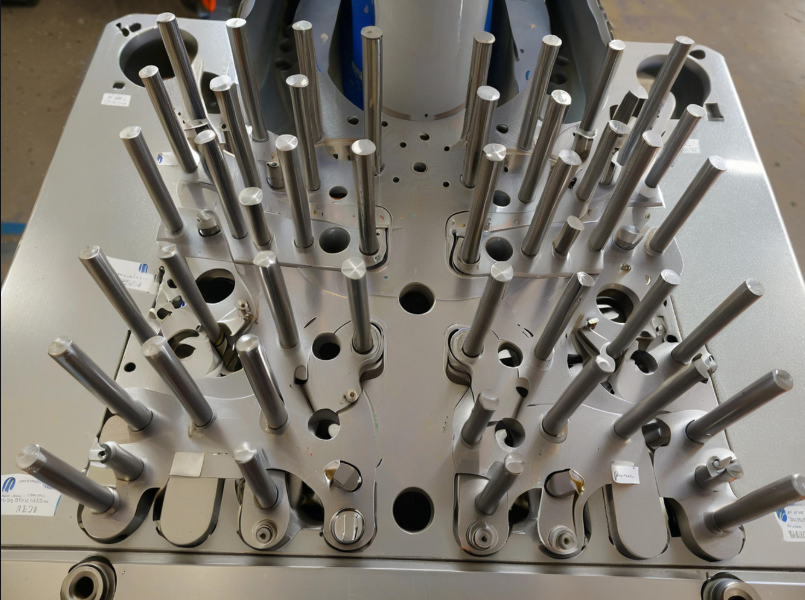
The growing auto industry demands higher precision and efficiency in cylinder head manufacturing.
Engineers widely use aluminum cylinder heads for their light weight, heat dissipation, and corrosion resistance.
However, aluminum’s low hardness and toughness challenge CNC milling.
Manufacturers widely use CNC milling in engine cylinder head production.
CNC milling enables machining of complex surfaces and precision holes to meet engine requirements for high precision and low roughness.
CNC milling parameter selection directly affects efficiency, quality, and tool life.
Optimizing CNC milling parameters for engine aluminum cylinder heads greatly improves manufacturing quality and efficiency.
Aluminum cylinder head CNC milling objective function construction
Engine cylinder head CNC milling aims to minimize roughness, maximize removal rate, and cut costs.
Optimizing CNC milling parameters for engine aluminum heads aims to minimize roughness and maximize removal rate.
Optimize milling parameters to reduce CNC aluminum cylinder head surface roughness and improve quality; the minimum roughness objective function is:
f1( x)=min R=min(ημesκ).
Where: f1(x) is the minimum surface roughness objective function; x represents CNC milling parameters.
x denotes CNC milling parameters; R, surface roughness; η, correction coefficient.
μ: fitting coefficient; e: feed per revolution; s: average roughness; κ: camber angle.
We build the maximum material removal rate objective function using feed rate, spindle speed, and tool teeth number.
Specifically, this objective function can be expressed as:
f2(x) = max E = max (vab).
Where: f2(x) represents the objective function of maximum material removal rate for CNC milling of engine aluminum cylinder head;
E: material removal rate; v: milling width; a: milling depth; b: feed speed.
Combine the two functions to form the multi-objective CNC milling function for aluminum cylinder heads:
(fx) = ϖ1f1(x) + ϖ2f2 (x).
Where: (fx) is the CNC milling multi-objective function; ϖ1and ϖ2 are the weight coefficients.
Setting constraints for CNC milling
Constraints within the objective function ensure accurate optimal milling parameter selection and application.
First, introduce constraints on milling power, expressed as:
δ=rvmax- kP≤0.
Where: δ is average CNC milling power; r, tool arc radius; vmax, maximum milling speed.
vmax: max milling speed; k: milling efficiency; P: tool wear capacity.
Secondly, set the constraints of milling depth a, which is expressed by the formula:
amin≤a≤amax.
Where: amin and amax are the minimum and maximum CNC milling depths for engine aluminum cylinder heads.
Through the above constraints to limit the milling depth within a reasonable range of change.
We construct the aluminum cylinder head CNC milling optimization model by optimizing milling parameters and constraints as:

Where: k is the CNC milling optimization model; s.t. denotes constraints.
Next, mathematical optimization solves the model to find the best milling parameters that meet constraints and minimize the objective function.
This process involves complex math and algorithms but yields desired optimization results through a sound strategy.
Optimal parameter combination solving
The ant colony algorithm finds optimal milling parameters meeting constraints and minimizing the objective function.
The ant colony algorithm mimics ants searching for food and iteratively solves the model; the process is:
Step 1: Initialization of the algorithm.
Assume each solution forms an initial ant colony; set algorithm parameters accordingly.
Step 2: Place all ants at a starting node (randomly selected) in the solution space.
Each ant selects the next node to be visited in order.
The selection rule combines pheromone concentration and heuristic info (e.g., inverse distance) between current and unvisited nodes.
The formula can calculate the specific selection probability:

Where: p denotes the probability that the ant chooses the next visited node i; W denotes the set of possible solutions of the optimization model;
n denotes the number of nodes; ξ(K) denotes the set of neighboring nodes of node i; Lij denotes the distance from node i to node j. υ denotes the distance from node i to node j;
υ denotes the pheromone concentration of the path between node i and node j; λ denotes the heuristic information influence coefficient.
Using the above formula, the ant selects the node with the highest probability as the next node to visit.
The construction process ends when the ant has constructed the complete path (back to the starting point or satisfies specific conditions).
Step 3: Repeat iterations where all ants re-explore and update pheromones until reaching the iteration limit or stopping criteria.
All ants record and track the optimal paths throughout the process, forming the global optimal solution.
Fitness value determines the optimal path; higher fitness means the ant path is closer to the goal.
Step 4: Upon convergence, output the path with the highest fitness; its solution optimizes CNC milling parameters for the engine aluminum cylinder head.
Experimental demonstration
Experimental equipment
We conduct a comparative experiment using the GROB G320 machining center to verify the proposed CNC milling parameter optimization method.
The machining center uses a 20 mm carbide tool with 35 mm flute length and four teeth for smooth milling.
The tool type is a cylindrical helical end mill for GROB G320 series machining center.
The machined part is an aluminum cylinder head from an engine, with dimensions of 454.55 mm × 255.75 mm × 140.5 mm.
Using the method designed in this paper to optimize the milling parameters of the engine aluminum cylinder head.
Experimental parameters and indicators
We set CNC milling parameters based on the GROB G320 features and actual conditions in the experiment with 200 engine aluminum cylinder heads.
Set the maximum milling cutter travels: 60 mm horizontal, 30 mm vertical, 36.42 mm third axis; tool helix angle 30°, helix length 90 mm.
The horizontal and vertical rotation angles are set to – 20° and 120° respectively according to the machining requirements.
Set spindle DC motor rated current to 18 A, stages to 4, minimum feed rate to 25%, and rated power to 110 kW.
The specific processing is shown in Figure 1.

We set the CNC milling optimization algorithm parameters as follows:
Set max iterations to 500, initial population to 50, pheromone concentration to 0.5, and volatility coefficient to 0.02.
The optimization model was solved by the algorithm to optimize the CNC milling machining parameters iteratively.
Two control groups use optimization methods from [1] (genetic algorithm) and [2] (response surface).
Acceptance rate of machined parts serves as the index—higher rates indicate better milling precision and optimization.
Experimental results and discussion
Figure 2 shows the acceptance rate of CNC milling machined parts of engine aluminum cylinder head under the application of three methods.
From Fig. 2, the method in [2] yields the lowest acceptance rate—below 60%—for optimized CNC milling of aluminum cylinder heads.
The acceptance rate of this method is the highest, more than 85%.
Therefore, the experiment proves that this method accurately optimizes CNC milling parameters to ensure machining quality.

Conclusion
Engineers optimize CNC milling parameters to improve engine performance, reliability, and reduce cost.
In-depth exploration and practice led to effective methods optimizing machining efficiency, quality, and energy use.
This study provides guidance for CNC milling engine aluminum heads and optimizing parameters for similar parts.
With industry and technology advancing, engine cylinder head machining demands are rising.
Continuous research and exploration of efficient, precise, and eco-friendly CNC milling methods are necessary.