Steel is a vital material for industrial development. Continuous advancements in cutting and processing technologies enable manufacturers to produce more precise and complex components.
These improvements meet the practical demands of modern manufacturing and related industries. Compared to traditional processing methods, laser technology primarily utilizes high-energy-density lasers.
It offers significant advantages, including high energy density, excellent directionality, and minimal impact on workpieces.
These features effectively address the limitations of conventional techniques, resulting in widespread attention and increased applications.
This article introduces the application principles, characteristics, and advantages of laser cutting, laser welding, and laser additive manufacturing technologies.
It also outlines the prospects of laser technology for reference.
Application of Laser Technology
Laser technology (Light Amplification by Stimulated Emission of Radiation) has become an essential tool in modern manufacturing. Its concentrated, high-energy beam allows precise, non-contact processing of various materials with minimal distortion and excellent surface quality.
Today, lasers are widely used in industries such as automotive, aerospace, and electronics for cutting, welding, marking, and surface modification.
Their high precision, flexibility, and compatibility with automation make them ideal for processing complex parts and hard-to-machine materials.
The following sections outline the main industrial applications of laser technology—cutting, welding, and surface modification—and their key technical characteristics.
Laser Cutting Technology
Laser cutting refers to the process where a laser beam moves along a cutting path, utilizing its energy to generate high temperatures that melt the material, thereby cutting it into specific shapes.
Compared to other cutting techniques, laser cutting offers exceptional precision, achieving positioning accuracy as high as 0.05mm, and high efficiency, with cutting speeds exceeding 20 mm/min.
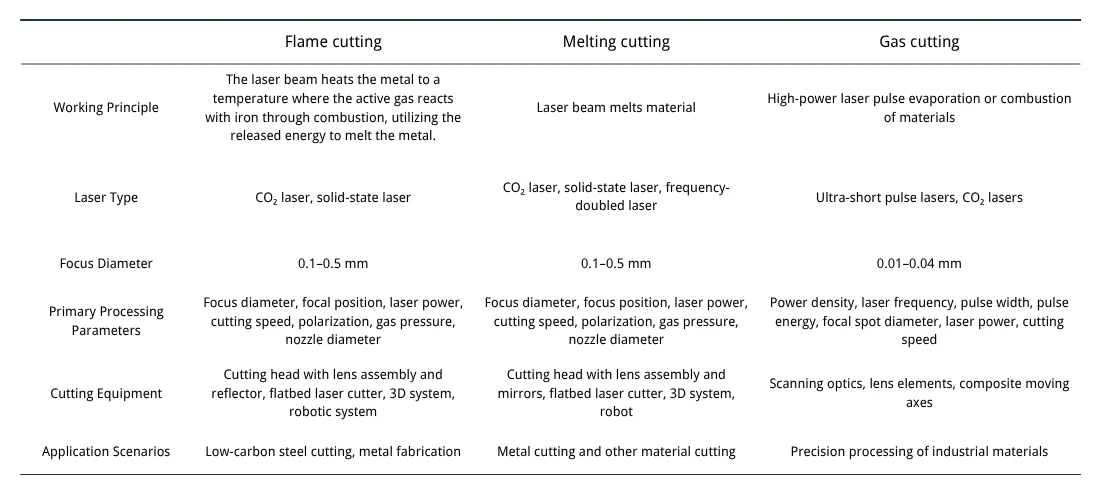
For steel material cutting, laser cutting technology can be categorized into flame cutting, fusion cutting, and vaporization cutting.
Flame cutting is commonly used for materials like low-carbon steel.
Typically employing oxygen as the cutting gas, it utilizes the substantial heat released by chemical reactions to assist the laser beam in rapidly completing the cutting operation.
Melting cutting employs cutting gases like ammonia or argon. As inert gases, nitrogen and argon do not react chemically with the material.
Their primary function is to blow away molten slag generated during laser cutting and protect the material edges from rapid oxidation.
Vaporization cutting typically employs ultra-short pulse lasers for metal cutting.
The advantage of this laser lies in its high energy, causing the material to rapidly sublimate during cutting with minimal thermal effects and no burr formation.
The technical characteristics of these three laser cutting processes are summarized in Table 1.
Laser Welding Technology
Laser welding utilizes a laser beam as the heat source to rapidly melt the material surface, forming a molten pool that solidifies upon cooling to achieve precision welding.
Compared to traditional welding techniques, laser welding offers three primary advantages:
First, the laser beam’s high energy density enables rapid heating and high welding efficiency.
Second, the laser beam’s fine spot size and precise positioning facilitate automated welding while meeting complex component welding requirements.
Third, it produces a minimal heat-affected zone, minimizing workpiece distortion and eliminating weld contamination.
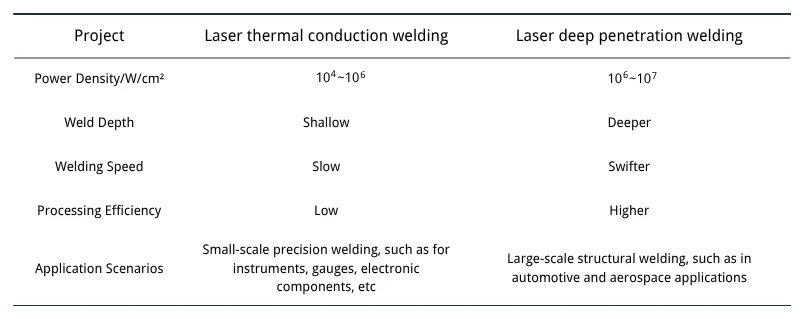
Based on welding principles, laser welding is categorized into laser conduction welding and laser deep penetration welding.
Laser conduction welding primarily affects the workpiece surface, with underlying material melting via heat conduction.
Its shallow penetration depth makes it suitable for small, thin components.
Laser deep penetration welding employs a laser beam with higher power density.
The workpiece surface rapidly vaporizes to form a keyhole, melting the metal around the entire cavity. This molten metal then solidifies to form the weld.
Due to its high welding efficiency, laser deep penetration welding is commonly used for processing large-sized materials. T
he technical characteristics of both methods are summarized in Table 2.
Laser Surface Modification Technology
Laser surface modification technology involves directing a laser beam onto a workpiece’s surface to rapidly heat and transfer heat, thereby altering the surface layer’s structure and physical-chemical properties.
Utilizing laser technology for surface modification enhances the hardness, strength, wear resistance, and other properties of steel materials and workpieces, extending the service life of components.
Currently, three primary laser surface modification techniques are commonly employed: laser surface hardening, laser surface cladding, and laser surface alloying.
(1)Laser Surface Hardening
Laser surface hardening operates on the principle of utilizing the material’s inherent physical and chemical properties.
By rapidly heating and cooling the surface, it induces a martensitic phase transformation to achieve hardening and strengthening.
Specifically, the laser beam rapidly heats the surface of steel materials to temperatures exceeding the phase transformation point.
Upon removal of the laser, the material’s excellent thermal conductivity transfers heat inward.
This process causes the surface temperature to drop below the transformation point and forms a strengthened zone.
Compared to other quenching techniques, laser hardening offers distinct advantages: its high-energy beam achieves rapid heating without requiring quenching media.
This results in minimal workpiece deformation and surface roughness changes.
Furthermore, automated control systems enable precise power regulation for fully automated quenching, delivering exceptionally high processing efficiency.
(2)Laser Surface Cladding
Laser surface cladding technology involves heating and depositing a specialized coating onto the surface of steel components based on processing requirements.
This process enhances or modifies the surface properties of the components.
Compared to traditional techniques like hardfacing and electroplating, laser cladding offers distinct advantages.
Its high energy density and rapid heating rate minimize the impact on the substrate while enabling rapid cooling.
This results in superior coating deposition and bonding.
Based on filler material delivery methods, laser surface cladding can be categorized into two types: pre-deposited powder method and synchronous powder feeding method.
The pre-deposited powder method, as the name suggests, involves adhering or spraying a layer of powder onto the workpiece surface beforehand, which is then melted by the laser beam to cover the surface.
This method is operationally convenient but often suffers from severe powder burn-off, resulting in generally mediocre cladding effects.
The synchronous powder feeding method employs a powder feeder to deliver powder to the laser beam’s position, processing while feeding.
It offers high efficiency and good formability but requires powder properties that meet the demands of powder feeding cladding.
(3)Laser Surface Alloying
Laser surface alloying shares certain similarities in principle with laser surface cladding.
However, alloying primarily utilizes alloying elements as materials, whereas cladding employs a wide variety of coating materials—including metallic, ceramic, and composite materials.
Furthermore, the alloying elements added interact with the steel workpiece itself, while laser cladding primarily leverages the performance advantages of the applied coating.
Laser Additive Manufacturing Technology
Traditional manufacturing techniques typically employ a subtractive approach, using methods such as cutting and grinding to transform large, solid materials into smaller components.
Additive Manufacturing (AM), however, operates on the opposite principle—an additive process that builds objects layer by layer, directly translating design blueprints into physical reality.
Additive manufacturing technology, also known as 3D printing, encompasses multiple techniques including CAD technology, layered manufacturing, CNC technology, laser technology, and others.
Laser additive manufacturing (LAM) is an additive manufacturing technique primarily utilizing lasers as the processing tool.
Based on its forming principles, it can be categorized into two main types: laser cladding deposition (LCD) with simultaneous powder feeding, and selective laser melting (SLM) with powder bed spreading.
(1)LCD Technology
When applying LCD technology, the CAD model must first undergo layered slicing processing.
This breaks down the contour data of each layer’s part model, which then serves as the machining path.
Using a laser beam as the heat source, powder fed synchronously is melted, deposited, and manufactured layer by layer, ultimately solidifying into a complete, single part.
The advantage of LCD technology lies in its ability to efficiently produce large, complex-shaped parts in a single process.
This eliminates the need for further forging while meeting the mechanical performance requirements of the part.
(2)SLM Technology
SLM technology also requires slicing CAD models into layers and acquiring manufacturing data.
A powder spreading system then deposits powder layer by layer, while a laser beam selectively melts and solidifies the metal powder according to each layer’s manufacturing data.
This process ultimately builds up the desired metal part. The advantages of SLM technology lie in its high part manufacturing precision and superior mechanical properties.
However, due to limitations in the powder spreading system’s size, it is primarily suited for producing small parts.
Laser Remanufacturing Technology
The steel industry serves as a major pillar within the industrial system, requiring substantial equipment and consumables for its operations.
Applying remanufacturing technology to reduce the consumption of equipment and consumables plays a crucial role in lowering production costs and enhancing resource utilization efficiency.
Remanufacturing engineering effectively enhances the utilization efficiency of components and equipment.
It enables true full-lifecycle product management that meets the demands for resource conservation, environmental protection, and sustainable development.
To produce high-quality, high-value-added equipment through remanufacturing, continuous integration of advanced techniques—such as laser remanufacturing technology—is essential.
Compared to traditional repair techniques, laser remanufacturing technology integrates multiple approaches including laser technology, CNC technology, and materials technology.
It offers distinct advantages such as advanced technology, high application efficiency, and energy-saving environmental benefits.
This technology not only repairs worn or damaged components but also enhances their performance to meet subsequent usage requirements.
Beyond the previously mentioned laser surface modification techniques, laser remanufacturing also encompasses technologies like laser texturing.
Laser texturing refers to the technique of preheating and strengthening the workpiece surface with a laser beam to form a micro-melting pool.
A side-blowing device then accumulates molten material at the edge of the pool.
Laser remanufacturing technology finds diverse applications in steel processing.
It is used for repairing and strengthening rollers, restoring shaft components, and repairing or enhancing high-value-added parts.
Prospects for Laser Technology Applications
Given its diverse application scenarios and unique advantages, laser technology has achieved widespread adoption.
Aligning with market demands and the processing manufacturing industry’s requirements, more advanced technical approaches are integrating with laser technology.
This convergence is driving new developmental characteristics in the field.
Digitalization and High Precision
The primary advantage of laser technology lies in its high processing accuracy.
This precision stems partly from the unique optical properties of lasers and partly from the unmanned control enabled by CNC systems.
As the market evolves, an increasing number of high-precision components demand even greater control and processing accuracy from laser technology.
Leveraging digital technology to enhance laser precision offers two key benefits:
First, the refinement of CNC systems. CNC systems utilize a master control unit to receive and process data transmitted by sensor systems.
They control the movement trajectory of the laser head via motion control cards while continuously monitoring real-time equipment parameters to ensure consistent operational stability.
Digital technology continuously enhances the response and processing capabilities of CNC systems, guaranteeing optimal equipment performance.
Second, establishing a parameter database. Laser technology requires controlling multiple parameters in practical applications.
Technical parameters must adjust based on variations in workpiece materials, thickness, and other factors.
As parameters change, the application efficiency of the laser beam also undergoes significant alterations.
To ensure laser technology performs effectively, a scientific and comprehensive working parameter database must be constructed.
Big data technology can assist in building and refining this database, providing essential references for laser technology applications.
Multi-Station Integrated Processing
Integrating multi-station time-sharing or parallel integrated processing into laser technology significantly enhances processing efficiency, meeting the practical manufacturing demands of enterprises.
Multi-station integrated processing refers to the technology of utilizing a single machine or laser source to perform simultaneous or time-shared processing across multiple stations.
As the steel industry continues to expand its production scale and output, demands for cutting and processing efficiency are constantly increasing.
Leveraging multi-station laser integrated processing technology enables the efficient and comprehensive completion of multiple processes such as cutting, welding, and marking.
Advanced equipment like dual-station laser cutting machines and 3D multi-station robotic laser welding machines has now emerged, fully meeting enterprises’ processing requirements.
Automation and Intelligence
Automation represents a significant current trend in laser technology development.
Many laser technologies have achieved deep integration with automated control systems, leveraging CNC systems to control equipment such as laser cutting machines.
This enables precise regulation and automatic adjustment of parameters including output power, focal spot diameter, polarization degree, focal spot positioning, and operating speed.
With the advancement of intelligent technologies, artificial intelligence (AI) and related techniques are propelling laser applications into a new era.
AI encompasses cutting-edge technologies like machine vision, sensing, and image processing, enabling intelligent control of laser cutting and processing.
In laser welding, for instance, AI can evaluate process quality and preemptively adjust equipment parameters based on processing requirements.
Simultaneously, during the welding process, AI can use sensing and image recognition technologies to monitor weld quality in real time.
It can identify potential issues and mitigate problems through immediate parameter optimization.
To implement AI in laser processing, mathematical relationships between laser parameters and welding performance must be established using techniques like convolutional neural networks and genetic algorithms.
This provides the mathematical models essential for parameter optimization.
Conclusion
Steel materials find extensive applications across numerous sectors such as automotive and aerospace.
To transform steel into diverse components, a series of cutting and processing procedures are required.
Laser technology, encompassing techniques like laser cutting, laser welding, and laser surface modification, can meet the cutting and processing demands of workpieces varying in size, type, and precision.
Consequently, it has gained widespread adoption in manufacturing.
Continuously exploring and researching the application scenarios and methods of laser technology holds significant importance for the long-term development of industry and manufacturing

Solomon Yang is a manufacturing industry professional with extensive experience in electronic, mechanical, and industrial component manufacturing. Having held various positions in American and Taiwanese manufacturing companies, he has developed a comprehensive understanding of manufacturing processes, production management, quality control, and global supply chain operations.
With expertise in business development, sales operations, international trade, customer relationship management, and engineering project support, Solomon bridges technical knowledge with commercial strategy to deliver innovative and cost-effective manufacturing solutions. He is passionate about advanced manufacturing technologies, process improvement, and continuous professional growth, with a strong commitment to creating value for customers and partners worldwide.