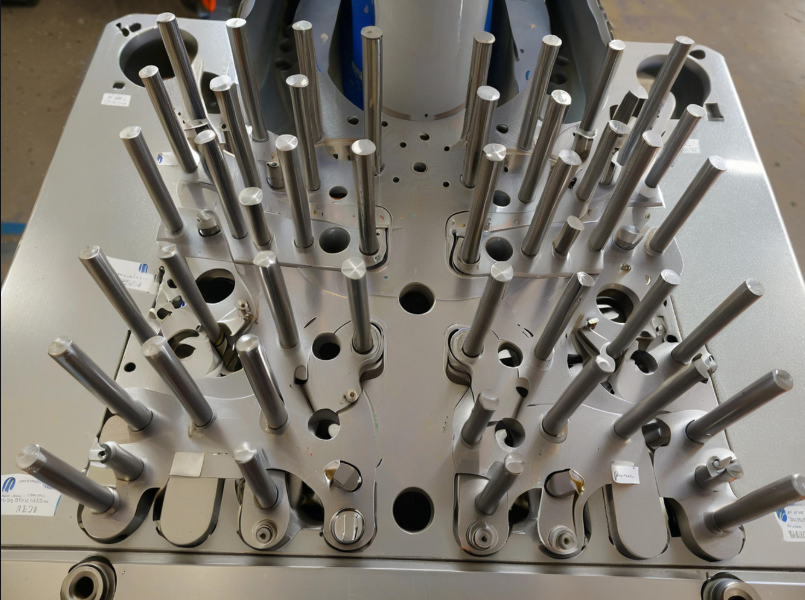
Complex-shaped components serve as core parts with intricate mechanical properties. The integrated forming process of these components directly influences vehicle performance and optimizes material efficiency.
Traditional sequential casting and machining production methods face technical bottlenecks, including limited geometric freedom and low material utilization.
These limitations make it difficult to meet the manufacturing demands for complex topological structures in next-generation electric vehicles.
Against this backdrop, additive manufacturing–CNC hybrid processing technology provides an innovative solution.
It integrates the advantages of layered deposition and precision subtractive machining to overcome the design and manufacturing barriers of complex components.
Existing research shows that the step effect and thermal accumulation deformation from laser cladding processes hinder component surface quality.
These issues also make it difficult for dimensional accuracy to meet automotive assembly standards.
Meanwhile, the limitations of CNC machining in accessing complex curved surfaces constrain the design freedom of traditional manufacturing processes.
By synchronizing the timing and coordinating the spatial arrangement of these two processes, we can retain the flexibility of additive manufacturing in forming irregular structures.
At the same time, we can eliminate surface defects through in-situ finishing.
Principles of Additive Manufacturing-CNC Hybrid Technology
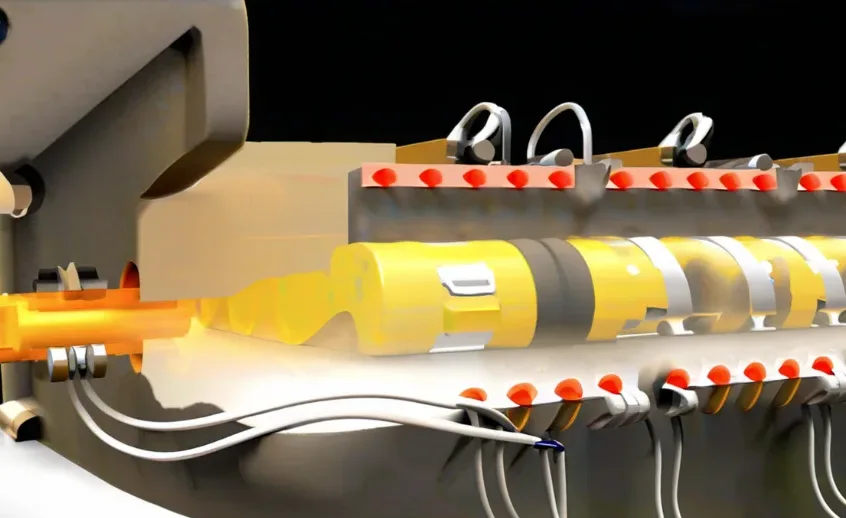
During the layered build process of additive manufacturing, metal powder rapidly melts and solidifies under laser beam irradiation.
This process progressively constructs near-net-shape blanks layer by layer. This process uses slicing software to convert 3D models into 2D layer information.
It then employs path planning algorithms to control cladding trajectories, enabling mold-free fabrication of complex cavities and topologically optimized structures.
However, issues such as anisotropy and residual stress concentration arising from layer-by-layer deposition directly impact component performance.
Introducing synchronized substrate preheating and interlayer cooling control effectively modulates the solidification kinetics of the melt pool, reducing the probability of micro-defect formation.
CNC machining systems perform precision finishing operations like milling and turning on additively manufactured parts through multi-axis interpolation and tool compensation.
The key to this hybrid process lies in establishing a sequential coordination mechanism.
Machinists start finishing operations immediately after completing a specific number of cladding layers.
This allows them to take advantage of the material’s plastic characteristics while it is still warm, thereby improving cutting quality.
Energy field coupling control is the core element ensuring process stability. Thermal accumulation during additive manufacturing changes the local thermodynamic state of materials.
To address this, operators maintain dynamic energy input equilibrium using infrared temperature measurement and adaptive power regulation.
In titanium alloy component manufacturing, combining the energy fields of laser cladding and ultrasonic vibration milling reduces peak cutting forces by 27%. This approach also enhances the interfacial bonding strength between dissimilar materials.
Technical Application Analysis
Advantages of Hybrid Additive-CNC Manufacturing for Lightweight Automotive Components
In the field of lightweight automotive components manufacturing, the synergistic application of additive manufacturing and CNC composite machining demonstrates unique advantages.
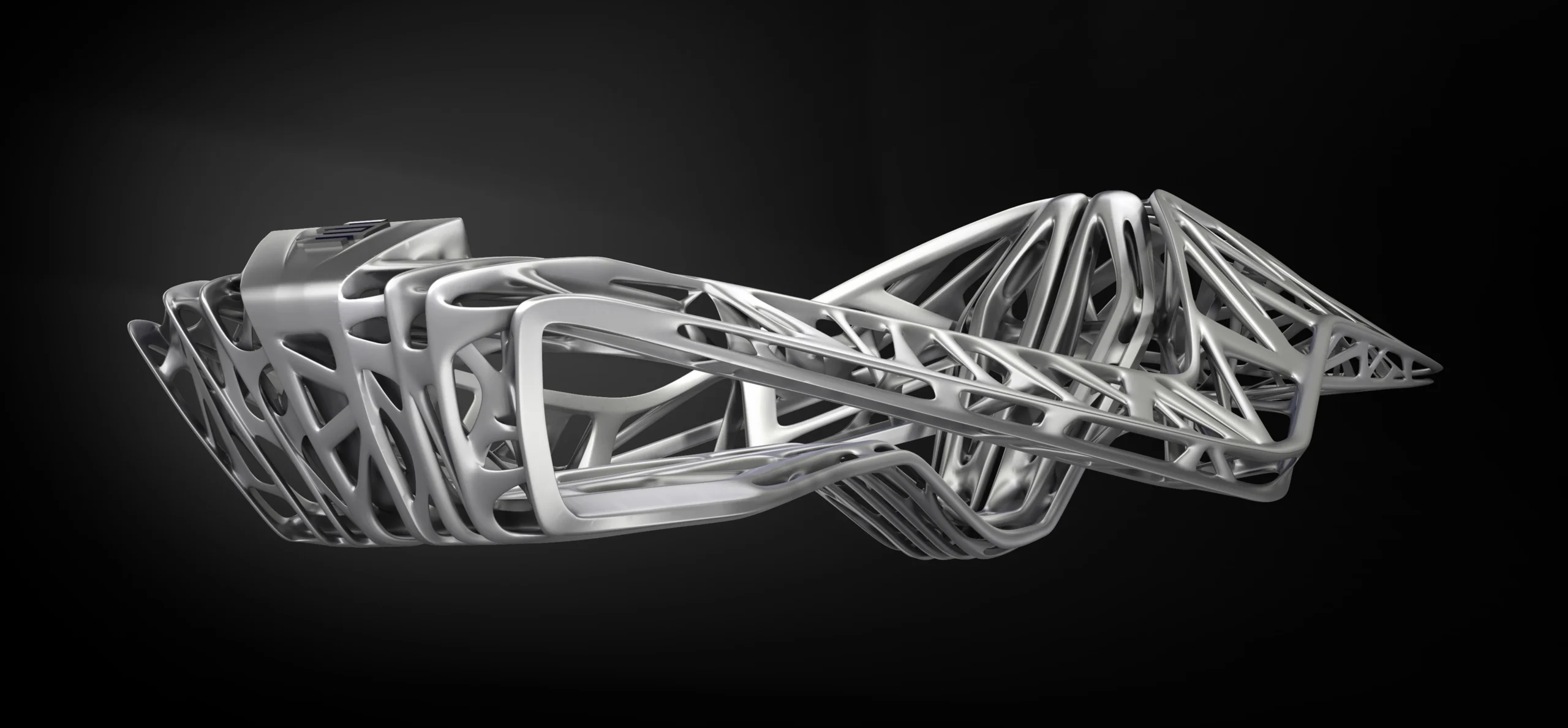
Topology optimization technology, through finite element inverse design, enables the removal of 30% to 50% of redundant material while maintaining mechanical properties.
Topology optimization software like OptiStruct, combined with the Gibson-Ashby porous structure mechanics model, enables the creation of biomimetic lattice structures in load-bearing components such as suspension knuckles.
This non-uniform pore distribution design gives components progressive crushing characteristics during collisions.
As a result, it improves energy absorption efficiency by 17% compared to traditional solid structures.
Gradient Material Deposition and Dynamic Machining for Enhanced Performance
Gradient material deposition path planning is central to enhancing component performance.
Path optimization algorithms based on molten pool dynamics enable gradient metallurgical bonding between aluminum alloy matrix and high-strength steel transition zones.
Research indicates that a helical progressive deposition strategy combined with interlayer cooling control reduces peak residual stresses in the interface region to below 380 MPa.
In electric vehicle battery pack bracket manufacturing, engineers dynamically matched heat source power with powder feed rate.
This approach produced gradient functional components with wear-resistant surfaces and high-toughness cores.
It achieved three-point bending strength 2.3 times higher than that of conventional welded parts. Dynamic machining allowance compensation effectively resolves dimensional deviations in additive-manufactured parts.
CNC systems automatically generate tool path offsets based on actual contour point cloud data acquired via laser scanning.
In titanium alloy exhaust manifold production, adaptive allowance allocation algorithms maintained finishing allowances between 0.2 and 0.8 mm.
This approach reduced cutting time by 43% compared to fixed allowance schemes. This technology breaks traditional machining allowance design norms, achieving a dynamic balance between material removal rate and surface quality.
Thermo-Mechanical Control and Engineering Validation
Thermal stress deformation collaborative control technology is key to ensuring component precision.
By combining online monitoring via infrared thermal imaging with finite element inverse compensation, warping deformation during the additive process can be predicted and compensated.
Experiments demonstrate that inserting localized milling operations after every 5 deposition layers can control flatness errors of thin-walled 6061 aluminum alloy components within 0.15mm/m.
This thermo-mechanical coupled control method has been successfully applied in electric vehicle door hinge manufacturing, elevating assembly clearance precision to IT8 grade.
Typical component cases validate the technology’s engineering value.
An aluminum alloy suspension arm for a new energy vehicle model achieved 42% weight reduction through composite manufacturing while passing 500,000 bench fatigue tests.
Body frame node components, treated with lattice filling and surface finishing, reduced weight by 28% compared to traditional stamped parts while maintaining equivalent strength.
These practical cases demonstrate that this technology system effectively breaks through bottlenecks in automotive component lightweighting.
Key Technological Breakthrough Directions
Multi-axis coordinated machining trajectory optimization is central to enhancing the forming precision of complex surfaces.
Five-axis machining centers can improve the surface roughness of laser cladding formed parts to 0.8μm through dynamic tool posture adjustments.
Trajectory optimization algorithms based on cutting chatter suppression reduce tool wear by 32% when machining topologically optimized components.
Enhancing interfacial bonding strength between dissimilar materials relies on metallurgical mechanism research.
Energy dispersive spectroscopy reveals a brittle TiFe intermetallic compound phase in the transition zone between 316L stainless steel and TC4 titanium alloy.
Gradient composition design combined with interlayer ultrasonic impact welding elevates interfacial shear strength to 420 MPa.
Diffusion kinetics simulations indicate that controlling the transition layer thickness within 80–120 μm effectively suppresses Kirkendall effect void formation.
Residual stress removal processes directly impact component service performance.
High-frequency mechanical vibration aging reduces surface residual stresses in aluminum alloy components by 65% while increasing fatigue life by 15%.
In manufacturing large body frame components, the combined application of stress-relief annealing and laser shock peening successfully controlled welding deformation within 1.2 mm.
The online quality monitoring system establishes a closed-loop control system for the manufacturing process.
Acoustic emission sensors collect stress wave signals during cutting to identify unfused defects within the cladding layer in real time.
Machine vision systems utilize molten pool morphology feature extraction technology to enable online prediction of forming accuracy.
The intelligent matching algorithm for process parameters is central to the system’s automation.
A neural network-based parameter optimization model automatically generates customized solutions for laser power, scanning speed, and cutting parameters based on the component’s geometry.
Engineering Validation and Performance Evaluation
Structural Integrity Testing Methods
Verification of structural integrity for composite manufactured components requires the integrated application of non-destructive testing and destructive testing.
Industrial CT scanning technology allows precise detection of micro-voids and lack-of-fusion defects at gradient material interfaces.
At the same time, digital image correlation measures and quantifies surface strain distribution characteristics. For load-bearing components like suspension arms, three-point bending tests validate yield strength and fracture toughness.
Load-displacement curves reveal multi-stage strengthening effects during plastic deformation in gradient structures.
Microhardness testing indicates hardness fluctuations within ±5 HV in the transition zone between the laser cladding layer and substrate, confirming uniform metallurgical bonding.
Fatigue Life and Dynamic Characteristics
Bench tests based on road load spectra indicate that composite-processed body frame nodes exhibit a crack initiation life 1.8 times longer than castings under one million cyclic loads.
Dynamic analysis reveals that the natural frequency distribution of topologically optimized components avoids common road excitation bands, reducing resonance risk by 60%.
Modal shapes obtained via scanning vibration testing demonstrate that the porous structure effectively suppresses local modal coupling in thin-walled components, increasing amplitude decay rates by 40%.
These characteristics significantly enhance NVH performance during high-speed operation of electric vehicles.
Quantitative Assessment of Lightweighting Efficiency
The lightweighting evaluation system based on equivalent stiffness demonstrates that lattice-filled components achieve 35%–48% mass optimization while maintaining equivalent load-bearing capacity.
Material utilization analysis indicates that composite processes—through near-net-shape forming and dynamic allowance compensation—reduce raw material loss rates for titanium alloy components from 65% in traditional machining to 18%.
In vehicle integration testing, the lightweight suspension system lowered energy consumption by 2.3 kWh per 100 kilometers.
This result validates the engineering value of structural weight reduction in improving energy efficiency.
FAQ
What is additive manufacturing–CNC hybrid processing technology?
Additive manufacturing–CNC hybrid processing integrates layered metal deposition with precision subtractive machining.
This approach enables the production of complex components with enhanced geometric freedom, high surface quality, and precise dimensional accuracy for next-generation electric vehicles.
How does hybrid processing improve surface quality of complex components?
By synchronizing additive layer deposition with in-situ CNC finishing, hybrid processing eliminates surface defects such as step effects and thermal deformation.
This ensures automotive assembly standards for surface roughness and dimensional tolerances are consistently met.
Why is energy field coupling control important in hybrid manufacturing?
Energy field coupling control stabilizes the thermal environment during laser cladding and CNC finishing.
Dynamic power regulation and infrared temperature monitoring prevent thermal accumulation, reduce residual stress, and improve cutting quality in materials like titanium alloys.
How does hybrid processing enhance lightweighting in automotive components?
Hybrid manufacturing combined with topology optimization enables up to 48% mass reduction while preserving mechanical properties.
Biomimetic lattice structures in suspension arms and body frame nodes improve energy absorption efficiency and reduce vehicle weight without compromising strength.
What role does gradient material deposition play in component performance?
Gradient deposition enables controlled metallurgical bonding between dissimilar materials, such as aluminum alloys and high-strength steel.
This approach improves wear resistance, toughness, and three-point bending strength, enhancing durability and crashworthiness of automotive components.
How do CNC systems compensate for dimensional deviations in additively manufactured parts?
CNC systems use laser scanning to generate point cloud data and automatically adjust tool paths through dynamic machining allowance compensation.
This ensures precise finishing even on complex curved surfaces and reduces cutting time by up to 43% compared to fixed allowance methods.
What methods ensure thermal stress and deformation control?
Hybrid processing applies online infrared monitoring, interlayer cooling, and finite element inverse compensation to predict and correct warping.
Localized milling after each few deposition layers controls flatness errors, achieving high precision in thin-walled aluminum alloy and other structural components.
How is structural integrity verified in hybrid-manufactured components?
Engineers combine non-destructive testing (Industrial CT scans) and destructive testing (three-point bending, microhardness measurement) to assess micro-voids, metallurgical bonding, and mechanical strength.
This ensures load-bearing performance and fatigue resistance in suspension arms and body frame nodes.
How does hybrid processing enhance dynamic performance and NVH characteristics?
Topologically optimized lattice structures suppress local modal coupling and distribute natural frequencies away from road excitation bands.
This reduces resonance risk by 60% and improves vibration amplitude decay by 40%, enhancing NVH performance during high-speed operation of electric vehicles.
What is the overall efficiency advantage of hybrid manufacturing for electric vehicles?
By combining near-net-shape additive forming, dynamic CNC compensation, and topology-optimized lightweighting, hybrid processing reduces material loss from 65% to 18%, lowers vehicle energy consumption by 2.3 kWh/100 km, and achieves precise, high-performance components with enhanced structural and mechanical efficiency.