With the rapid development of the automotive industry, consumers’ demands for the aesthetic quality and service life of vehicle exteriors continue to rise.
Surface treatment of automotive sheet metal ensures paint quality and improves corrosion resistance.
Emerging technologies and processes are advancing automotive sheet metal surface treatment.
Analysis of Automotive Sheet Metal Surface Treatment Technologies
Automotive sheet metal surface treatment encompasses a series of critical processes designed to enhance coating adhesion, corrosion resistance, and overall appearance. Each stage builds upon the previous one, beginning with pre-treatment, which lays the foundation for subsequent coating and finishing operations.
Pre-treatment Technologies
Pre-treatment is the first step in automotive sheet metal processing, directly affecting coating adhesion and appearance.
Oils and impurities are removed through alkaline and acid washing followed by chemical conversion coating, where sodium hydroxide is used in the alkaline cleaning stage.
Acid washing utilizes acidic solutions like hydrochloric acid or sulfuric acid to dissolve oxide layers and rust on the surface;
Chemical conversion forms a dense phosphate or chromate film, improving coating adhesion.
Chemical conversion can be categorized into inorganic processes (e.g., phosphating, chromating) and organic processes (e.g., titanium conversion, zirconium conversion).
Compared to traditional phosphating, novel nano-ceramic conversion coatings deliver superior corrosion resistance.
Electrophoretic Coating Technology
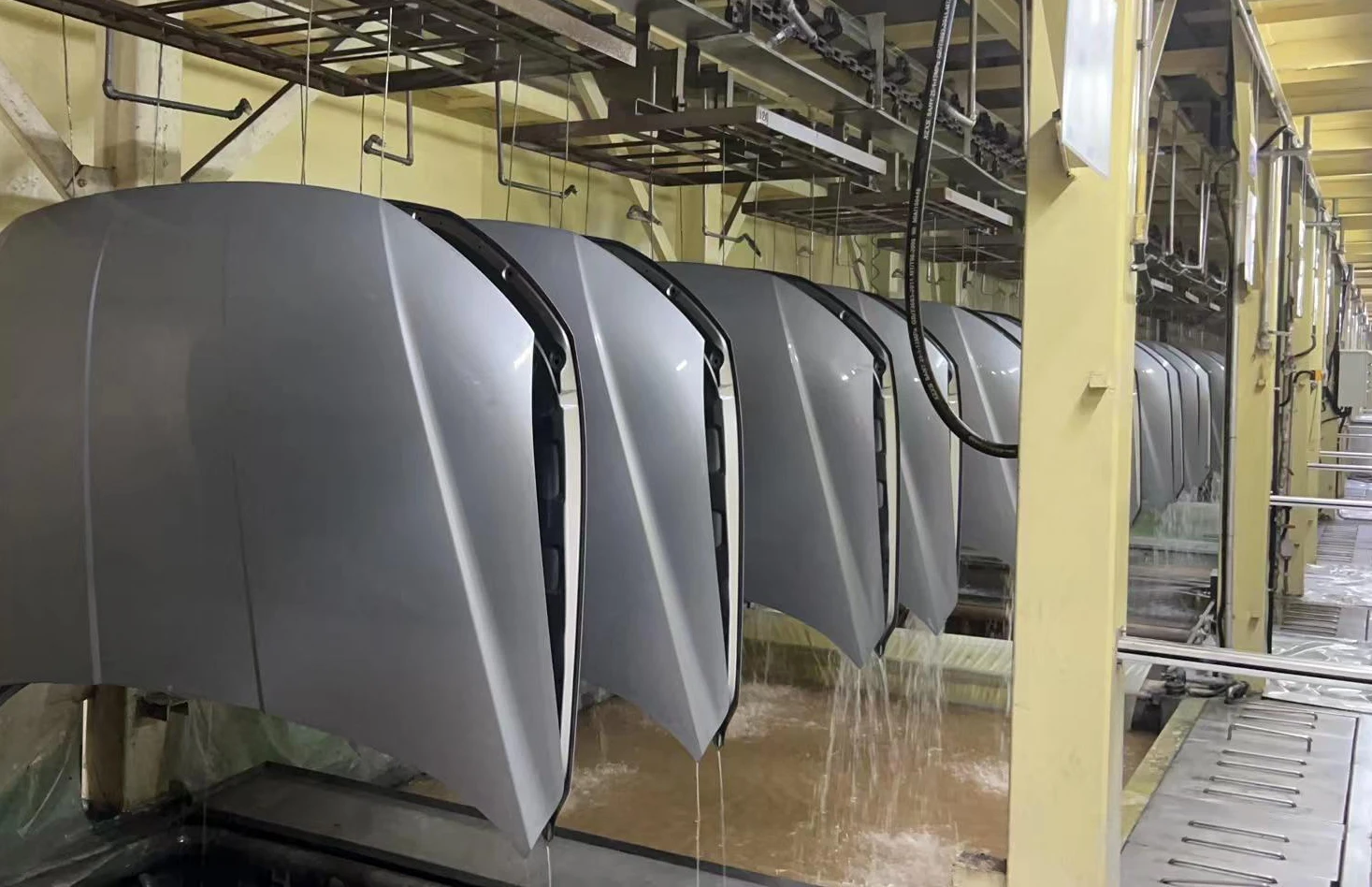
Electrophoretic coating uses electrophoresis to deposit paint uniformly and enables batch production.
Applying DC voltage between cathode and anode deposits a uniform water-based paint layer—an electrophoretic coating of cathodic or anodic type.
The automotive industry uses cathodic electrophoresis, forming a negatively charged resin-based coating controlled by voltage, current, time, and temperature.
Optimizing the electrophoresis coating formulation and process yields coatings with uniform film thickness, strong adhesion, and excellent corrosion resistance.
Spray Coating Technology
Spray coating applies 1–3 topcoat layers over pretreated and electrophoresed sheet metal for the final finish.
Paint is efficiently applied through air, airless, or electrostatic spray methods, with electrostatic spraying boosting efficiency by 30%.
Robotic spraying has recently advanced automation and intelligence, becoming widely used in automotive manufacturing.
Selecting appropriate spraying equipment and processes contributes to enhancing the consistency of coating quality.
Application Strategies for Automotive Sheet Metal Surface Treatment Technologies
Effective application of automotive sheet metal surface treatment technologies requires not only understanding the processes themselves but also implementing strategies to optimize performance, ensure consistency, and enhance efficiency. The following section focuses on precision control and process optimization in pretreatment, the foundational stage that directly impacts coating quality and durability.
Precision Control and Process Optimization of Pretreatment Technologies
As the foundational stage of surface treatment, quality control in pretreatment is particularly critical.
Pre-treatment chemicals should be optimized, using eco-friendly alkaline solutions and controlling alkalinity and temperature for consistent cleaning.
Eco-friendly, corrosion-resistant alternatives to chromium- and phosphorus agents reduce environmental impact and maintain performance.
Strictly control parameters such as time, temperature, concentration, and pH for stage coordination, with real-time monitoring to correct fluctuations.
Use intelligent control systems for automated monitoring and optimization, reducing human error and improving pretreatment precision.
For example, an automaker improved pretreatment quality by optimizing alkaline washing and conversion coating.
They used a mild, low-temperature alkaline cleaner and controlled washing to remove oils and ensure coating adhesion.
They developed a nano zirconium solution that forms a uniform film via electrolysis, boosting corrosion resistance and adhesion.
Automated lines with online monitoring were implemented to enable real-time control and enhance pretreatment consistency.
Parameter Control and Quality Enhancement in Electrophoretic Coating Technology
Electrophoretic coating is key to high-quality, corrosion-resistant vehicle coatings.
Optimizing the composition and formulation of electrophoretic paints ensures coating performance, maximizes paint utilization, and minimizes sludge formation.
Electrophoretic parameters should be optimized to ensure uniform, adhesive, and corrosion-resistant coatings.
Implement automated monitoring and control of bath solutions to maintain stability and reduce errors.
Use multi-stage and membrane filtration to remove impurities, reduce defects, and extend bath life.
An auto parts maker improved its electrophoretic process and developed high-solids cathodic paint, enhancing performance and efficiency.
Raising solids content from 15% to over 25% improved film thickness, corrosion resistance, and adhesion.
For electrophoretic process control, they adopted a constant current control mode.
By optimizing current density and application time, they achieved uniform coatings and reduced batch quality fluctuations.
Intelligent Application and Efficiency Enhancement of Spraying Technology
Spraying, the final step in decorative coatings, directly affects vehicle appearance, making advanced, reliable technology essential.
Proper equipment is crucial in spraying, e.g., electrostatic guns improve paint transfer and reduce waste.
Robotic spraying enables automation and intelligent control of the process, improving precision and efficiency.
Calibrating spray distance, pressure, and flow ensures fine atomization, uniform adhesion, and smooth coatings.
Control spray booth environment—temperature, humidity, and cleanliness—to prevent defects.
Use efficient exhaust systems to control VOC emissions and ensure eco-friendly spraying.
For example, an automotive manufacturer introduced an advanced robotic spraying production line, significantly improving spraying efficiency and quality.
The line uses 6-axis robots for 360° spraying with ±10 mm precision, ensuring uniform coating.
Robots with 3D vision automatically identify vehicle features and plan spray paths, adapting quickly to model changes.
Optimizing gun parameters and using electrostatic atomization improved atomization and adhesion, cutting paint loss over 30%.
Robotic spraying boosted efficiency by 30% and improved film quality, with first-pass yields over 98%.
Conclusion
As automotive consumer demands continue to evolve, quality requirements for vehicle painting grow increasingly stringent.
Surface treatment of automotive sheets is key to vehicle appearance and durability.
This paper reviews key surface treatment technologies and proposes strategies for process optimization, control, and automation.
Future surface treatment should enable lightweight, aesthetic designs and speed up R&D through industry-academia collaboration.
Lean management practices should be enhanced throughout surface treatment production to achieve full lifecycle quality traceability.
FAQ:
Automotive sheet metal surface treatment refers to a series of processes—such as pretreatment, electrophoretic coating, and spray coating—designed to enhance paint adhesion, corrosion resistance, and appearance. It’s essential for improving vehicle durability and ensuring a flawless finish that meets modern automotive quality standards.
The three primary stages include:
Pretreatment – cleaning and chemical conversion to prepare the metal surface.
Electrophoretic coating (E-coating) – applying a uniform primer layer for corrosion protection.
Spray coating – applying topcoats for color, gloss, and protection.
Each stage builds on the previous one to achieve high-performance coatings.
Pretreatment removes oil, rust, and oxides from sheet metal using alkaline and acid washing, followed by chemical conversion coatings like phosphating or zirconium conversion. This creates a clean, uniform surface that ensures strong adhesion between the metal and subsequent paint layers, preventing peeling or corrosion.
Modern pretreatment processes use chromium-free and phosphorus-free alternatives such as nano-ceramic and zirconium conversion coatings. These solutions provide excellent corrosion resistance, reduce environmental impact, and enhance coating uniformity—supporting sustainable automotive manufacturing.
E-coating involves applying a DC voltage between a cathode and an anode to deposit a uniform water-based paint film on the vehicle body. The automotive industry primarily uses cathodic electrophoresis, which offers strong adhesion, superior corrosion resistance, and consistent film thickness across complex geometries.
Optimizing E-coating performance involves:
Balancing paint composition and solids content (raising from 15% to over 25%).
Controlling current density, voltage, and time.
Using real-time bath monitoring and filtration to reduce impurities.
These measures enhance coating thickness, adhesion, and corrosion protection while minimizing waste.
Robotic spray coating provides precision, efficiency, and consistency. Using 6-axis robots with 3D vision systems, automakers can achieve 360° coverage, ±10 mm accuracy, and uniform film thickness. Robots also adapt to model changes automatically, reducing human error and increasing first-pass yield above 98%.
Electrostatic spraying charges paint particles so they are attracted to the grounded metal surface, increasing paint transfer efficiency by up to 30%. This not only reduces material waste but also ensures more even coating application and improved finish quality.
Automation and real-time monitoring systems ensure precise control over temperature, pH, and coating parameters. Automated production lines enhance consistency, minimize defects, reduce operator dependence, and enable smart manufacturing—a key step toward Industry 4.0 integration in automotive paint shops.
Future trends focus on lightweight materials, eco-friendly coatings, and intelligent process control. Collaboration between industry and academia will drive innovation in nanotechnology coatings, low-VOC materials, and digitalized quality management for full lifecycle traceability and sustainability.

Solomon Yang is a manufacturing industry professional with extensive experience in electronic, mechanical, and industrial component manufacturing. Having held various positions in American and Taiwanese manufacturing companies, he has developed a comprehensive understanding of manufacturing processes, production management, quality control, and global supply chain operations.
With expertise in business development, sales operations, international trade, customer relationship management, and engineering project support, Solomon bridges technical knowledge with commercial strategy to deliver innovative and cost-effective manufacturing solutions. He is passionate about advanced manufacturing technologies, process improvement, and continuous professional growth, with a strong commitment to creating value for customers and partners worldwide.