Quick Answer
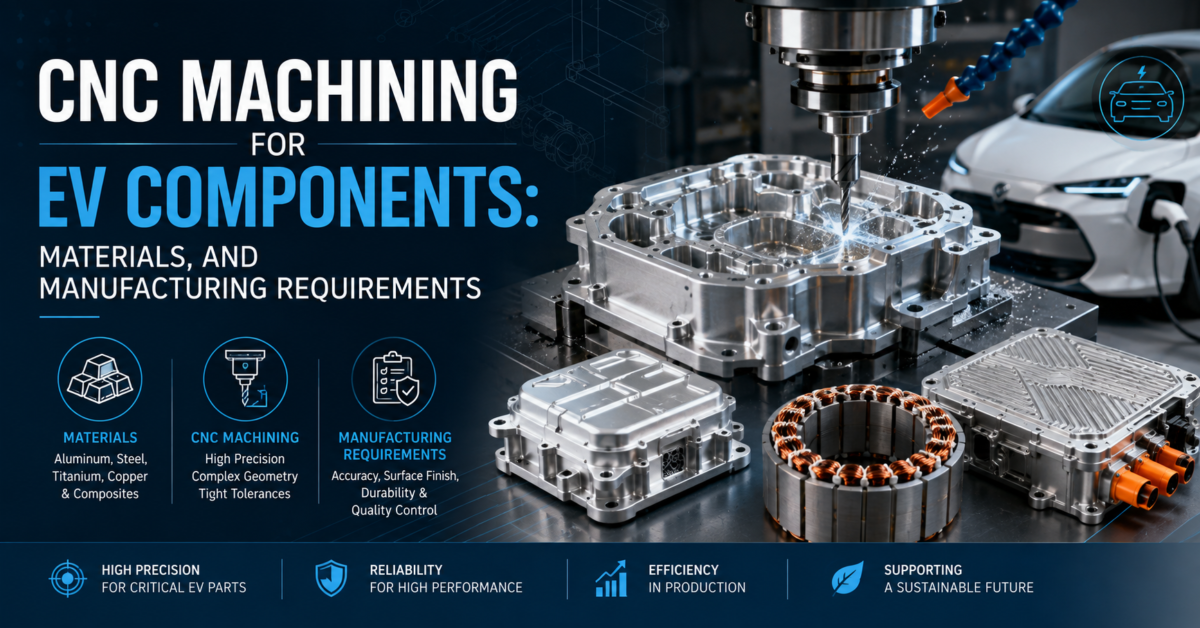
CNC machining is used on EV components wherever casting or stamping cannot hold the needed tolerance or sealing quality, mainly on battery trays, motor housings, inverter enclosures, and busbars. 6061-T6 and 7075-T6 aluminum, copper alloys, and stainless steel are the most common materials, and parts typically move from CNC prototype validation to a mix of casting and machining at production volume.
Introduction
Electric vehicle programs put pressure on manufacturing in a way that gasoline platforms never did. A battery tray has to stay watertight and structurally sound while shedding as much weight as possible. A motor housing has to hold a bore tolerance tight enough to keep the motor quiet and efficient. An inverter enclosure has to seal against the elements while managing serious heat. Casting and stamping can get close on many of these parts, but they routinely fall short on the thin walls, sealing surfaces, and tight bores that EV components demand, which is why CNC machining shows up throughout the EV supply chain, from early prototypes through low and mid volume production. This guide walks through the components, the materials, the machining processes, and the tolerance requirements that EV buyers in the USA, Canada, and Europe need to plan for when sourcing a machining partner.
Key Takeaways
- EV programs use CNC machining wherever casting or stamping cannot hold the tolerance, sealing, or thermal requirement, especially on battery trays, motor housings, and power electronics enclosures.
- Aluminum 6061-T6 and 7075-T6 dominate structural EV parts, while copper alloys cover busbars and stainless steel covers fasteners and structural brackets.
- Flatness, bore concentricity, and sealing surface quality are usually more critical than raw dimensional tolerance on EV parts.
- 5-axis machining is increasingly used for motor housings and complex cooling geometry where multiple setups would otherwise introduce stack-up error.
- A machining partner with CMM inspection and material traceability reduces risk on safety-critical battery and motor components.
Where CNC Machining Fits in EV Manufacturing
Electric vehicle platforms rely on precision machining wherever a cast or stamped part cannot deliver the tolerance, flatness, or thermal performance the component needs. Battery enclosures, motor housings, inverter cases, and cooling plates are the parts that most often move from casting to CNC finishing or full CNC production, particularly at prototype and low to mid volume stages. This complements our rapid prototyping services for teams validating a new EV platform before committing to production tooling.
| Did You KnowA typical EV battery tray removes 30 to 40 percent of the starting billet weight through pocketing, since walls as thin as 2 to 4 millimeters are common on structural aluminum trays. |
Key EV Components That Use CNC Machining
Battery pack housings and trays
Battery trays require flatness and sealing surface control to keep the pack watertight and structurally sound. Wall sections of 2 to 4 millimeters are common, and CNC machining with vacuum fixturing holds these thin sections within tight tolerance while removing 30 to 40 percent of the starting billet weight through pocketing.
Motor housings
Motor housings need precise stator bore roundness and cylindricity because the bore directly affects motor efficiency and noise. Bearing seat runout and water jacket passage geometry are also closely controlled, since these features affect both mechanical fit and thermal performance.
Inverter and power electronics housings
Inverter housings, DC-DC converter cases, and onboard charger enclosures need flat sealing surfaces for effective EMI shielding and precise connector hole patterns. Heat sinks, whether machined from billet or extruded and finish machined, need controlled fin geometry for thermal performance.
Busbars and conductive connectors
Copper busbars inside the battery pack and inverter carry high current and require precision machining to the same tolerance discipline as structural parts, along with clean edges to avoid localized heating at sharp corners.
Structural and drivetrain brackets
Suspension components, gearbox housings, and structural brackets are frequently machined from aluminum or hardened steel where weight reduction and fatigue performance both matter.
Have a battery, motor, or inverter part in mind? Get an instant quote for prototype or low-volume production.
Machining Processes Used on EV Parts
| Process | Typical EV application | Why it is used |
| 3-axis milling | Brackets, simple enclosure covers, plates | Lowest cost for straightforward prismatic geometry |
| 5-axis simultaneous milling | Motor housings, complex cooling channels, impeller-style parts | Machines complex angled features in one setup, avoiding stack-up error |
| CNC turning / Swiss turning | Shafts, connectors, cylindrical terminals | Best surface finish and concentricity for round parts |
| Wire EDM | Fine internal slots, hardened tooling details | Cuts hardened or hard-to-machine material without cutting forces |
| CNC finishing of cast blanks | Battery trays, large housings starting as castings | Combines casting economics with machined precision on critical faces |
Materials Used in EV Component Machining
| Material | Typical EV use | Why it is chosen |
| 6061-T6 aluminum | Battery trays, brackets, general structure | Good machinability, strength-to-weight ratio |
| 7075-T6 aluminum | High-load structural parts | Higher strength for weight-critical components |
| 6063-T5 aluminum | Cold plates, heat sinks | Good thermal conductivity and machinability |
| Copper alloys | Busbars, terminals, connectors | High electrical conductivity |
| Stainless steel 304 / 316 | Fasteners, structural brackets | Corrosion resistance and strength |
| Ti-6Al-4V (Grade 5) titanium | Weight-critical motor or suspension parts | High strength-to-weight, premium applications |
Tolerance and Quality Requirements
EV components are frequently held to tighter tolerances than a general industrial part because of how tolerance stacking affects motor efficiency, sealing, and safety. Typical requirements include stator bore roundness and cylindricity in the single-digit micron range, cold plate flatness at or below 0.02 millimeters on the thermal interface surface, and pressure testing of cooling channels at several bar to confirm leak-free sealing. Full material and process traceability, supported by CMM inspection reports, is standard practice for safety-critical EV parts and is close to what an AS9102 first article inspection package looks like in aerospace work.
| Pro Tip : Ask a prospective machining partner to show a sample CMM report for a similar EV part before you commit a design. It tells you in a few minutes whether their inspection equipment and reporting actually match what your program will require. |
From Prototype to Production: A Typical Workflow
- Design review and DFM feedback on the CAD model before any cutting starts, flagging thin walls, deep pockets, and tolerance conflicts.
- CNC prototype run, usually 1 to 20 units, to validate fit, function, and assembly before tooling is committed.
- Design freeze and, where volume justifies it, a transition plan to casting, stamping, or die casting for the high-volume version of the part.
- First article inspection on the initial production batch to confirm the process meets every drawing requirement.
- Ongoing production with periodic CMM sampling and material lot traceability maintained through the program.
Supplier Evaluation Checklist for EV Programs
- Experience machining thin-wall aluminum structures and sealing surfaces, not only general prismatic parts.
- In-house CMM inspection and the ability to produce a first article inspection report on request.
- Material traceability back to the mill certificate for every batch used on safety-critical parts.
- 5-axis capability where the part geometry requires it, to avoid multiple setups and the tolerance stack-up that comes with them.
- A clear quoting process that separates prototype pricing from production pricing, since the two use different cost logic.
| Expert Insight : Buyers moving from a lab-validated prototype to a 5,000-unit production run most often run into trouble at the communication stage, not the design stage. A supplier who pushes back on assembly tolerances during the RFQ is telling you they understand what production-rate machining will actually require, which matters more for EV programs than an aggressive first quote. |
Frequently Asked Questions
Why not just cast EV battery trays and motor housings instead of machining them?
Casting works for many parts, but thin-wall sections, flatness on sealing surfaces, and tight bore tolerances are difficult for casting alone to hold consistently, so CNC machining is used to finish critical features or to produce the part directly.
What is the most common material for EV structural parts?
6061-T6 and 7075-T6 aluminum dominate structural EV components because they combine good machinability with a strong strength-to-weight ratio.
Do EV parts need the same inspection rigor as aerospace parts?
Not identical, but safety-critical EV components such as battery enclosures and motor housings increasingly require CMM inspection, material certification, and process documentation similar in spirit to aerospace first article inspection.
Can CNC machining support EV prototype and production volumes both?
Yes. CNC machining is commonly used for prototype validation and low to mid volume production, then complemented by casting or stamping once tooling is justified at higher volumes.
When does an EV part need 5-axis machining instead of 3-axis?
5-axis machining is used when a part has complex angled features, such as a motor housing with multiple cooling passages, that would otherwise require several separate setups and risk tolerance stack-up between them.