Programming technology for CNC mill-turn machine tools is currently the main bottleneck affecting their application. Although many CAM software are available, most do not offer solutions for mill-turn compound machining, making programming difficult.
Mill-turn programming typically involves classifying and sequencing processes, then using CAM software to plan and integrate milling and turning. However, the rapid development of mill-turn technology has raised higher programming demands, becoming a bottleneck in production.
Mill-turn technology is new, so many times programs are generated with general CAM software and then manually integrated by craftsmen. This method not only requires the high skills of craftsmen but also the programming process is cumbersome. Therefore, it is particularly important to study the manual programming of mill-turn machining centers, especially the C-axis programming method.
Characteristics of CNC turning and milling compound machine tool
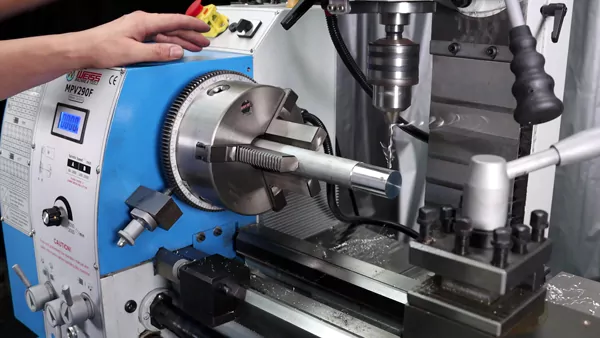
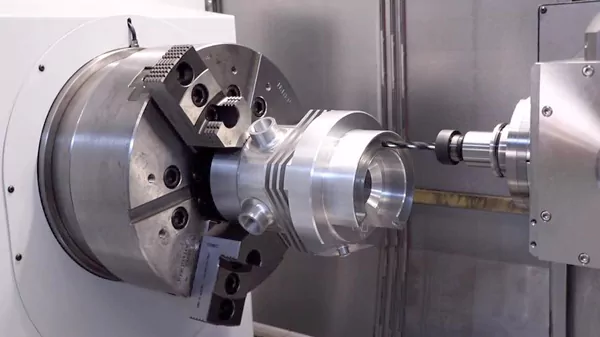
CNC mill-turn compound machine tool is a high-performance machine tool that integrates the functions of a lathe and milling machine. It achieves multi-process machining by installing lathe tool holders and milling spindles on the same table, offering high integration, efficiency, and suitability for precision and mass production. The following are the main features of CNC mill-turn machine tools:
1. Highly integrated
The CNC milling machine tool will be integrated with the lathe tool holder and milling spindle, enabling various machining operations on a single worktable. This design boosts efficiency, reduces workpiece handling and clamping, and enhances accuracy and productivity. Due to its precision machining capability, CNC mill-turn machine tools have significant advantages in the processing of high-precision requirements.
2. High efficiency
CNC mill-turn machines use multi-axis parallel control for efficient multi-face and multi-angle machining, allowing simultaneous turning and milling on the same workpiece, reducing machining time. They also support automated programming, saving manual labor and costs.
3. Widely used
CNC turning and milling machine tool has a wide range of applications in the field of machining. CNC mill-turn machine tools are key equipment in industries like aviation, aerospace, automotive, mold, machinery, and nuclear energy, meeting high precision and efficiency demands in areas such as axle machining, propeller machining, and large-scale vertical machining.
The basic principle of CNC machine tool programming technology
CNC programming controls machine tool motion to achieve precise workpiece machining. The basic principle of CNC machine tool programming technology involves three aspects: mathematical model, language specification, and program generation.
1. Mathematical model
CNC machine tool programming is based on a mathematical model that describes the geometry and spatial location of the workpiece, including coordinate systems, points, lines, surfaces, and other elements. This ensures accurate movement control while meeting the machining requirements for precision and efficiency. Through precise mathematical modeling, it can ensure the accuracy and stability of CNC machine tools in the machining process.
2. Language specification
The language specification in CNC programming ensures the program follows rules and format for correctness and readability. Currently, the programming of CNC machine tools mainly uses G code and M code two languages. G code controls the machine’s cutting actions and trajectory, while M code manages auxiliary functions like coolant, alarms, and spindle control l. The standardization and unity of programming is ensured by the standardized programming language.
3. Program Generation
Program generation is the core of CNC programming, creating machining programs by combining the object’s mathematical model with the programming language specification. The program describes in detail the workpiece machining process, machining sequence, cutting parameters, and so on. Program generation can be done manually, using CAM software, or through computer-aided programming, with automated systems enhancing efficiency and accuracy by optimizing the machining process.
Programming technology of CNC milling-turning composite machine tool
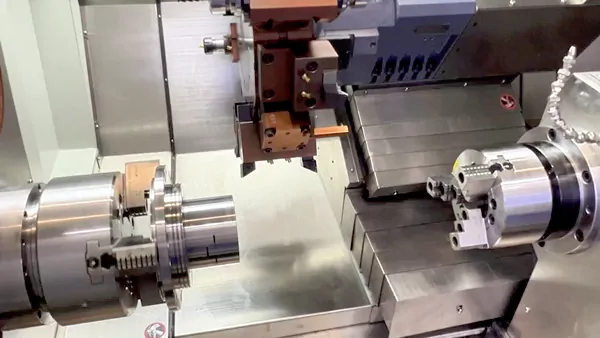
The CNC turning and milling composite machine combines both processes, using programming to perform complex tasks. Effective CNC programming technology not only improves machining accuracy but also optimizes machining efficiency and reduces production costs. This will detail the CNC programming language, common instructions, path planning optimization, and programming optimization methods.
1. Types and characteristics of CNC programming language
CNC programming language is an important part of CNC mill-turn composite machine tool programming. Common CNC programming languages include ISO, G code, M code, custom macros, and high-level languages. Each programming language has its specific use and characteristics:
ISO Programming Language
ISO is an international standard CNC programming language used to control machine tool motion, speed, and parameters. Its simple operation and easy-to-understand code make it suitable for beginners.
G Code
G code is the most commonly used instruction set in CNC programming for controlling machine movement during machining. It includes control of basic elements such as coordinate system, feed speed, tool radius, etc. It has high precision and control capability and is widely used in CNC machine tool processing.
M code
M code controls additional CNC functions like start, stop, tool change, and coolant. It enhances the functionality of the machine tool and is an integral part of CNC programming.
Custom Macro Programs
A custom macro program is a reusable program that significantly improves programming efficiency and reduces repetitive work through modular programming.
High-Level Languages
High-level languages (e.g., CNC control programs, programmable controllers) enable more flexible, complex CNC machine programming.
2. Analysis and application of common commands in CNC programming
In CNC programming, common instructions include linear instructions, arc instructions,s, and hole machining instructions. Each instruction has a specific format and application scenario:
Linear Instruction
The straight line instruction (e.g. G01 XYY ZZZ F_) is used for straight line machining, where G01 indicates straight line interpolation, XYY ZZZ indicates the end point coordinates of the straight line, and F_ indicates the feed rate of machining. This instruction is widely used for straight-line contour machining.
Arc Instruction
Arc instruction is used for curve machining, which can accurately control the start, end, and radius of an arc in CNC machining. By reasonably setting the parameters of the arc, the problems of machining error and excessive cutting load can be avoided.
Hole Processing Instruction
Hole machining instructions control drilling, milling, and other equipment for hole operations. Setting appropriate parameters based on material and requirements improves efficiency and ensures quality.
3. Command setting and path planning optimization
When writing instructions, you need to reasonably set the machining parameters, such as feed rate, depth of cut, tool selection, etc., to ensure machining accuracy and efficiency. In addition, path planning is also critical, reasonable path design can not only improve machining efficiency but also reduce tool wear and machine burden, reducing machining errors.
4. Optimization methods of CNC programming technology
To improve the efficiency and machining accuracy of CNC programming, the following optimization methods can be taken:
Switching coordinate system optimization
In CNC machining, switching different coordinate systems (such as workpiece coordinate system, and machine coordinate system) is a common operation. To improve efficiency, minimize coordinate system switches and ensure accuracy is maintained to avoid machining errors.
Optimization of machining tool paths
Reducing the movement path of the tool is an effective means of improving machining efficiency. Optimizing the machining strategy and tool path design reduces empty walks and repetitive movements, enhancing efficiency.
Optimization of machining parameters
Reasonable machining parameter settings have an important impact on machining accuracy and efficiency. Adjusting machining parameters based on material properties ensures process stability and efficiency.
Optimization of the machining process
In addition to programming itself, the entire machining process needs to be optimized. Check the workpiece and tool condition before machining to ensure they meet requirements; maintain chip cleaning and hydraulic oil temperature control during machining for stability and reliability.
Optimization of programming technology of CNC mill-turn compound machine tool
As demand for high-efficiency, high-precision machining grows, CNC milling and turning composite machine tool programming is increasingly used in manufacturing. It enhances processing efficiency and quality while driving industry advancement toward intelligence and automation. Future innovations and challenges will focus on improving production efficiency and addressing new material processing and automation needs, significantly impacting the manufacturing sector.
1. CNC milling and turning machine tool programming technology in the application of machinery manufacturing
CNC turning and milling composite machine tool programming is increasingly used in machinery manufacturing, mainly in the following aspects:
Efficient processing methods
CNC turning and milling composite machine tool programming offers a more flexible and efficient processing method than traditional manual or mold processing. Through CNC programming, the manufacturing process is digitalized, informative, and intelligent, significantly improving the degree of automation in manufacturing.
Improve machining accuracy and quality
CNC turning and milling composite programming enables precise, complex processing, improving part accuracy and product quality, especially in engraving, while reducing manual errors and waste.
Reducing Human Operational Errors
CNC programming minimizes human error, ensuring stability and accuracy, especially for complex mechanical products.
Reduce Costs
CNC turning and milling compound machines reduce labor costs and errors, lowering manufacturing costs.
2. The development trend of CNC turning and milling machine tool programming technology
With the intensification of industrial manufacturing competition, CNC milling machine tool programming technology is facing new challenges and development opportunities. The future development trend is mainly reflected in the following aspects:
Improve production efficiency and product quality
.With the intensification of global competition, manufacturing enterprises are increasingly focusing on improving production efficiency and reducing production costs. CNC milling and turning machines improve production efficiency, ensuring high precision and high-efficiency processing, boosting enterprise competitiveness.
Responds to the machining needs of new materials
New materials have higher hardness, toughness, and rigidity, and traditional machining methods often difficult to cope with these requirements. CNC mill-turn machines quickly and accurately process new materials using advanced programming to meet modern manufacturing standards.
Automation Development
The automation level of CNC turning and milling compound machine tools will continue to improve. Robot and vision technologies will make machine tools smarter, reduce manual intervention, and enhance efficiency and quality.
Technological innovation
With technological advancements, CNC turning and milling composite machine tool programming will become more automated and intelligent, driving the manufacturing industry toward greater efficiency, accuracy, and flexibility.
3. CNC milling machine tool programming technology application trends
Future research and applications in CNC turning and milling composite machine tool programming will focus on continuous optimization in the following key areas:
High-efficiency improvement
Optimizing program design and improving motion paths can significantly boost the productivity of CNC turning and milling machines. For example, additive manufacturing with the help of advanced algorithms and computer technology can accelerate the machining process. AI and machine learning will optimize programming, reduce human error, and improve efficiency.
Intelligent Development
Machine learning, voice recognition,n, and other technologies will significantly improve the level of intelligence of CNC milling and turning machines. Machine learning optimizes machining strategies by analyzing data, while voice recognition allows operators to control machines with voice commands, improving convenience and accuracy.
Increased Flexibility
CNC mill-turn machine programming will focus on flexibility, enabling a wide range of tasks through modular design and improved interfaces for faster, more efficient operation.
Conclusion
The future development direction of CNC mill-turn programming technology is intelligence, precision, and automation. Future research will focus on precision control technology, big data technology, and intelligent programming technology. These studies are expected to provide strong technical support for the development of CNC turning and milling compound machines.