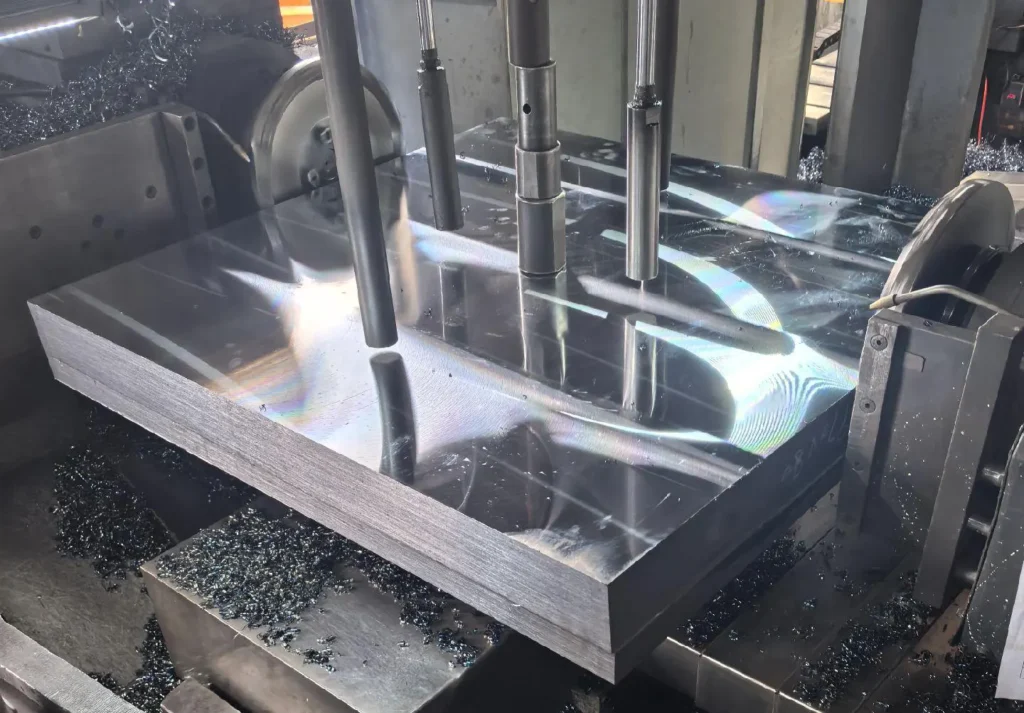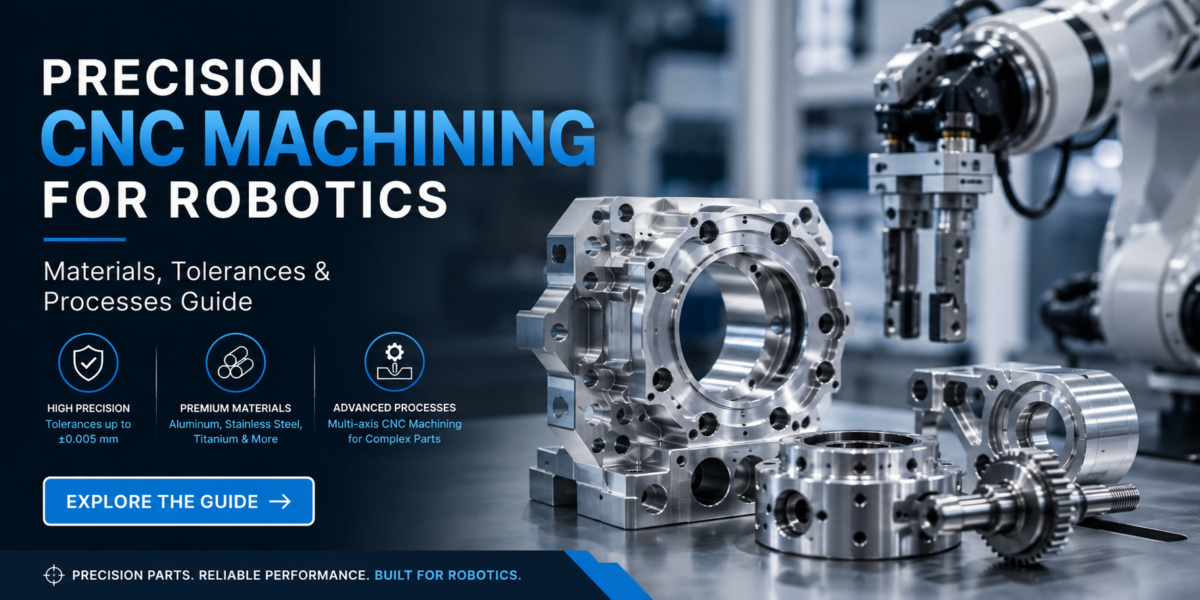
| Quick AnswerCNC machining for robotics manufactures high-precision joints, arm links, end-effectors, drive shafts, and sensor mounts using multi-axis milling, turning, and EDM. It delivers tolerances as tight as ±0.005 mm across aluminum, titanium, stainless steel, and engineering plastics, making it the go-to process wherever robotic motion control demands repeatable dimensional accuracy. |
| Key TakeawaysCNC machined robotics parts achieve tolerances as tight as ±0.005 mm, critical for motion-control accuracy.Aluminum 7075-T6, titanium Grade 5, and stainless steel 17-4 PH are the top materials for structural robotic components.5-axis CNC machining handles complex robotic joint geometries in a single setup, eliminating re-fixturing errors.Precision CNC machining covers structural frames, drive shafts, encoder mounts, gear housings, and end-effectors.Choosing an ISO 9001-certified robotics CNC machining manufacturer with in-house CMM inspection is essential for production reliability.Prototype-to-production continuity from a single supplier reduces risk, lead time, and tolerance drift between batches. |
- pinco-original.com
- mosbet az
- pinup az
- pin up casino
- mosbet casino
- 4abet
- pin up
- mosbet
- mosbet az
- mostbet
- mosbet casino kz
- mosbet
- pinup casino
- pinup az
- mosbet casino
- pinko casino
- mosbet
- 1x bet
- mostbet casino
- mostbet online
- pin up
- pin-up
- mosbet
- mosbet
- chicken road uz
- mosbet casino
- pin up online
- mosbet casino
- 1win az
- misli bahis
Why CNC Machining Is Central to Robotics Manufacturing
Robotics demands parts that perform consistently under repeated motion cycles, dynamic loads, and tight spatial constraints. CNC machining services meet these demands because the process is numerically controlled, removing human variation from every cut. Where casting suits high-volume, lower-precision applications, robotic systems require dimensional accuracy that only subtractive precision manufacturing can reliably deliver. A 0.05 mm deviation in a joint bore causes cumulative positioning errors that make a robot miss its target entirely.
The global robotics industry now operates over 4.2 million industrial robots, each requiring hundreds of precision-machined components throughout its lifespan. Across collaborative robots (cobots), industrial robotic arms, medical robots, and autonomous mobile robots (AMRs), multi-axis CNC capabilities keep these systems running precisely.
| Did You Know?According to the International Federation of Robotics (IFR), the global stock of operational industrial robots hit a record 4.28 million units in 2023, up 10% year-on-year. Every one of those robots contains dozens of precision-machined joints, shafts, and housings. As robot deployments accelerate, demand for tight-tolerance CNC machined robotics parts is growing at the same rate. Source: IFR World Robotics Report |
Common CNC Machined Robotics Parts
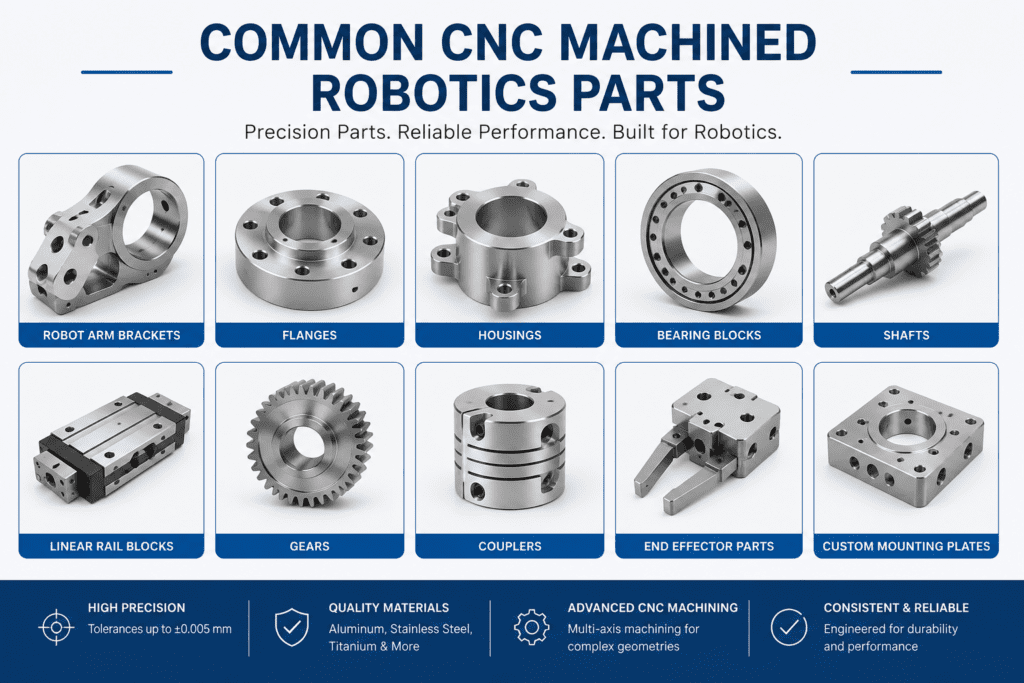
Robotics CNC machining covers a wide range of components. Below are the most frequently machined parts and what makes each one demanding to produce.
Robotic Arm Links and Structural Frames
These carry dynamic loads through the full range of motion. Aluminum 7075-T6 is the preferred material for its high strength-to-weight ratio. CNC milling services produce the lightening pockets, pocket radii, and precise mounting interfaces these structures require without the porosity risk of casting.
Joint Housings and Bearing Bores
Bearing bores require H7 tolerance fits (typically ±0.010 mm) for reliable bearing seating. CNC boring and remaining deliver this repeatably. A housing that is even 0.02 mm oversize allows bearing migration under load, degrading joint accuracy over time.
End-Effectors and Gripper Components
Custom CNC robotics parts for grippers are machined from stainless steel or engineering plastics like Delrin and PEEK, depending on whether the application involves food handling, cleanrooms, or general industrial use. View examples of custom metal parts machined for robotic end-effectors.
Drive Shafts and Couplings
CNC turning services produce precision-machined, highly concentric shafts with surface finishes as fine as Ra 0.8 or better, improving rotational stability in high-speed robotic systems. Advanced live-tool lathes also allow secondary milling operations, such as keyways, flats, and cross-holes to be completed in a single setup, reducing handling time and improving part accuracy.
Gear Housings and Transmission Components
Tight-tolerance cavities, thread inserts, and sealing surfaces that keep gear trains aligned and lubricated are a core output of precision CNC machining. Wall parallelism under 0.005 mm is achievable on surface-ground gear housing mating faces.
Encoder and Sensor Mounts
Positional accuracy of the robot depends on sensor alignment. Encoder brackets machined to ±0.01 mm ensure the sensor reads true position. Even a small angular offset of 0.1 degrees in a sensor mount translates to measurable path deviation at the end-effector.
Materials Used in Robotics CNC Machining
| Material | Typical Application | Key Property |
| Aluminum 6061-T6 | Frames, covers, brackets | Lightweight, good machinability |
| Aluminum 7075-T6 | High-load arm links | Highest strength-to-weight ratio |
| Titanium Grade 5 | Surgical robots, aerospace cobots | Biocompatible, corrosion-resistant |
| Stainless Steel 303/304 | Shafts, fasteners, grippers | Corrosion resistance, hygiene |
| Stainless Steel 17-4 PH | High-stress joints | Hardened, fatigue-resistant |
| PEEK | Cleanroom end-effectors | Chemical resistance, low friction |
| Delrin (POM) | Light-duty gears, guides | Self-lubricating, dimensionally stable |
Material selection for CNC parts for robotics depends on the robot’s payload, operating environment, weight budget, and any industry-specific standards such as FDA compliance for food or medical robots.
Need to add button here – View our Material selections here
CNC Machining Processes for Robotics Components
3-Axis CNC Milling
Sufficient for flat plates, brackets, and housings with features on one plane. Faster and more cost-effective for simpler robotics parts that do not require compound angles.
4-Axis CNC Machining
Adds rotational indexing, enabling shaft slots, cross-holes, and radial features without repositioning. See the full 4-axis CNC machining services for typical applications.
5-Axis CNC Machining
The standard for complex robotic joint geometries. A 5-axis CNC machining centre tilts and rotates the part continuously, reaching undercuts and compound angles in a single setup. This eliminates re-fixturing errors that compound across an assembly. For precision CNC machining for robotics, 5-axis capability is not optional for production-grade joints.
CNC Turning
Produces shafts, spindles, and rotational components to tight roundness tolerances. CNC turning services with live-tool lathes add milling capability in the same operation, reducing lead time and cumulative fixturing errors on drive shafts.
Wire EDM and Sinker EDM
Used for hardened steel inserts, fine-feature gear teeth, and micro-scale features where conventional tooling cannot reach. Critical in high-precision robotics CNC machining for small joint components requiring contour accuracy below 0.005 mm.
Surface Grinding
Applied after hardening to achieve parallelism and flatness below 0.005 mm on mating surfaces such as linear guide rails and motor mounting faces.
Tolerances and Quality Standards
Robotics CNC machining manufacturers apply specific tolerance classes defined by ISO 2768 and ASME Y14.5. Standard requirements for robotic components:
- General dimensions: ISO 2768-m (medium) or finer
- Bearing fits: H7/p6 for press fits, H7/g6 for clearance fits
- Thread quality: 6H internal, 6g external
- Surface finish: Ra 0.8 to 1.6 for mating surfaces; Ra 3.2 for non-contact faces
Quality verification uses coordinate measuring machines (CMM), optical comparators, and bore gauges. A reliable robotics parts manufacturer conducts first-article inspection (FAI) on every new part. Review quality processes on the quality assurance page.
How to Choose a Robotics CNC Machining Parts Manufacturer
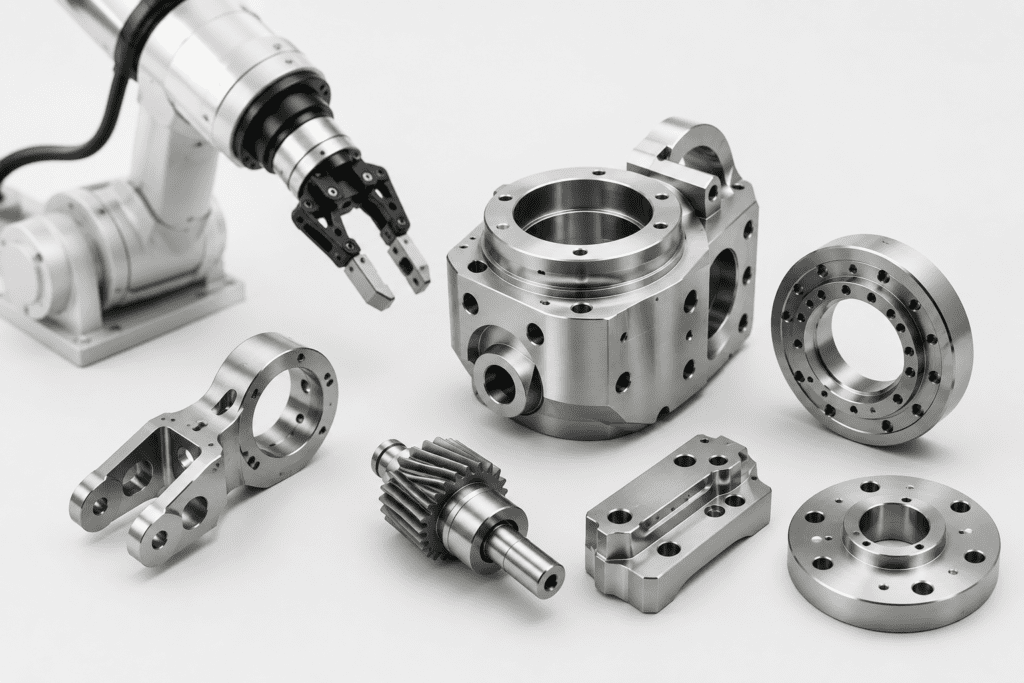
Not every machine shop qualifies as a robotics CNC machining manufacturer. Here are the five questions every engineer should ask before placing an order.
1. Do they have 5-axis machining centres on the floor?
Robotic components with compound geometry cannot be made to tolerance on 3-axis equipment alone. 5-axis CNC machining is non-negotiable for precision joint production.
2. Can they machine titanium and hardened stainless steel?
These materials require specific tooling, feeds, and coolant strategies. Ask for material test certificates and confirm the shop runs your required alloys regularly, not just occasionally.
3. Do they have documented quality systems?
CMM inspection reports, ISO 9001 certification, and a formal first-article inspection process indicate systematic quality control. View quality assurance details.
4. Can they support prototyping and production from the same facility?
A manufacturer that handles both reduces program risk. Rapid prototyping services that seamlessly hand off to production machining eliminate the tolerance drift that often occurs when prototyping and production are separated across suppliers.
5. Do they provide DFM feedback?
A qualified supplier will flag unnecessary tight tolerances or features that add cost without adding function. This is especially important on robotic assemblies where tolerance stack-up across multiple parts compounds into positioning error.
Request a CNC machining quote and receive a DFM review with your quotation.
Surface Treatments for CNC Machined Robotics Parts
Raw machined aluminum and steel oxidize, wear, and corrode unless treated. The right finish extends service life and meets industry compliance requirements. All options below are available through surface treatment services.
| Finish | Best For | Key Benefit |
| Hard Anodizing (Type III) | Aluminum joint housings, frames | 400-600 HV surface hardness |
| Black Oxide | Steel fasteners, shafts | Mild corrosion protection, no dimensional change |
| Electroless Nickel | Complex stainless geometry | Uniform coating, wear and corrosion resistance |
| PVD Coating | Gear teeth, sliding contacts | Extreme wear resistance |
| Passivation (ASTM A967) | Food-grade, medical stainless parts | Removes free iron from surface |
CNC Machining vs. Other Manufacturing Methods for Robotics
CNC Machining vs. Metal 3D Printing (DMLS/SLM)
Metal additive manufacturing excels at internal channels and topology-optimized geometries but produces as-built surface finishes (Ra 6-12) and residual porosity that require post-machining. For structural robotics parts requiring tight bores and mating surfaces, CNC machining remains the primary process even when 3D printing is used for near-net shapes.
CNC Machining vs. Die Casting
Die casting suits high-volume, simpler geometries at lower per-part cost. However, casting porosity affects fatigue life in dynamic robotic joints. Precision CNC machining is preferred for joints and load-bearing components in low to medium volumes where fatigue life and dimensional accuracy are critical.
CNC Machining vs. Stamping/Forming
Sheet metal stamping cannot produce the three-dimensional features required in robotic arm links, joint housings, or transmission components. CNC machining handles all geometries, from simple plates to complex multi-feature housings.
Industries Using Robotics CNC Machining
Industrial Automation
6-axis robotic arms on assembly lines use precision CNC machined joints, wrists, and end-effectors capable of millions of duty cycles without dimensional drift. Repeatability under 0.02 mm at the end-effector is the standard for automotive and electronics assembly robots.
Collaborative Robots (Cobots)
Cobots prioritize lightweight aluminum and compact joint designs. CNC machining robotics components for cobots requires lightweighting strategies like pocket milling and thin-wall tolerancing, where wall thickness as low as 1.0 mm must be maintained to ±0.05 mm.
Medical and Surgical Robots
Surgical robots require titanium and stainless steel parts meeting ISO 13485 and biocompatibility standards. Tolerances are typically in the sub-0.01 mm range on mating surfaces, and every part requires traceability documentation back to raw material certification.
Agricultural and Food Robotics
Stainless steel 316L and FDA-compliant PEEK are machined for food-contact grippers and washdown-rated housings where corrosion resistance and surface hygiene are non-negotiable.
Aerospace and Defense Robotics
Titanium, Inconel, and carbon fiber composite inserts are machined to AS9100 standards for UAV actuators and space robotics mechanisms, where weight and reliability constraints are extreme.
Frequently Asked Questions
What tolerances can CNC machining achieve for robotics parts?
Standard precision CNC machining for robotics achieves ±0.01 mm on critical dimensions. Ultra-precision features reach ±0.005 mm using grinding and lapping as supplementary operations. General non-critical dimensions typically hold ISO 2768-m (±0.1 mm on dimensions under 30 mm).
What is the best material for CNC machined robotic arm links?
Aluminum 7075-T6 offers the best combination of strength, weight, and machinability for most robotic arm links. Titanium Grade 5 is preferred when weight budget is critical and cost allows. Stainless steel 17-4 PH is used where fatigue loading is extreme.
How long does it take to machine custom CNC robotics parts?
Prototype lead times are typically 5 to 10 business days for machined robotics components, depending on complexity and material availability. Rapid prototyping services can reduce this to 3 days for straightforward aluminum parts.
Can CNC machining produce full robotic assemblies?
CNC machining services can supply individual components, sub-assemblies, or complete mechanical assemblies with hardware installed, reducing supply chain complexity and tolerance stack-up risk.
What surface finish is standard on CNC machined robotic joints?
As-machined aluminum joints typically have Ra 1.6 on mating faces and Ra 3.2 on non-contact surfaces. Hard anodizing is applied for wear resistance. For stainless joints in corrosive or hygienic environments, passivation per ASTM A967 is standard.
How do I know if my robotic part design is machinable?
Submit your drawing for a free DFM (Design for Manufacturability) review. The most common issues are internal corner radii too small for available tooling, unnecessary tight tolerances on non-functional surfaces, and thin walls that risk deflection during machining. Request a quote and DFM review to get feedback within 24 hours.
Summary
CNC machining for robotics bridges design intent and real-world performance. From 5-axis milling of complex joint geometries to tight-tolerance turning of drive shafts, precision CNC machining produces the robotic components that move, actuate, and sense with the reliability modern automation demands.
Selecting the right robotics CNC machining manufacturer, one with multi-axis capability, material expertise, and documented quality systems, is the deciding factor between a robot that performs and one that fails in the field.

Solomon Yang is a manufacturing industry professional with extensive experience in electronic, mechanical, and industrial component manufacturing. Having held various positions in American and Taiwanese manufacturing companies, he has developed a comprehensive understanding of manufacturing processes, production management, quality control, and global supply chain operations.
With expertise in business development, sales operations, international trade, customer relationship management, and engineering project support, Solomon bridges technical knowledge with commercial strategy to deliver innovative and cost-effective manufacturing solutions. He is passionate about advanced manufacturing technologies, process improvement, and continuous professional growth, with a strong commitment to creating value for customers and partners worldwide.