A request for quotation is the first real conversation you have with a CNC machining parts manufacturer in China, and it usually decides how fast, and how accurate, your price comes back. Send a thin package and you get a padded number designed to cover unknowns. Send a complete one and a shop like Ruiyi can quote it in a day instead of a week.
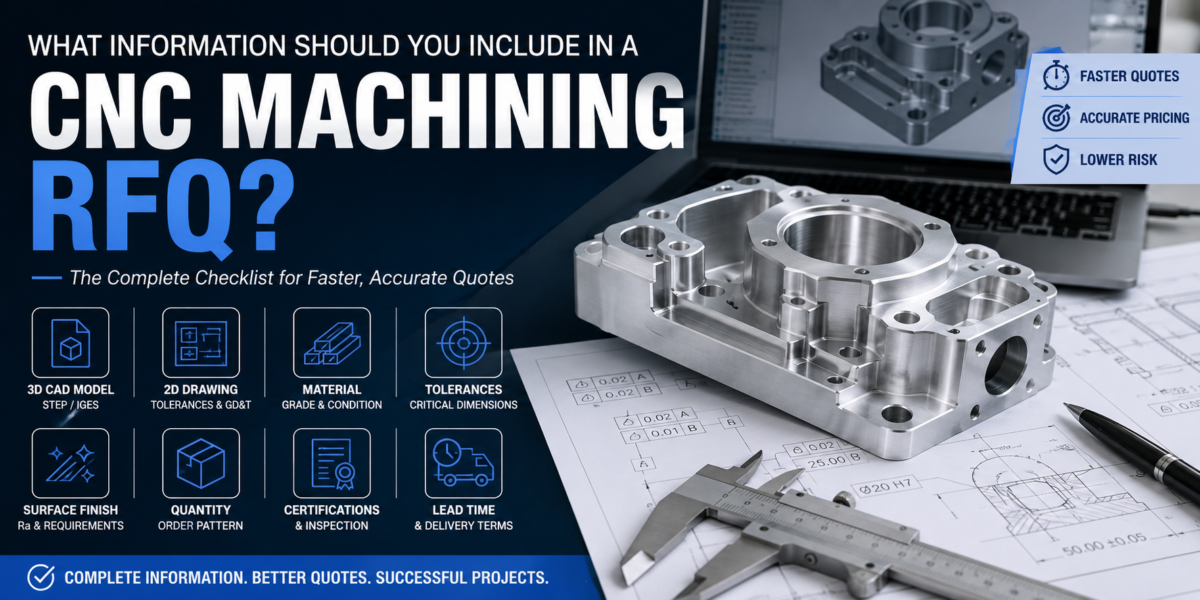
If you’re working with a CNC machining parts provider in China, a complete RFQ should include a 3D CAD model, 2D drawing, material grade, tolerances, quantity, surface finish requirements, certifications, and delivery schedule. Leave out any one of these seven items and expect delays, clarification emails, or a quote that quietly builds in risk money to cover what you did not specify.
Key Takeaways
- A complete RFQ needs seven core elements: 3D model, 2D drawing, material grade, tolerances, finish, quantity, and lead time.
- Incomplete RFQs typically add 3–5 business days of back-and-forth clarification before you see a real price.
- Vague or missing tolerance callouts are the single biggest cause of inflated quotes.
- Separating prototype RFQs from production RFQs gets you more realistic pricing for each stage.
- A supplier working from ISO 9001 and ISO 13485 systems can flag manufacturability issues before quoting instead of after production has started.
What Is a CNC Machining RFQ?
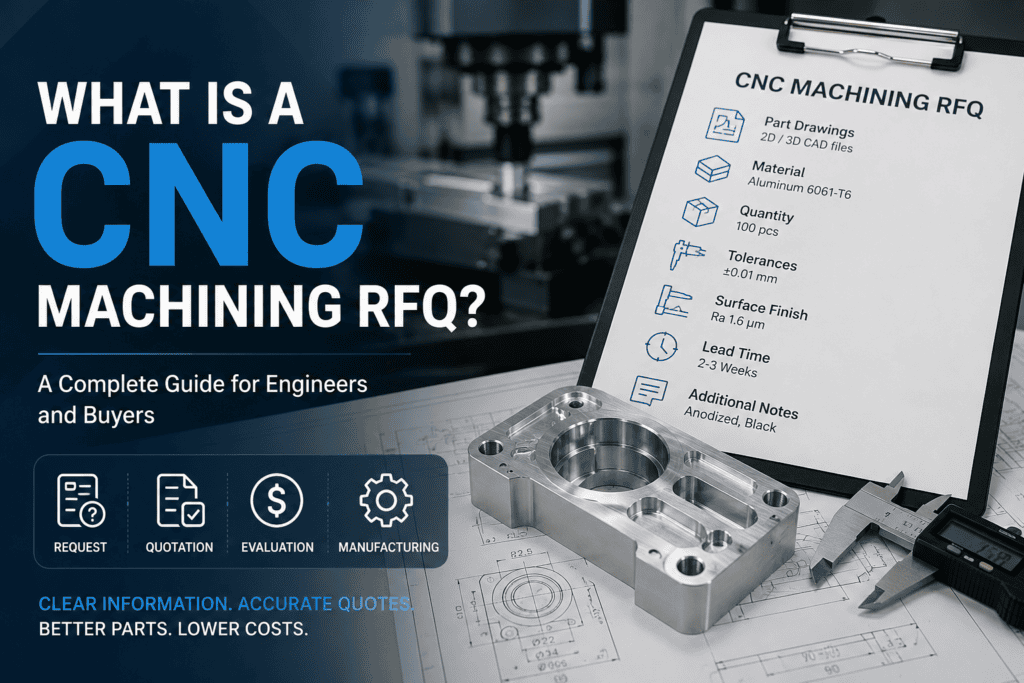
An RFQ, or request for quotation, is the formal technical package a buyer sends to a CNC machining parts provider asking for a price, lead time, and commercial terms on a specific part or assembly. It is not the same as a casual price check. A proper RFQ gives an estimator everything needed to quote without guessing, which is what separates a same-day quote from a week of email ping-pong.
Most buyers sourcing custom cnc machine parts from China send RFQs to multiple suppliers before selecting a manufacturing partner. A detailed RFQ helps CNC machine parts manufacturers compare your project accurately, recommend cost-saving improvements, and reduce production delays.
The Seven Things Every CNC Machining RFQ Should Include
1. A 3D CAD Model in a Universal Format
Send a STEP or IGES file rather than a native SolidWorks, Fusion, or Inventor file whenever possible. Native files can fail to open if the supplier runs a different software version, and that alone can cost a full day. The 3D model is the geometric source of truth: it tells the shop what tool paths, fixturing, and machine (3-axis, 4-axis, or 5-axis) the part actually needs.
2. A 2D Engineering Drawing with Tolerances and GD&T
The 2D drawing carries everything the 3D model cannot: dimensional tolerances, geometric dimensioning and tolerancing (GD&T) callouts, thread specifications, and general notes. Without it, a supplier defaults to a general tolerance standard for every dimension, which is rarely what a functional assembly actually needs. Call out tight tolerances only where a feature mates, seals, or moves, and leaves everything else at a general tolerance.
3. Exact Material Grade and Condition
“Aluminum” or “stainless steel” is not specific enough. State the full grade and temper or condition, for example 6061-T6 aluminum or 316L stainless steel. The grade affects machinability, strength, corrosion behavior, and cost, and a shop cannot price a job accurately without it. If material substitution is acceptable to save cost, say so explicitly in the RFQ.
4. Surface Finish and Secondary Processes
Specify the required surface roughness (Ra value) for functional surfaces and name any secondary operations up front: anodizing, powder coating, bead blasting, passivation, or plating. Anodizing in particular changes part dimensions slightly, so tight-tolerance mating features near an anodized surface need to be called out with that growth in mind.
5. Quantity and Order Pattern
State exact quantities, and note whether this is a one-time prototype run or the first of a recurring production order. Setup costs are fixed regardless of batch size, so the same part can look expensive at ten pieces and completely reasonable at five hundred. Telling the supplier your production intent lets them quote tooling and fixturing decisions correctly.
6. Required Certifications and Inspection Level
If your part needs ISO 9001 or ISO 13485 quality systems, First Article Inspection, a CMM report, or Material Test Reports, state this in the RFQ itself rather than after the quote is approved. Requesting inspection documentation late in the process is one of the most common causes of hidden fees and delayed shipments.
7. Lead Time and Delivery Terms
Give a realistic needed-by date rather than an unrealistically tight one. Vague or artificially rushed timelines force suppliers to add expediting fees or quote worst-case shop capacity. Also state your preferred shipping terms and, for international orders, who is responsible for customs and duties.
| Did You Know? – Research published by the National Institute of Standards and Technology on design-for-cost engineering shows that decisions made during the design phase, before a single part is ever machined, determine the large majority of a product’s total manufacturing cost. An incomplete RFQ effectively pushes decisions that should happen in design into the quoting stage instead, which is exactly where they get the most expensive to fix. |
Common RFQ Mistakes That Slow Down Your Quote
- Sending a native CAD file with no neutral STEP or IGES export.
- Leaving tolerances off the drawing and assuming the supplier will apply the right default.
- Copying a title block from an old project that carries an unrelated tight tolerance note.
- Requesting inspection reports or certifications only after the quote has already been approved.
- Giving a rush deadline without flagging it, then being surprised by an expedite fee.
- Omitting quantity tiers, which prevents the supplier from quoting volume discounts accurately.
How a Better RFQ Helps Reduce CNC Machining Costs
Many buyers focus only on obtaining the lowest quotation. In reality, submitting a more complete RFQ often reduces the final manufacturing cost.
Providing detailed technical information allows engineers to:
- Recommend alternative materials
- Suggest easier-to-machine features
- Reduce unnecessary tight tolerances
- Improve machining efficiency
- Minimize setup time
- Recommend better production quantities
These engineering recommendations can lower machining costs without affecting the performance or functionality of the finished part.
Prototype RFQ vs Production RFQ: What Changes
Prototype RFQs prioritize speed and design validation. You typically need one to five parts fast, the design may still be in flux, and tooling investment is not yet justified. Production RFQs shift the priorities toward unit cost, tooling amortization, and repeatability across a larger run. Sending the same RFQ format for both stages usually produces a worse outcome than tailoring the request to which stage you are actually in.
Prototype vs Production RFQ Comparison:
| Feature | Prototype RFQ | Production RFQ |
|---|---|---|
| Quantity | 1–20 | 100+ |
| Primary Goal | Validate Design | Reduce Unit Cost |
| Speed | Highest Priority | Moderate |
| Tooling | Minimal | Optimized |
| Cost Focus | Development | Production |
| Engineering Changes | Frequent | Rare |
| Inspection | Basic | Full Documentation |
How Ruiyi Industrial Manufacturer Reviews Your RFQ
Having reviewed thousands of incoming RFQs across telecommunications, medical device, robotics, and automotive projects, the pattern is consistent: the fastest, most accurate quotes always come from packages with all seven elements above. At Ruiyi, every RFQ is checked against our ISO 9001:2015 and ISO 13485 quality systems before quoting, and our team will flag manufacturability concerns, such as a tolerance that does not match the chosen material, rather than silently pricing around them. Combined with our Zero-Risk Assurance Policy, where no upfront payment is required and you only pay after inspecting the finished parts, a complete RFQ is the fastest way to get from drawing to production.
Frequently Asked Questions
What file format should I use for my CNC machining RFQ?
Send a STEP (.stp or .step) file for the 3D model whenever possible, since it opens reliably across CAD systems. Pair it with a PDF 2D drawing that shows tolerances, GD&T, and notes the 3D model cannot capture.
Do I need a 2D drawing if I already have a 3D model?
Yes. The 3D model defines geometry, but only the 2D drawing communicates tolerances, thread callouts, surface finish, and other manufacturing intent. A model alone forces the supplier to guess at requirements.
How much does an incomplete RFQ delay my quote?
Incomplete packages that need clarification typically add 3–5 business days compared with a complete RFQ, which a responsive shop can often quote within 24 to 48 hours.
Should I include a target price in my RFQ?
It can help. Stating a target price lets the supplier suggest design-for-manufacturability changes, such as loosening a non-critical tolerance, to help meet your budget without sacrificing function.
What is the difference between an RFQ and a quote?
An RFQ is the request you send describing what you need. A quote is the supplier’s response with price, lead time, and terms based on that request. The quality of the RFQ directly determines the accuracy of the quote.
Can I send an RFQ before my design is finalized?
Yes, for prototype-stage RFQs this is common. Flag clearly that the design may change and specify a shorter validity period on any early pricing, since quantities and tolerances at production stage will likely differ.
Does Ruiyi require payment before production starts?
No. Under our Zero-Risk Assurance Policy, no upfront payment is required. We arrange production and shipping, and payment is due only after you receive and inspect the parts.

Solomon Yang is a manufacturing industry professional with extensive experience in electronic, mechanical, and industrial component manufacturing. Having held various positions in American and Taiwanese manufacturing companies, he has developed a comprehensive understanding of manufacturing processes, production management, quality control, and global supply chain operations.
With expertise in business development, sales operations, international trade, customer relationship management, and engineering project support, Solomon bridges technical knowledge with commercial strategy to deliver innovative and cost-effective manufacturing solutions. He is passionate about advanced manufacturing technologies, process improvement, and continuous professional growth, with a strong commitment to creating value for customers and partners worldwide.