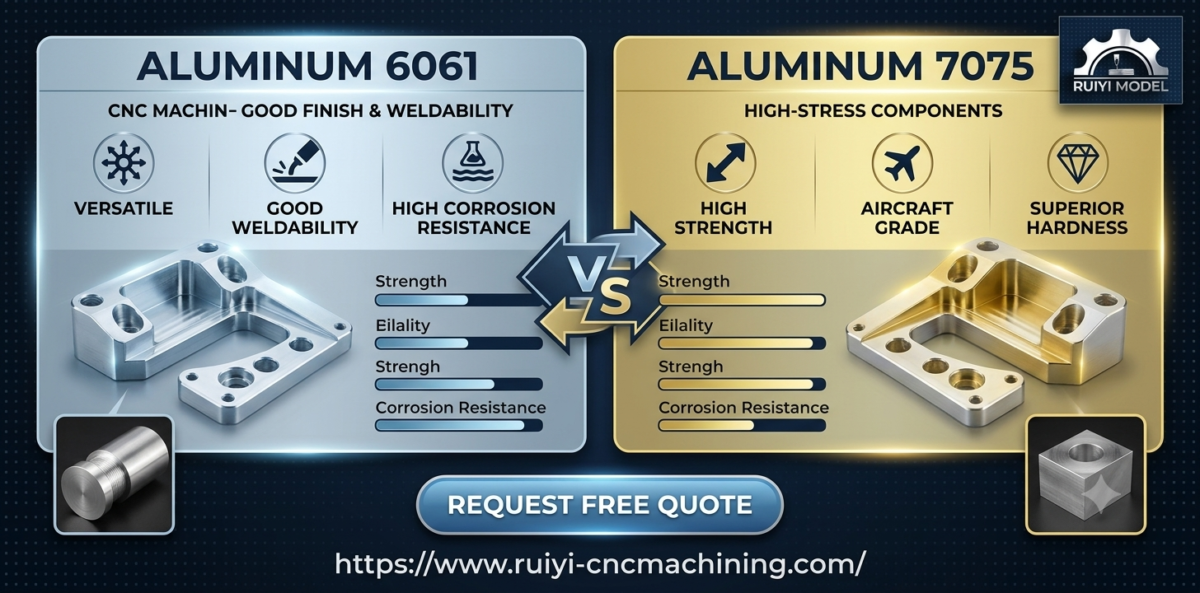
| QUICK ANSWER Aluminum 6061 offers excellent machinability, corrosion resistance, and lower cost, making it the go-to choice for most structural and general-purpose CNC parts. Aluminum 7075 provides significantly higher tensile strength (up to 572 MPa vs 310 MPa for 6061) and is the preferred alloy for aerospace, defense, and high-performance mechanical applications where the strength-to-weight ratio is critical. |
Aluminum is the most commonly machined non-ferrous metal in the world. And within the aluminum family, 6061 and 7075 are the two alloys that come up in virtually every conversation between engineers, product designers, and CNC manufacturers.
They look identical. They work similarly. But they are not the same material, and choosing the wrong one for your application can mean overbuilt parts that cost too much, or underbuilt parts that fail under load. Neither outcome is acceptable.
This guide gives you the engineering data and decision logic to pick the first time correctly.
Alloy Overview: What Makes Them Different
Both 6061 and 7075 are heat-treatable aluminum alloys, but their alloying elements and resulting properties differ substantially.
Aluminum 6061 is a magnesium-silicon alloy. The major alloying elements are magnesium (0.8 to 1.2%) and silicon (0.4 to 0.8%), with smaller additions of copper and chromium. This composition delivers a balanced profile: good strength, excellent corrosion resistance, strong machinability, and good weldability. It is the general-purpose workhorse of the aluminum family.
Aluminum 7075 is a zinc-magnesium-copper alloy. The dominant alloying element is zinc (5.1 to 6.1%), supplemented by magnesium (2.1 to 2.9%) and copper (1.2 to 2.0%). This combination produces one of the highest-strength aluminum alloys available, rivaling some steel grades in tensile strength while remaining substantially lighter.
For a broader view of how aluminum compares with steel in CNC applications, see our post: Alloy Steel vs Stainless Steel: A Comprehensive Comparative Guide for Engineers.
Mechanical Properties Compared
| Property | 6061-T6 | 7075-T6 |
| Ultimate Tensile Strength | 310 MPa (45 ksi) | 572 MPa (83 ksi) |
| Yield Strength (0.2% offset) | 276 MPa (40 ksi) | 503 MPa (73 ksi) |
| Elongation at Break | 12% | 11% |
| Hardness (Brinell) | 95 HB | 150 HB |
| Density | 2.70 g/cm³ | 2.81 g/cm³ |
| Thermal Conductivity | 167 W/m·K | 130 W/m·K |
| Fatigue Strength | 97 MPa | 159 MPa |
| Modulus of Elasticity | 68.9 GPa | 71.7 GPa |
The headline number is clear: 7075-T6 is roughly 85% stronger in tension than 6061-T6. But that single number hides nuance. The density difference between the two alloys is only about 4%, so both deliver excellent strength-to-weight ratios. The choice is about how much absolute strength your application requires.
Machinability: Which Is Easier to Machine?
Both alloys machine well by any industrial standard, but there are real differences that affect cycle time and tooling life.
6061 is the easier material to machine. The lower hardness (95 HB vs 150 HB) means lower cutting forces, longer tool life, and the ability to run higher feed rates without chatter. Surface finishes are predictable and consistent. For high-volume runs, 6061 will almost always deliver lower cycle time per part.
7075 machines well but demands more from tooling. The higher zinc and copper content increases cutting forces. Carbide tooling is strongly recommended over HSS. Speeds and feeds need to be dialed in more carefully to avoid work hardening at the cut surface. That said, 7075 still machines significantly better than any stainless steel or titanium alloy.
| Machining Factor | 6061 | 7075 |
| Relative Machinability Rating | Excellent (B rating) | Good (C rating) |
| Recommended Tooling | HSS or Carbide | Carbide preferred |
| Chip Formation | Long, easy to manage | Shorter, more fragmented |
| Surface Finish Quality | Excellent | Very good |
| Cycle Time (relative) | Faster | 5 to 15% slower |
| Coolant Requirement | Recommended | Required for fine features |
For a complete look at our CNC milling capabilities across materials, visit our CNC Milling Services.
Corrosion Resistance
This is where 6061 holds a clear advantage. The magnesium-silicon composition of 6061 forms a stable, tenacious oxide layer that resists most atmospheric and chemical environments well. It performs reliably in marine environments, humid conditions, and mild chemical exposure without additional surface treatment.
7075, with its high copper and zinc content, is significantly more susceptible to galvanic corrosion and stress corrosion cracking (SCC), particularly in the T6 temper in high-humidity or salt environments. This is not a disqualifying flaw; it is a design constraint to manage. Anodizing, Alodine (chromate conversion coating), or protective paints are standard solutions for 7075 components used in corrosive environments.
| PRO TIPFor aerospace applications using 7075 in structural components exposed to the environment, specify T73 temper instead of T6. The T73 overaged temper sacrifices approximately 10 to 15% of tensile strength but dramatically improves stress corrosion cracking resistance. |
Anodizing is a key surface protection process for both alloys. Learn more in our blog post: CNC Milling Prototype Surface Treatment Selection: Sandblasting.
Weldability and Formability
6061 welds cleanly using MIG or TIG processes with 4043 or 5356 filler wire, losing approximately 30% of its T6 strength in the heat-affected zone. This is predictable and manageable for structural design.
7075 is generally considered unweldable by conventional arc welding processes. The high zinc and copper content leads to hot cracking in the weld zone. Friction stir welding (FSW) can be used for 7075, but it requires specialized equipment and is not widely available as a general fabrication process. If your part requires welding, 6061 is almost always the correct choice.
Cost Comparison
Raw material cost for 7075 is typically 30 to 50% higher than 6061 in equivalent bar or plate form. The cost premium compounds slightly in machining due to longer cycle times and faster tooling wear.
| Cost Factor | 6061 | 7075 |
| Raw Material (relative) | Baseline | 30 to 50% higher |
| Machining Cost (relative) | Baseline | 5 to 15% higher |
| Surface Treatment Needs | Optional | Often required (corrosion) |
| Overall Part Cost (relative) | Baseline | 35 to 65% higher |
The 7075 premium is justified when strength requirements genuinely demand it. Specifying 7075 for a bracket that would perform adequately in 6061 simply wastes budget. Always let load analysis drive material selection, not habit or perceived prestige.
Understanding how material choice affects total part cost is explained further in our article: How to Calculate CNC Milling Costs.
Which Industries Use Each Alloy?
Aluminum 6061 Common Applications
- Structural frames and chassis components
- Pneumatic and hydraulic manifolds
- Heat sinks and thermal management parts
- Consumer electronics enclosures
- Marine hardware and fittings
- Bicycle frames and sports equipment
- General industrial fixtures and tooling
- Automotive brackets and mounts
Aluminum 7075 Common Applications
- Aircraft structural members, ribs, spars, and bulkheads
- Defense and military equipment
- High-performance bicycle and cycling components
- Rock climbing equipment (carabiners, cams)
- High-load robotic arm components
- Performance automotive parts (connecting rods, suspension)
- Firearm components (receivers, bolt carriers)
- High-stress orthopedic surgical instruments
For precision machining of titanium and other high-performance materials, see: How to Efficiently Process Titanium Alloy Integral Impellers.
Decision Guide: How to Choose
| Your Situation | Choose |
| Budget is a primary constraint | 6061 |
| Part will be welded | 6061 |
| Exposed to marine or humid environment | 6061 (or 7075 with coating) |
| High fatigue or cyclic loading | 7075 |
| Weight minimization is critical | 7075 |
| Aerospace or defense application | 7075 (or per spec) |
| High-volume production run | 6061 (lower cycle time) |
| Static structural, moderate loads | 6061 |
| Yield strength > 350 MPa required | 7075 |
| EXPERT INSIGHT“The single most common over-specification we see is engineers defaulting to 7075 because they associate it with aerospace quality, even for parts that load analysis shows would be fine in 6061. The result is a 40 to 60% material premium with no functional benefit. Good material selection starts with load analysis, not with brand recognition. Run the numbers, define your safety factor, and let that determine your alloy. If 6061 passes your analysis with margin, use 6061.”— RuiYi Industrial Manufacture Team |
| Key Takeaways7075-T6 is approximately 85% stronger in tension than 6061-T6, but costs 35 to 65% more per finished part.6061 is superior in corrosion resistance, weldability, and machinability.7075 machines well but requires carbide tooling and tighter process control.7075 should not be welded with conventional arc processes; specify 6061 for weldments.For corrosive environments, anodize or coat 7075 parts; 6061 performs better without treatment.Let load analysis drive material selection, not assumption or habit.The T73 temper of 7075 trades some strength for dramatically better stress corrosion cracking resistance. |
Conclusion
Selecting between Aluminum 6061 and 7075 comes down to a disciplined trade-off analysis: strength vs cost, machinability vs performance, and corrosion resistance vs structural demand. For the vast majority of general-purpose machined parts, 6061-T6 is the right answer. Reserve 7075 for applications where load analysis genuinely requires its superior strength. When you are ready to request parts, RuiYi Industrial Manufacture works with both alloys across milling, turning, and five-axis operations, and our engineering team provides material selection guidance as part of every DFM review.
Frequently Asked Questions
Is 7075 aluminum stronger than steel?
7075-T6 has a tensile strength of approximately 572 MPa, which exceeds mild steel (around 400 MPa) and approaches some low-alloy structural steels. However, high-strength alloy steels and tool steels are significantly stronger. Where 7075 truly excels is strength-to-weight ratio: it delivers that 572 MPa at a density of just 2.81 g/cm³, roughly one-third the density of steel.
Can I anodize both 6061 and 7075?
Yes, both alloys anodize well. 6061 produces a consistent, clear anodize layer and accepts dye colors reliably. 7075 also anodizes successfully, and anodizing is particularly important for 7075 to improve its corrosion resistance. Note that the high copper content in 7075 can produce a slightly darker natural anodize color compared to 6061.
What does T6 mean for aluminum alloys?
T6 is a temper designation indicating the alloy has been solution heat-treated and then artificially aged. This process maximizes the precipitation hardening effect, producing peak strength. Both 6061-T6 and 7075-T6 are the most commonly machined tempers of their respective alloys. T651 is a variation that has also been stress-relieved by stretching, which improves dimensional stability during machining.
Which aluminum is better for bicycle frames, 6061 or 7075?
Both are used successfully in bicycle manufacturing. Most aluminum frame tubing is 6061 because it welds well and performs excellently for the loads involved. 7075 is used in high-performance components where machining from solid is feasible, such as stems, handlebars, crankarms, and suspension pivot housings, where its higher strength allows thinner, lighter cross-sections.
What is the difference between 7075-T6 and 7075-T73?
T73 is an overaged temper that sacrifices approximately 10 to 15% of T6 tensile strength in exchange for dramatically improved resistance to stress corrosion cracking (SCC). T73 is specified for aerospace structural components in environments where SCC is a service life risk. If your application involves sustained tensile stress in humid or salt environments, T73 or T7351 tempers should be evaluated seriously.
How do I specify aluminum alloy on a CNC drawing?
Use the full designation on the drawing title block or material call-out: for example, “Aluminum Alloy 6061-T651 per ASTM B209” for plate material, or “6061-T6511 per ASTM B221” for extruded bar. Include the ASTM or AMS specification number, particularly for aerospace and defense parts where material traceability is required. Your CNC supplier should provide a material certification (cert) with each order confirming the specification has been met.