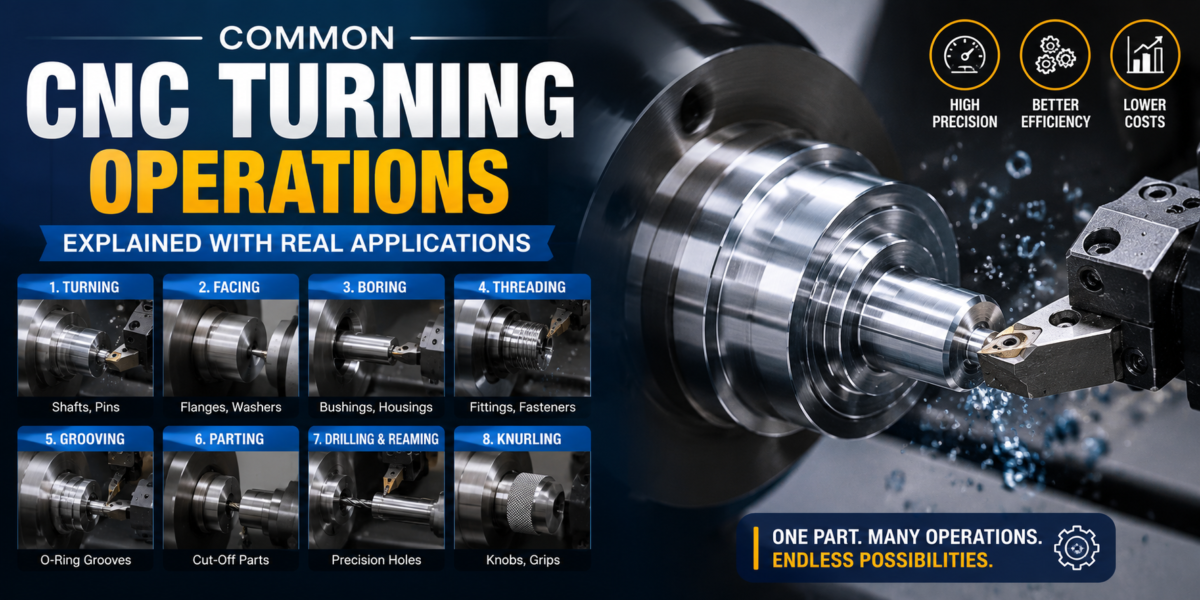
CNC turning operations use a rotating workpiece held in a chuck while a stationary cutting tool removes material to create cylindrical shapes. The most common operations are turning, which reduces outer diameter, facing, boring, threading, grooving, parting, drilling and reaming, and knurling. Most turned parts, like shafts, bushings, and fittings, combine several of these operations in a single CNC turning setup.
Walk through nearly any machine shop and you will find a CNC lathe running, turning a spinning bar of metal into a shaft, bushing, or fitting in a matter of minutes. CNC turning is one of the oldest and most efficient machining processes, and it remains the fastest way to produce round, cylindrical parts in volumes ranging from a single prototype to tens of thousands of units.
But CNC turning is not one single operation. It is a family of related cutting operations, turning, facing, boring, threading, grooving, and more, each suited to a different feature on the part. Understanding what each operation actually does, and where it shows up on a real part, makes it easier to design parts of that machine efficiently and to have an informed conversation with a CNC turning provider about your project.
Key Takeaways
- CNC turning removes material from a rotating workpiece using a stationary tool, the opposite of milling, where the tool rotates and the part stays still.
- Turning and facing are the two most common operations, used on nearly every turned part.
- Threading, grooving, and boring add function, mating threads, seal seats, and internal bores, to an already-turned part.
- Combining operations in a single chucking reduces setup time and improves concentricity between features.
- Choosing the right operation for each feature, rather than defaulting to the most familiar one, keeps cycle time and cost down.
Why Understanding CNC Turning Operations Matters
Understanding CNC turning operations is about more than learning machining terminology. Each operation affects cycle time, tooling requirements, dimensional accuracy, and ultimately the total cost of manufacturing a part. Choosing the right operation at the design stage can reduce unnecessary machining steps, improve production efficiency, and simplify inspection once the part reaches the shop floor.
For engineers and procurement teams sourcing components from CNC machining services in China, knowing how turning, boring, grooving, and threading are applied also makes it easier to evaluate supplier recommendations and compare quotations accurately. Experienced CNC machine parts manufacturers often suggest small design adjustments that eliminate unnecessary machining complexity while maintaining the part’s intended function.
Whether you’re producing a single prototype or planning high-volume production, understanding these operations helps you communicate more effectively with your machining partner and make informed decisions before production begins.
CNC Turning Operations at a Glance
| Operation | Purpose | Typical Applications |
| Turning | Reduce outer diameter | Shafts, pins |
| Facing | Create flat surfaces | Flanges, washers |
| Boring | Machine internal diameters | Bushings, bearing housings |
| Threading | Create internal or external threads | Fittings, fasteners |
| Grooving | Machine seal grooves | Hydraulic cylinders |
| Parting | Separate finished part | All bar-fed parts |
| Drilling & Reaming | Produce accurate holes | Pump bodies, connectors |
| Knurling | Improve grip | Knobs, tool handles |
| Did You Know? – According to Grand View Research, the global market for CNC machining and turning centers was valued at nearly 26 billion US dollars in 2023 and is projected to keep growing at roughly 6.6 percent a year, driven largely by demand from the aerospace, medical, and automotive industries for precise, round components. |
8 Common CNC Turning Operations and Where They’re Used
1. Turning (Straight and Taper Turning)
Turning is the core lathe operation. The cutting tool moves parallel to the spindle axis, reducing the workpiece’s outer diameter to a target size. Straight turning produces a constant diameter, while taper turning produces a gradually changing diameter. Real application: motor shafts, pins, and stepped shafts with multiple diameters along their length.
2. Facing
Facing moves the tool perpendicular to the spindle axis across the end of the workpiece, creating a flat surface and setting the part’s overall length. Nearly every turned part starts or ends with a facing pass. Real application: flanges, washers, and any part that needs a flat, square end for assembly.
3. Boring
Boring enlarges an existing hole, whether drilled or cast, to a precise internal diameter, and can also create internal tapers or grooves. Real application: bushings, hydraulic cylinder bores, and bearing housings that need tight internal tolerances.
4. Threading
Threading cuts a helical groove of a specified pitch on the outside or inside of a part, using a single-point tool synchronized to the spindle rotation. RuiYi’s blind hole thread turning process guide covers the added considerations for threading holes that do not go all the way through. Real application: fasteners, threaded fittings, and threaded shafts.
5. Grooving
Grooving cuts a narrow recessed feature into the outer, inner, or face surface of a part, usually to seat an O-ring, retaining ring, or relief for a mating thread. Real application: hydraulic seal grooves and retaining ring channels.
6. Parting (Cut-Off)
Parting separates the finished part from the remaining bar stock using a narrow, rigid tool fed straight into the rotating workpiece. It is typically the final operation in the sequence. Real application: any part machined from bar stock, from small fasteners to finished shafts.
7. Drilling, Reaming, and Tapping
With the tool held stationary in the tailstock or a lathe turret, drilling creates a hole along the part’s centerline, reaming sizes that hole to a precise diameter, and tapping cuts internal threads. Real application: pump housings, connector bodies, and any part with a centered fastener hole. Accurate tool setting matters here, since even a small offset throws off concentricity between the hole and the outer diameter.
8. Knurling
Knurling presses a textured diamond or straight pattern into the surface of a part using a forming tool rather than a cutting tool, increasing grip or providing a light press fit. Real application: hand tool handles, knobs, and grip sections on manual adjustment components.
| Pro TipGrouping, turning, facing, boring, and threading into a single chucking, rather than machining a feature, removing the part, and re-clamping it later, keeps concentricity tight between features and cuts cycle time. If your part needs several of these operations, ask your CNC turning services provider whether it can be completed in one setup. |
Expert Insight
Working through customer prints day to day, RuiYi’s turning team sees the biggest efficiency gains not from faster machines, but from sequencing operations well: roughing all diameters first, then finishing, then threading and grooving last, so a delicate feature is not damaged by the clamping forces of an earlier operation. On a titanium part with a large diameter, for example, Our large-diameter titanium turning case study shows how operation sequencing affects distortion control. Getting the sequence right on the shop floor is usually a bigger lever on cost and lead time than the raw cutting speed of the machine itself.
CNC Turning Design Tips to Reduce Manufacturing Costs
Many expensive machining problems originate in the design stage rather than on the shop floor. Designing with manufacturability in mind allows machining operations to be completed more efficiently without sacrificing part performance.
Consider these practical guidelines before releasing a drawing for quotation:
- Apply tight tolerances only to features that directly affect fit or function.
- Use standard thread sizes whenever possible to avoid special tooling.
- Match internal corner radii to standard cutting tool sizes.
- Avoid unnecessarily deep pockets or narrow grooves that require long-reach tooling.
- Maintain adequate wall thickness to reduce vibration during machining.
- Design features that can be completed in a single machining setup whenever practical.
- Specify surface finish requirements only where they are functionally necessary.
- Review the design with an experienced CNC machine parts manufacturer before production begins.
Even small design changes can significantly reduce machining time, tooling costs, and inspection requirements while improving overall manufacturability.
Industries That Depend on CNC Turning
Because CNC turning produces highly accurate cylindrical components with excellent repeatability, it is widely used across industries where precision and reliability are critical. Common applications include:
- Automotive – drive shafts, bushings, transmission components, wheel hubs.
- Aerospace – landing gear components, spacers, precision shafts, engine hardware.
- Medical Devices – surgical instruments, orthopedic implants, diagnostic equipment components.
- Robotics & Automation – actuator shafts, bearing housings, couplings, precision rollers.
- Hydraulic & Pneumatic Systems – valve bodies, piston rods, hydraulic fittings, cylinders.
- Industrial Equipment – bearings, sleeves, spacers, threaded connectors, machine components.
- Electronics – precision connectors, sensor housings, heat sink components.
- Energy & Oil & Gas – high-pressure fittings, valve stems, drilling equipment components.
Working with an experienced CNC machining services provider in China ensures that material selection, machining strategy, and quality inspection are tailored to the specific performance requirements of each industry.
Real Engineering Example
A customer required a stainless steel hydraulic shaft featuring multiple outside diameters, an internal precision bore, external threads, and several seal grooves. Although the drawing could have been machined through multiple setups, our engineering team optimized the process by combining facing, turning, boring, threading, and grooving into a single chucking.
Completing these operations in one setup improved concentricity between critical features, reduced handling time, and minimized cumulative positioning errors. The revised machining strategy also shortened overall cycle time and lowered inspection requirements, allowing the customer to achieve both tighter quality control and lower manufacturing costs without changing the original part design.
This type of process optimization is one reason experienced CNC turning services can often identify cost-saving opportunities before production begins.
Common Mistakes to Avoid
A few turning-specific mistakes are worth watching for: skipping tailstock support on long, slender parts, which lets the workpiece flex and chatter, specifying a thread relief that is too shallow for the tool’s runout, and choosing a tool nose radius that does not match a part’s fillet callouts, which leaves a visible mismatch at every internal corner.
Frequently Asked Questions
What is the difference between CNC turning and CNC milling?
In turning, the workpiece rotates and the cutting tool stays largely stationary, which is ideal for round, cylindrical parts. In milling, the tool rotates and the workpiece stays fixed, which suits flat, prismatic, or complex 3D shapes. Many shops, including RuiYi, offer both CNC turning and CNC milling so a project can use whichever process fits each feature.
What materials can be CNC turned?
Most machinable metals and plastics can be turned, including aluminum, stainless steel, brass, titanium, and engineering plastics like PEEK and POM. Material choice affects cutting speed, tool wear, and achievable surface finish more than it limits which operations are possible.
How tight can tolerances be on a CNC turned part?
Standard CNC turning routinely holds tolerances around plus or minus 0.02 to 0.05 millimeters, with tighter tolerances achievable on critical features using slower finishing passes or grinding as a secondary operation.
What is a live tooling or mill-turn lathe?
A live tooling lathe adds rotating tools, drills and mills, that can machine features off the part’s centerline while it is still chucked, combining turning and milling operations in a single setup and reducing the need for a separate milling operation afterward.
Can CNC turning produce non-round features?
Yes. With live tooling or a secondary milling operation, a turned part can include flats, slots, and off-axis holes, though purely round features are still faster and cheaper to produce with standard turning operations alone.
When should I choose CNC turning over 3D printing for a prototype?
CNC turning is usually the better choice when the prototype needs to be made from the actual production material and needs realistic tolerances, surface finish, and mechanical properties. Rapid prototyping services can help decide which process fits a given part and timeline.
Whether a part needs a simple straight turn or a full sequence of facing, boring, threading, and grooving, understanding what each CNC turning operation actually does makes it easier to design parts that machine efficiently and cost less to produce. RuiYi’s CNC turning services team can review your drawing and recommend the right operation sequence for your part, and the CNC machining cost calculator gives a fast estimate to help you plan your project.
Conclusion
Although CNC turning is often viewed as a single machining process, most precision parts combine several turning operations such as facing, boring, threading, grooving, drilling, and parting.
Understanding how each operation works helps engineers design parts that are easier to manufacture, reduces unnecessary machining costs, and improves overall production efficiency.
If you’re looking for reliable CNC turning services in China, Ruiyi’s engineering team can review your CAD files, recommend Design for Manufacturability (DFM) improvements, and provide accurate quotations for prototype and production machining projects.

Solomon Yang is a manufacturing industry professional with extensive experience in electronic, mechanical, and industrial component manufacturing. Having held various positions in American and Taiwanese manufacturing companies, he has developed a comprehensive understanding of manufacturing processes, production management, quality control, and global supply chain operations.
With expertise in business development, sales operations, international trade, customer relationship management, and engineering project support, Solomon bridges technical knowledge with commercial strategy to deliver innovative and cost-effective manufacturing solutions. He is passionate about advanced manufacturing technologies, process improvement, and continuous professional growth, with a strong commitment to creating value for customers and partners worldwide.