Getting an accurate CNC machining quote can feel like guesswork. One supplier says $200 per part, another quotes $800 for what looks like the same drawing. The difference is real, and it is explainable. Understanding the factors behind CNC machining costs will help you design better parts, negotiate smarter, and avoid expensive surprises when the invoice arrives.
This guide breaks down every major pricing factor, shares realistic 2026 cost benchmarks, and gives you practical ways to reduce your spend without sacrificing quality. Whether you are a product designer ordering your first prototype or a procurement manager evaluating supplier quotes, these numbers and explanations will give you the clarity you need.
| Did You Know?According to Fortune Business Insights, the global CNC machine market is projected to grow from USD 108.58 billion in 2026 to USD 251.61 billion by 2034, registering a compound annual growth rate of 11.10%. China alone is estimated to account for USD 35.04 billion of CNC machine consumption in 2026, making it the world’s largest single national market for this technology. For manufacturers sourcing from China, this scale translates directly into competitive pricing, dense tooling ecosystems, and faster lead times compared with Western suppliers. |
What Is CNC Machining Cost Made Up Of?
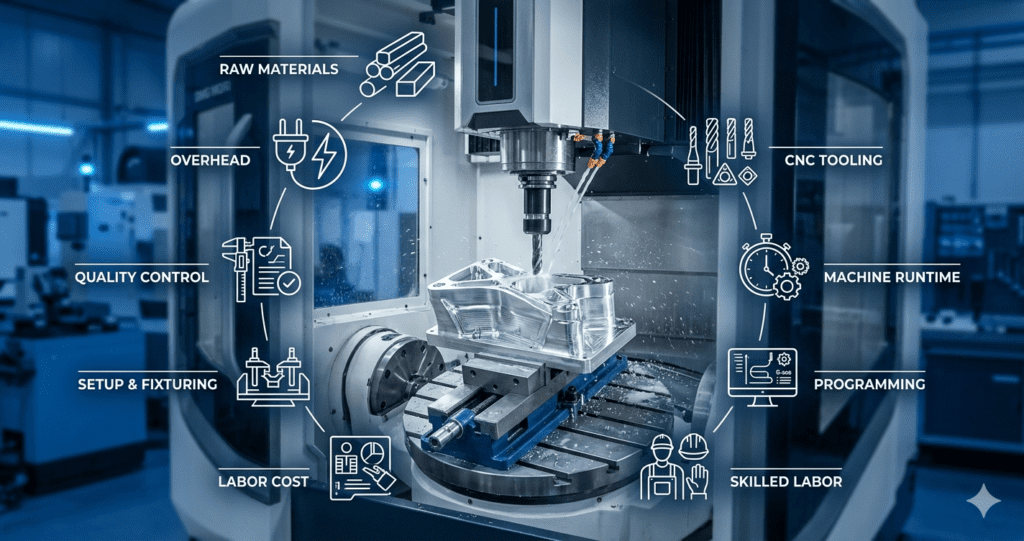
CNC machining cost is not a single number. It is the sum of several distinct cost elements, each controlled by different variables. The six main components are:
- Material cost (raw stock, alloy grade, billet size)
- Machine time (hourly rate multiplied by cutting and non-cutting cycle time)
- Setup and programming cost (CAM programming, fixturing, tool offset entry)
- Tooling cost (cutting tools, inserts, wear rates driven by material hardness)
- Post-processing and finishing cost (deburring, anodising, plating, inspection)
- Overhead and margin (facility rent, quality systems, logistics, supplier profit)
According to industry data, material cost typically accounts for 30 to 50% of total project cost, machine time for 25 to 35%, and setup plus programming for 10 to 20% on low-volume orders. These proportions shift significantly with volume, as described later in this guide.
2026 CNC Machining Hourly Rate Benchmarks
Machine hourly rates are the most-cited figure in CNC pricing discussions, though they tell only part of the story. The table below reflects current 2026 market data for the most common machine types and regions.
| Machine Type | China (per hour) | USA / Europe (per hour) | Typical Applications |
|---|---|---|---|
| 3-axis CNC milling | $35 to $50 | $80 to $120 | Brackets, housings, flat plates |
| 3-axis CNC turning | $30 to $45 | $60 to $100 | Shafts, bushings, connectors |
| 4-axis CNC milling | $45 to $70 | $100 to $160 | Angled features, complex slots |
| 5-axis CNC milling | $60 to $120 | $150 to $300 | Impellers, turbine blades, medical implants |
| CNC turning + milling | $55 to $90 | $120 to $220 | Complex rotational parts |
| Swiss-type CNC turning | $70 to $110 | $150 to $280 | Micro parts, watch components, medical screws |
Source: Aggregated from Lewei Precision, HLW CNC, and industry pricing benchmarks (2026). Rates include equipment depreciation, facility overhead, operator labor, and consumables. They do not include material or post-processing.
A frequently overlooked point: a higher hourly rate does not always mean a higher total cost. A 5-axis machine that completes a part in two setups will often cost less than a 3-axis machine that requires five setups for the same geometry. The number that matters is total landed cost per part, not the shop rate printed on the quotation.
The 8 Key Factors That Determine Your Final Cost
1. Material Selection
Material is the most controllable cost driver you have at the design stage. Aluminum 6061 is one of the most cost-effective engineering metals, currently priced at roughly $4 to $7 per kilogram, and it machines quickly with low tool wear. Stainless steel 304 typically costs $6 to $10 per kilogram but increases cycle times significantly. Titanium Ti-6Al-4V can exceed $80 per kilogram and demands slow feeds, specialist tooling, and active coolant, making each hour of machining far more expensive on a per-part basis.
For guidance on material performance trade-offs, our alloy steel vs stainless steel comparison guide covers the engineering properties and machinability of the most common structural materials. If you are working with titanium components, our detailed resource on efficiently processing titanium alloy integral impellers explains how to minimise waste and machine time for this high-value material.
2. Part Complexity and Geometry
Parts with flat faces, large radii, and standard hole diameters are fast to machine and easy to program. Parts with deep cavities, narrow slots, undercuts, internal contours, and non-standard thread forms require more programming time, more setups, and specialist tooling. A part requiring five unique tool paths costs roughly three to four times more to program than a part requiring two.
Thin-walled geometries add a significant cost premium because they require slower feeds, vibration-damping fixtures, and multiple finishing passes to hold tolerances.
3. Tolerances and Surface Finish Requirements
Standard commercial tolerances (typically plus or minus 0.1 mm) cost nothing beyond normal programming. Tighter tolerances such as plus or minus 0.01 mm require slower feeds, additional inspection passes, temperature-controlled environments, and sometimes grinding operations in addition to milling or turning. Industry data indicates that specifying a tolerance of plus or minus 0.001 inch (approximately 0.025 mm) can increase part cost by 30 to 50% compared with a standard commercial tolerance.
Surface roughness requirements work similarly. A standard machined surface (Ra 3.2 micrometres) is included in a normal machining cycle. A mirror-polished surface or a hard-anodised finish requiring Ra 0.4 micrometres adds significant post-processing time and cost.
4. Production Volume and Batch Size
Setup costs are fixed. Whether you make one part or one hundred from a single setup, you pay the same programming fee, the same fixture cost, and the same time to load your first tool offset. This is why per-part cost drops dramatically with volume.
A useful rule: for quantities under ten parts, setup often costs more than machining time. At 100 parts, setup cost per part typically drops to under 5% of total cost. At 1,000 parts, it becomes negligible. If you are ordering small batches regularly, talk to your supplier about holding a live program and a dedicated fixture, which eliminates setup fees on repeat orders.
5. Number of Setups Required
Every time an operator re-clamps or repositions your part, the clock is running on the machine. A part that requires three separate setups on a 3-axis machine might be completed in one unattended operation on a 5-axis machine, saving two full setup cycles. For a complex part, this can reduce total cost by 20 to 40% even though the 5-axis hourly rate is higher.
Fixture design is closely tied to setup count. A well-designed modular fixture that grips your part from one face can eliminate secondary setups entirely.
6. Programming and CAM Time
Simple prismatic parts (blocks with through-holes and flat pockets) take 30 to 90 minutes to program in CAM software. Complex sculptured surfaces, helical features, or intricate internal geometries can require 8 to 20 hours of programming. At a typical engineering rate of $50 to $120 per hour, this difference translates directly into quote variability.
Providing complete 3D STEP or IGES files eliminates interpretation errors and reduces programming time compared with 2D DXF drawings alone. Clearly calling out critical dimensions and tolerances on a clean drawing reduces back-and-forth communication, which suppliers often bill as engineering time. The CNC machining design guidelines offer a practical checklist for preparing files that speed up the quoting and programming process.
7. Post-Processing and Surface Treatment
Raw machined parts delivered without finishing are the cheapest option. However, most production parts require at least some post-processing. Common operations and their approximate cost impact:
- Deburring and edge break: Low cost, 5 to 15 minutes of manual time per part
- Anodising (Type II): Adds $3 to $15 per part depending on surface area
- Hard anodising (Type III): Adds $8 to $30 per part, more for complex geometries
- Electroless nickel plating: Adds $10 to $40 per part, dependent on substrate
- Powder coating: Adds $15 to $50 per part including masking
- CMM inspection report: Adds $50 to $200 per batch for a formal dimensional report
8. Supplier Location and Labour Rates
Geography remains one of the most significant cost variables in CNC machining. Chinese suppliers currently charge $35 to $50 per hour for 3-axis work compared with $80 to $150 per hour in the United States and Western Europe for equivalent quality. This 40 to 60% cost advantage for comparable ISO 9001-certified output is the primary reason global buyers source precision components from Chinese manufacturers.
Shenzhen, Dongguan, Suzhou, and Ningbo are China’s main precision machining hubs, combining dense supplier ecosystems, strong technical training, and export logistics infrastructure.
CNC Machining Cost by Process Type
| Process | Typical Per-Part Range (Prototype) | Typical Per-Part Range (100+ units) | Best For |
|---|---|---|---|
| CNC milling | $50 to $500+ | $10 to $100+ | Flat and prismatic parts, housings |
| CNC turning | $20 to $200+ | $5 to $50+ | Shafts, pins, connectors |
| CNC turning + milling | $80 to $800+ | $20 to $150+ | Complex rotational geometry |
| 5-axis milling | $200 to $2,000+ | $50 to $400+ | Impellers, complex organic shapes |
| Wire EDM | $100 to $1,000+ | $30 to $200+ | Tool steel, hardened parts, tight tolerances |
Ranges are highly dependent on material, tolerance, and part size. These figures are intended as budgeting anchors, not firm quotes.
7 Proven Ways to Reduce Your CNC Machining Costs
- Design for standard tooling. Specify internal corner radii that match standard end mill sizes (4 mm, 6 mm, 8 mm, 10 mm, 12 mm). Non-standard radii force custom tooling or multiple passes.
- Avoid unnecessarily tight tolerances. Every tolerance tighter than plus or minus 0.05 mm costs money. Review your drawings and ask: does this dimension actually need to be this tight for the part to function?
- Group hole sizes. Using three different hole diameters requires three tool changes. Standardising on one or two sizes reduces cycle time with no functional impact in most designs.
- Minimise deep cavities. Depth-to-width ratios above 4:1 require slow feeds, long reach tooling, and multiple passes. Shallow pockets are dramatically faster to machine.
- Order in volume. Even moving from 5 to 25 parts can reduce per-part cost by 30 to 50% by spreading setup cost across more units.
- Apply DFM review before tooling. A DFM (Design for Manufacturability) review by your supplier before CAM programming catches costly features early.
- Provide STEP files with a clean 2D drawing. Suppliers who have to interpret ambiguous 2D drawings will add interpretation time and safety margin to their quotes. A complete 3D model eliminates this uncertainty.
Did You Know?
| Did You Know?A 2026 industry dataset analysing 60 live RFQs submitted to Chinese CNC suppliers found that prototype orders (1 to 5 units) attracted an average of 18.7 quotes per inquiry, which is the highest competitive intensity of any order tier. This means Chinese CNC suppliers compete most aggressively for single-unit prototype work, often keeping prototype pricing lower than buyers expect. The same dataset found that 43.3% of all China CNC machining demand in 2026 is for prototype quantities, confirming that low-volume sourcing from China is not only feasible but actively encouraged by suppliers. |
Frequently Asked Questions
Q1. How much does a simple CNC machined part cost in China in 2026?
A simple aluminum part such as a bracket or spacer with standard tolerances ordered as a prototype typically costs $30 to $150 per part from a Chinese CNC supplier. The same part at 100 units generally falls to $8 to $40 per part depending on complexity. These ranges assume no special finishing beyond deburring.
Q2. Why does my CNC quote vary so much between suppliers?
The main reasons are: different machine overhead rates, different assumptions about setup time, material sourcing cost differences, varying labour rates, and differing interpretations of your drawing. Suppliers also price risk differently. A supplier unfamiliar with your alloy will add a safety margin; a specialist will not. Providing complete 3D models, clear tolerance call-outs, and a defined surface finish specification substantially reduces quote variability.
Q3. Is CNC machining in China actually cheaper than local machining?
For equivalent quality certified to ISO 9001, Chinese CNC suppliers are typically 40 to 60% less expensive than US or Western European suppliers for the same part. The primary drivers are lower labour costs, higher machine utilisation rates, and stronger economies of scale in tooling and material purchasing. Lead times for air freight delivery from China range from 7 to 21 days, which is acceptable for most non-urgent production programmes.
Q4. What is the minimum order quantity for CNC machined parts?
Most CNC shops have no strict minimum order quantity. However, the economics change significantly below 5 parts because setup and programming cost is fixed regardless of quantity. For parts priced at under $50 each, a one-part order may carry a $200 to $400 setup fee, making the per-part cost appear very high. If you plan to order regularly, discuss with your supplier about amortising setup cost across planned future orders.
Q5. Does tighter tolerance always mean higher cost?
Yes, but the relationship is non-linear. Tolerances in the range of plus or minus 0.05 to 0.1 mm are achievable within a normal machining cycle with no premium. Below plus or minus 0.025 mm, additional finishing passes, temperature-stabilised environments, and formal CMM inspection are typically required, adding 20 to 50% to machining cost. Below plus or minus 0.005 mm, grinding or precision lapping is usually necessary.
Q6. How does material hardness affect CNC machining cost?
Harder materials reduce cutting speed, increase tool wear, and demand more frequent tool changes. Machining hardened H13 tool steel (58 to 62 HRC) takes three to five times longer per unit volume than machining annealed 6061 aluminium. Tool life in hardened steel is measured in minutes rather than hours. These factors combine to make hard-metal machining substantially more expensive per kilogram of material removed.
Q7. What post-processing costs should I budget for?
As a working rule of thumb, budget an additional 20 to 35% on top of raw machining cost to cover deburring, a standard anodise or zinc phosphate treatment, basic CMM spot-checking, and packaging. If your part requires hard anodising, plating, or a full first article inspection report, budget an additional 30 to 50% depending on part complexity and surface area. Always request a detailed line-item quote from your supplier that separates machining, finishing, and inspection costs.
Q8. How can I get an accurate CNC machining quote faster?
Provide a STEP or IGES 3D model plus a dimensioned 2D drawing with all critical tolerances called out. Specify your material and alloy grade explicitly (for example, aluminium 6061-T6, not just ‘aluminium’). State your required surface finish as an Ra value or a specific process (for example, Type II clear anodise). Give the quantity and any delivery date requirements. This information allows a supplier to produce an accurate quote in hours rather than days.

Solomon Yang is a manufacturing industry professional with extensive experience in electronic, mechanical, and industrial component manufacturing. Having held various positions in American and Taiwanese manufacturing companies, he has developed a comprehensive understanding of manufacturing processes, production management, quality control, and global supply chain operations.
With expertise in business development, sales operations, international trade, customer relationship management, and engineering project support, Solomon bridges technical knowledge with commercial strategy to deliver innovative and cost-effective manufacturing solutions. He is passionate about advanced manufacturing technologies, process improvement, and continuous professional growth, with a strong commitment to creating value for customers and partners worldwide.