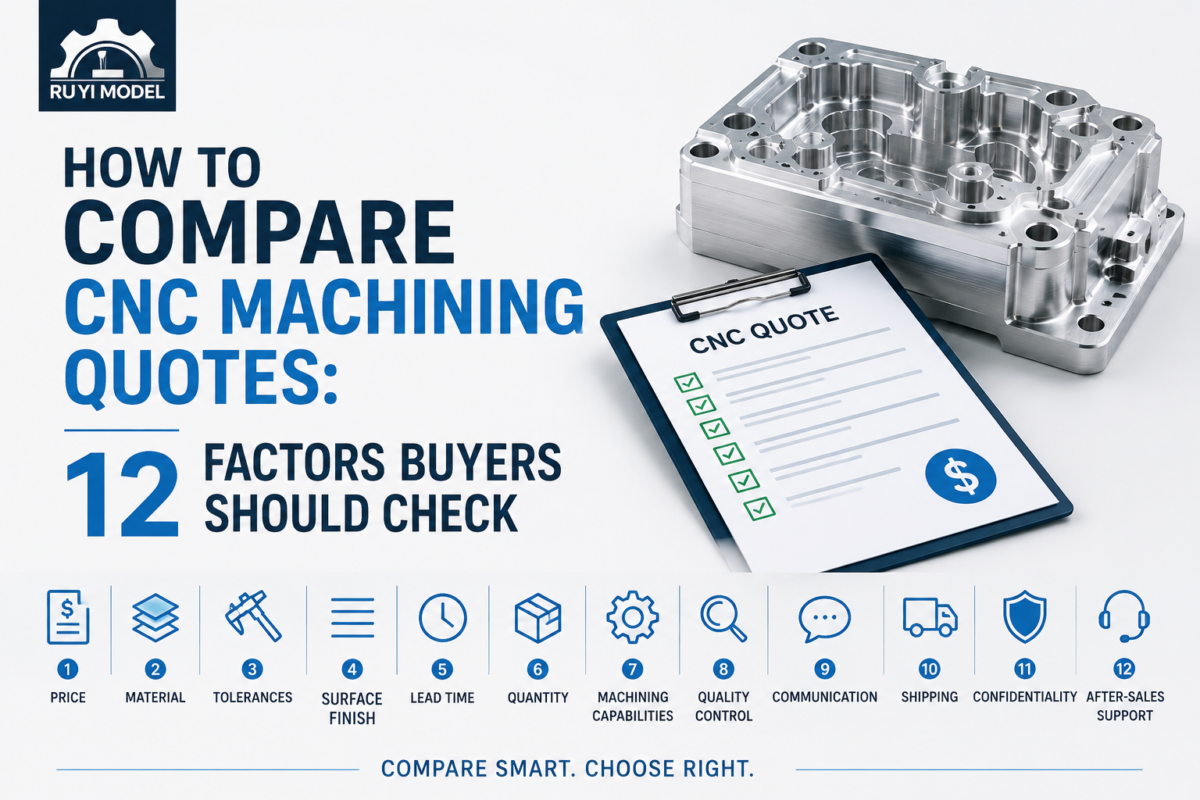
Ask three CNC machine shops for a quote on the same part and you can end up with three very different numbers, sometimes 100 to 200 percent apart, for a drawing that has not changed at all. For a buyer new to sourcing machined parts, that spread can feel impossible to make sense of, and it tempts a lot of teams into picking the lowest number and hoping for the best. That is usually a mistake. A CNC machining quote is really a technical judgment about your part, not just a price tag, and once you know what is actually driving the number, comparing quotes stops being guesswork. This guide walks through the 12 factors that explain most of the spread between quotes, gives you a complete RFQ checklist so every supplier is pricing the same job, and flags the red flags that tend to show up before a bad order does, so buyers across the USA, Canada, and Europe can compare offers with confidence.
| Quick Answer : Compare CNC machining quotes by normalizing scope first: check cycle time basis, exact material grade and certificate type, tolerance and inspection level, finish, quantity breaks, lead time, and certifications like ISO 9001 or AS9100 before ranking by price. The cheapest number is only meaningful once every quote covers the same work. |
Key Takeaways
- A low price alone tells you almost nothing. Two quotes for the same drawing can differ by 2 to 3 times once scope, material certification, and inspection level are accounted for.
- The strongest predictor of a good outcome is whether the supplier’s quote shows they understood the drawing, not just the price line.
- A complete RFQ package, sent identically to every supplier, is what makes quotes comparable in the first place.
- Certifications such as ISO 9001 and AS9100 are a fast way to filter suppliers before you spend time on a detailed comparison.
- A handful of recurring red flags, an instant quote with no questions, no DFM feedback, refusal to provide a sample FAI, are strong early warning signs.
Why CNC Machining Quotes Vary So Much
Send the same drawing to five machine shops and you will often get five different numbers, sometimes 200 percent apart. This is not usually a sign that someone is overcharging or underbidding. It happens because a CNC machining quote is really a technical judgment about the part, and different shops make different assumptions about tolerance, setup, material sourcing, and risk. A shop that reads a blanket tight tolerance across the whole drawing will quote a slower process and more inspection than a shop that assumes only the toleranced features actually matter. Before comparing prices, it helps to understand our own approach to CNC machining services so you know what a complete quote should include.
| Did You KnowLabor rates for CNC machining in China typically run 40 to 60 percent lower than comparable shops in the USA or Western Europe for similar quality, which is one reason offshore quotes look attractive before freight and duty are added back in. |
Build a Complete RFQ Package First
Quotes are only comparable when every supplier is pricing the same job. Missing information is the single biggest cause of inconsistent pricing and slow turnaround. Send the same package to every supplier on your shortlist.
- A 3D CAD model in a neutral format such as STEP, plus a 2D drawing showing tolerances, GD&T, and thread callouts. A 3D model alone cannot encode thread class, flatness, or true position.
- The exact material grade, alloy, and temper, not a generic term like aluminum or stainless steel.
- Which dimensions are function-critical versus which can use a standard tolerance band such as ISO 2768.
- Target quantity plus your likely repeat volume, so the supplier prices the correct process rather than guessing.
- Finish and post-processing requirements, including color, thickness, or coating specification where relevant.
- Required documentation: material certificates, CMM inspection reports, first article inspection, or certificate of conformance.
- Delivery location, requested lead time, and any applicable Incoterms.
Ready to see how a fully scoped quote looks? Get an instant quote and our team will confirm every field above before pricing your part.
12 Factors to Check Before You Compare Numbers
1. Scope: what is actually included
Confirm whether the number covers machining only, or machining plus material, finishing, packaging, and inspection reports. A quote that looks 20 percent cheaper is not a saving if finishing and inspection are billed separately later.
2. Cycle time assumptions
Machine time, often called Time on Machine, is the single biggest driver of CNC cost. Ask how the supplier estimated cycle time: from CAM simulation, from a similar past job, or from actual machine-specific data. Guesswork here is the most common source of quote disputes later.
3. Material grade and certification type
A quote for 6061-T6 aluminum is not the same as a quote for unspecified 6061 stock. Material certificates also come in different levels, and the difference matters for both cost and traceability, as shown below.
| Certificate type | What it confirms |
| Type 2.2 | A statement of conformity based on the supplier’s own records, without specific test results |
| Type 3.1 | Test results from the actual batch supplied, verified by the manufacturer’s own quality department |
| Type 3.2 | The same batch-specific results, additionally witnessed and signed by an independent third party |
An RFQ that simply says certificate required leaves the supplier to guess which type you mean, and the costlier version is not automatically the correct one for your application. State the exact type you need.
4. Tolerance and inspection level
Tight tolerances on non-critical features quietly inflate cost. A blanket tolerance of plus or minus 0.01 millimeters across the whole drawing is one of the most common avoidable cost drivers. Check that the supplier only applies tight tolerances where the drawing actually requires them, and confirm what inspection method is used, such as CMM, calipers, or gauges.
| Pro TipOnly mark the features that truly need a tight tolerance on your drawing, and let ISO 2768 general tolerances cover everything else. This single change is one of the fastest ways to lower a CNC quote without changing the part’s function. |
5. Setup and programming cost treatment
For prototypes and small batches, setup and CAM programming can be most of the bill. Ask whether these are quoted separately or amortized into the per-part price, since this changes how the quote scales with quantity. This is also why prototype and production RFQs should usually be sent as separate requests rather than one combined ask.
6. Finishing and post-processing
Anodizing, plating, passivation, powder coating, and heat treatment are frequently outsourced by the machine shop itself. Confirm the finish specification, color or thickness where relevant, and whether the cost and lead time already account for this outside step. Passivation on stainless parts, for example, is commonly evaluated against ASTM A967, so referencing the standard directly in your RFQ removes ambiguity.
7. Quantity breaks and minimum order
A single unit price is only useful for prototypes. For production quantities, request pricing at two or three volume tiers, for example 10, 50, and 200 units, so you can see how setup cost amortizes and where the part hits its efficient batch size.
8. Lead time and real capacity
A fast quote does not guarantee a fast delivery. Ask for the committed ship date, not just an estimate, and confirm what happens if your quantity or design changes after the order is placed.
9. Quality certifications
Certifications are one of the fastest ways to pre-qualify a supplier. ISO 9001 covers general quality management, AS9100 adds aerospace-specific traceability and risk controls, and ISO 13485 applies to medical device parts. Ask to see the certificate itself, not just a logo on the website.
10. Quality of DFM feedback
A supplier who flags a thin wall, a deep pocket, or an unreachable feature before quoting is telling you they actually reviewed the geometry. A supplier who pushes back and asks whether a very tight tolerance is truly necessary has read the drawing carefully, while a supplier who agrees to everything without comment may not have. A quote with no design for manufacturability comments on a complex part is a warning sign, not a strength.
| Expert Insight : Experienced buyers treat DFM pushback as a positive signal rather than friction. A supplier asking whether a tolerance can be relaxed has actually read your drawing. A supplier agreeing to everything without a single question usually has not, and that gap tends to surface later as a rejected part rather than as a quote issue. |
11. Total cost of ownership
Shipping, duties, currency exchange, and rework risk belong in the comparison, not just the unit price. An offshore quote that looks cheaper on paper can lose its advantage once freight and customs are added for buyers in the USA, Canada, or Europe. A high scrap rate on a first production batch can erase the entire savings of a lower unit price.
12. Communication and responsiveness
How a supplier handles the RFQ is a preview of how they will handle the order. Clear, specific questions about your drawing are a good sign. A quote that arrives instantly with no questions on a complex part deserves a second look.
Red Flags That Signal a Risky Supplier
A pattern of warning signs is more telling than any single flag. Watch for two or more of these together.
- A quote returned in minutes on a complex part, with no questions about tolerance, material, or finish.
- A price noticeably lower than every other quote, with no explanation for the gap.
- Refusal to provide a first article inspection report or sample material certificate on request.
- No mention of which machine or process the part will actually run on.
- Reluctance to sign an NDA before sharing full drawings, or a request for full payment upfront before any sample approval.
- Vague answers about which operations, if any, will be subcontracted to a third party.
Quote Comparison Worksheet
Before ranking any quotes by price, put every one of them on the same basis using a simple field-by-field worksheet like the one below.
| Field | Supplier A | Supplier B | Supplier C |
| Material grade and certificate type | |||
| Tolerance class applied | |||
| Finish and post-processing included | |||
| Inspection method and report type | |||
| Lead time (committed, not estimated) | |||
| Unit price at each quantity tier | |||
| Freight, duty, and payment terms |
Domestic vs Offshore Quotes
Offshore quotes often look attractive on the unit price line because of lower labor rates. The fair comparison adds freight, duty, currency risk, and the longer lead time back in before judging which quote is actually cheaper. For buyers who want to keep both options open, a useful approach is a hybrid strategy: use instant online quotes for early budgeting and design iteration, then move to a detailed RFQ with a vetted precision machining parts manufacturers partner once the design is stable and production volume is confirmed.
Quote Comparison at a Glance:
| Factor | Why it matters | What to ask for |
| Cycle time basis | Drives the largest share of cost | How was machine time estimated |
| Material certification | Confirms traceability and grade | Mill certificate, exact type (2.2, 3.1, or 3.2) |
| Tolerance and inspection | Overspecified tolerance adds cost | Inspection method and sample report |
| Certifications | Pre-qualifies supplier capability | ISO 9001, AS9100, or ISO 13485 scope |
| Total landed cost | Offshore savings can disappear | Freight, duty, and lead time together |
Frequently Asked Questions
Is the cheapest CNC machining quote usually the best choice?
Not on its own. The cheapest number is only meaningful once you confirm it covers the same material, tolerance, finish, and inspection scope as the other quotes you are comparing.
How many CNC machining quotes should I request?
Three quotes is a practical minimum for a new part. It gives you enough spread to spot an outlier without spending excessive time managing an RFQ process.
Do offshore CNC machining quotes always work out cheaper?
Often for material and labor cost, but freight, duties, and longer lead times can close much of the gap, so total landed cost is the fairer comparison.
What is the biggest mistake buyers make when comparing quotes?
Comparing unit price alone without checking whether every quote includes the same material certification, tolerance, finish, and inspection level.
What is the difference between a Type 3.1 and Type 3.2 material certificate?
A Type 3.1 certificate reports batch-specific test results verified by the manufacturer’s own quality department. A Type 3.2 certificate carries the same results with an additional independent third-party witness, and typically costs more.
Should I ask for a first article inspection before placing a production order?
For any new part, yes. An FAI confirms the supplier’s process can actually meet every drawing requirement before you commit to a full production quantity.
Final Words:
A CNC machining quote is a technical document as much as a commercial one. Working through these 12 factors, sending a complete RFQ package, and watching for the red flags above turns a confusing spread of prices into a clear decision. If you would like a transparent, scope by scope breakdown for your next part, our precision machining parts manufacturers team is happy to walk through it with you, or you can get an instant quote directly.