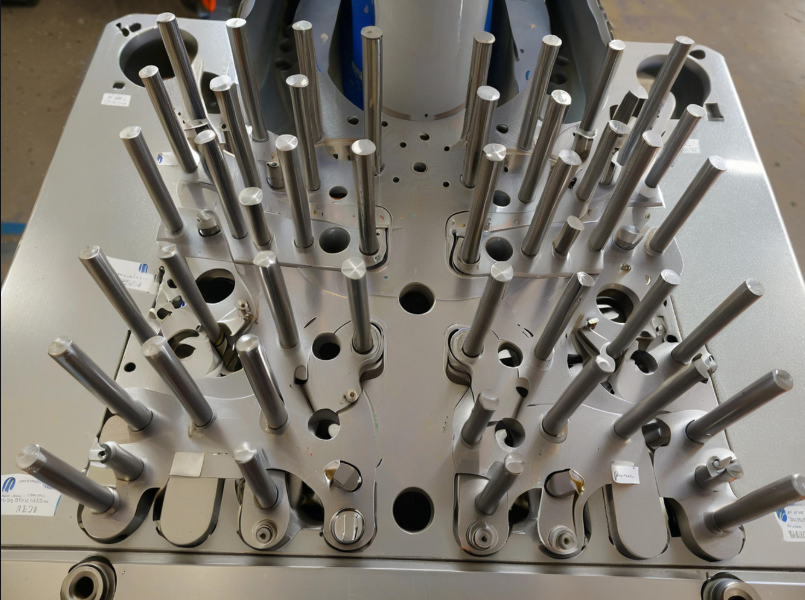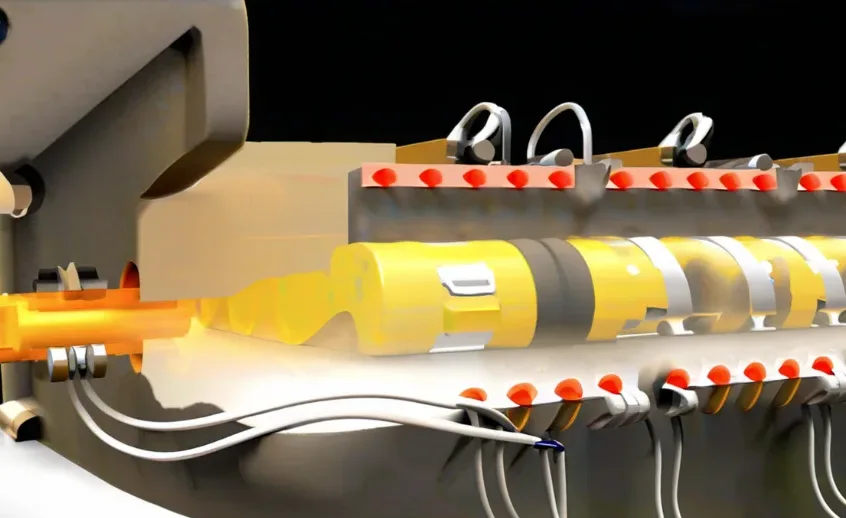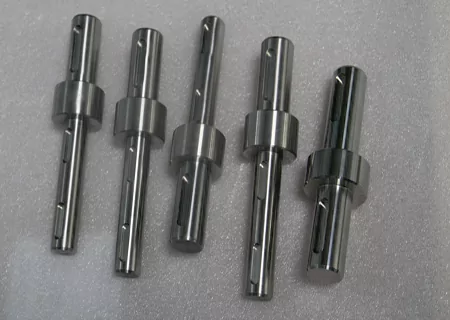
If you have ever held a precision-cut aluminum bracket, an aerospace fitting, or a custom stainless steel implant, there is a good chance a CNC machine made it. CNC machining is the backbone of modern manufacturing, used in industries from medical devices to automotive components to consumer electronics.
Yet for many engineers, product developers, and buyers encountering the process for the first time, the core question remains: what exactly is CNC machining, and how does it work?
This complete guide answers that question from first principles. By the end, you will understand what computer numerical control means, how raw material becomes a finished part, what tolerances and materials are realistic, and whether Custom CNC machining is the right process for your project.
What Is CNC Machining?
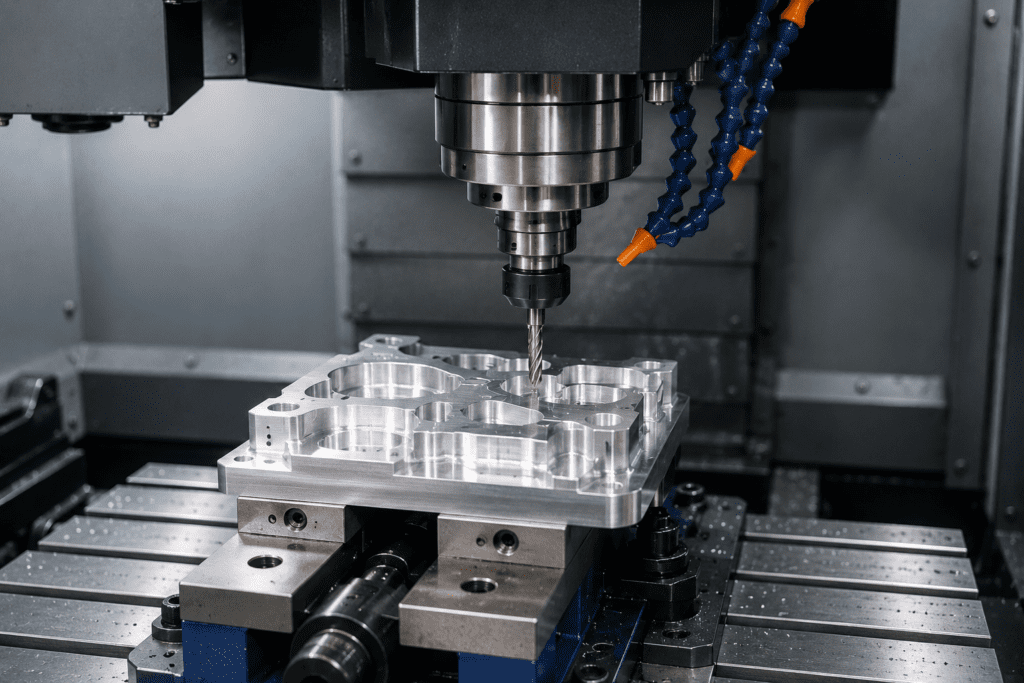
CNC machining is a subtractive manufacturing process in which computer-controlled machines remove material from a solid workpiece to produce a finished part with precise dimensions, features, and surface finishes.
Unlike additive manufacturing (3D printing), which builds parts layer by layer, CNC machining starts with a solid block, bar, or tube of material and cuts away everything that is not the finished part. The result is typically stronger, dimensionally more accurate, and better suited to demanding end-use environments than printed counterparts.
The key differentiator between CNC and older manual machining is control. A manual operator turns handwheels and reads dials. A CNC machine reads G-code, a standardized programming language that instructs the spindle, axes, and tooling exactly where to move, at what speed, and with how much force, thousands of times per second.
Quick definition: CNC machining = computer-directed cutting tools + solid raw material = precise finished parts.
Why CNC Machining Matters in Modern Manufacturing
The global CNC machine tools market was valued at approximately USD 86.83 billion in 2023 and is projected to grow at a CAGR of 6.8% through 2030, driven by rising demand for precision parts in aerospace, medical, and automotive sectors (Grand View Research).
This growth reflects a fundamental reality: modern products, from smartphones to surgical implants to electric vehicle battery housings require levels of precision and consistency that only computer-controlled manufacturing can reliably deliver.
What Does CNC Stand For?
CNC stands for Computer Numerical Control.
The term precisely describes how the technology works:
- Computer — a dedicated microprocessor or industrial PC governs all machine operations
- Numerical — movements are defined by numerical coordinates (X, Y, Z axes and rotational positions)
- Control — the computer directs every mechanical movement of the machine in real time
What CNC Control Means in Practice
The “numerical” in CNC refers to how machine movements are defined, as precise X, Y, Z coordinates and rotational positions, updated thousands of times per second. The “computer” interprets a program and translates those numbers into electrical signals that drive servo motors with extreme accuracy.
The result: CNC machining centers routinely hold tolerances of ±0.005 mm (0.0002 inches) and switch between dozens of cutting tools automatically, completing a complex part in a single setup that would take a manual machinist hours of careful, error-prone work.
How Does a CNC Machine Work?
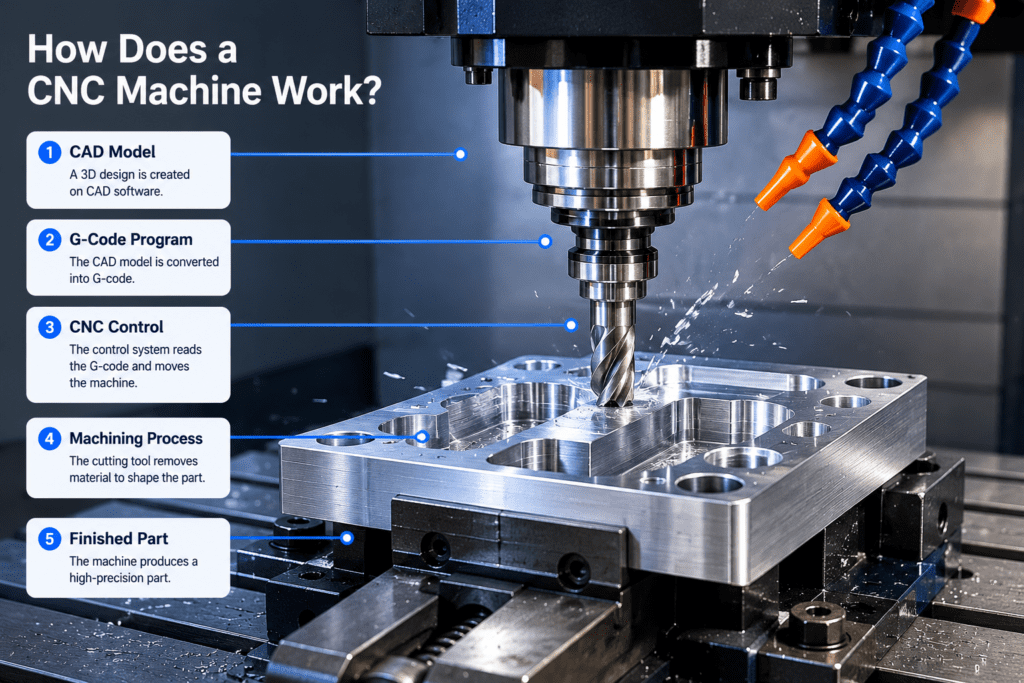 A CNC machine works by following digital instructions to move cutting tools along precise paths, removing material from a workpiece to achieve a specific geometry.[/caption]
Here is the sequence in plain terms:
- A 3D CAD design defines the part geometry
- CAM software translates the geometry into G-code toolpaths
- The CNC controller reads G-code line by line
- Servo motors drive ball screws or linear guides along X, Y, Z axes (and rotational axes on multi-axis machines)
- Precision sensors provide real-time feedback, verifying tool position against the digital blueprint
- High-speed spindles rotate cutting tools at thousands of RPM, shearing material away
- Coolant systems flush chips and manage heat to protect tool life and dimensional accuracy
Does CNC Machining Use G-Code?
Yes. G-code is the primary programming language for CNC machines. A typical line reads:
G01 X25.400 Y12.700 Z-5.080 F500
This instructs the machine to move linearly (G01) to coordinates X=25.4mm, Y=12.7mm, Z=5.08mm below the surface at a feed rate of 500 mm/min. A complete part program may contain thousands of such lines, each one a precise mechanical instruction.
Must Read: Advanced High-Precision CNC Machining Strategies
Main Parts of a CNC Machine
Component | Function |
Spindle | Rotates the cutting tool or workpiece at high speed |
Controller (CNC unit) | Interprets G-code and sends signals to drive motors |
Machine bed/frame | Rigid structure that absorbs cutting forces and maintains alignment |
Servo motors | Drive linear and rotational axes with precision |
Automatic tool changer (ATC) | Switches between cutting tools without operator intervention |
Coolant system | Reduces heat, flushes chips, extends tool life |
Control panel | Operator interface for program loading, monitoring, and manual overrides |
The CNC Machining Process Step by Step
Step 1: CAD Design
Everything starts with a 3D model. Engineers use CAD software, SolidWorks, CATIA, Fusion 360, or AutoCAD — to create a digital representation of the part. The model defines every dimension, feature, hole, thread, and surface finish requirement.
Common file formats: .STEP, .IGES, .STL, .DXF
The quality of the CAD model directly determines the quality of the finished part. Features that are geometrically unclear, underspecified, or physically impossible to cut will cause costly problems downstream.
Design for manufacturability (DFM) tip: Parts designed with CNC constraints in mind, avoiding unnecessarily deep cavities, standardizing hole sizes, minimizing setups, cost significantly less to produce.
Step 2: CAM Programming
The CAD file is imported into CAM software, which generates the toolpaths, the precise trajectories the cutting tool follows to remove material. CAM accounts for:
- Machine type and axis count
- Cutting tools available
- Material being machined
- Required surface finish
- Optimal sequence of operations to minimize setup changes
The output is G-code: a text file of precise motion instructions sent to the machine controller.
Skilled CAM programmers optimize toolpaths to minimize machining time, reduce tool wear, and avoid collisions between cutter, workpiece, and fixture. This programming expertise is what separates a 4-hour cycle time from a 1.5-hour cycle time on the same part.
Step 3: Machine Setup
Before cutting begins, a machinist prepares the machine:
- Workholding: Securing raw material in a vise, chuck, fixture, or clamp
- Tool loading: Installing correct cutters in the spindle or automatic tool changer
- Datum setting: Establishing the zero-point origin for all machine movements (an error of 0.1 mm here affects every feature on the part)
- Material verification: Confirming correct grade, size, and condition of raw stock
Setup time is a significant cost driver, especially for small batches. A well-designed part that machines in a single setup costs less and achieves better accuracy than one requiring multiple repositioning steps.
Step 4: Machining
With setup complete, the operator runs the program. The controller reads G-code line by line and drives servo motors to move the cutting tool through the workpiece with high precision.
During cutting:
- Coolant reduces heat, flushes away chips, and extends tool life
- Real-time sensors monitor cutting forces and tool position
- Closed-loop feedback allows the controller to make micro-adjustments if deviations are detected
Modern machining centers can run lights-out, unattended, overnight with pallet changers automatically cycling through multiple workpieces.
Step 5: Quality Inspection
After machining, parts are measured against the engineering drawing or 3D model. Common inspection tools:
- Calipers and micrometers — straightforward dimensional checks
- Coordinate Measuring Machines (CMMs) — 3D feature verification
- Surface roughness profilometers — finish verification against Ra requirements
- Thread gauges — checking threaded holes and fastener features
Depending on quality requirements, inspection may be first-article only, statistical sampling, or 100% of every part.
At Ruiyi CNC Machining, every order includes dimensional inspection with full documentation. Our ISO 9001:2015 and ISO 13485 certifications govern the quality process from raw material receipt through final shipment.
Step 6: Post-Processing and Surface Treatment
Most machined parts require finishing before use:
- Deburring removes sharp edges and chips
- Anodizing improves corrosion resistance and adds color to aluminum parts
- Electroplating adds wear resistance or conductivity
- Powder coating provides durable decorative finishes
- Heat treatment increases hardness for steel parts
- Sandblasting creates uniform matte finishes
Ruiyi’s surface treatment services cover all major post-machining finishing options, applied in-house to reduce lead time and handling.
Types of CNC Machines
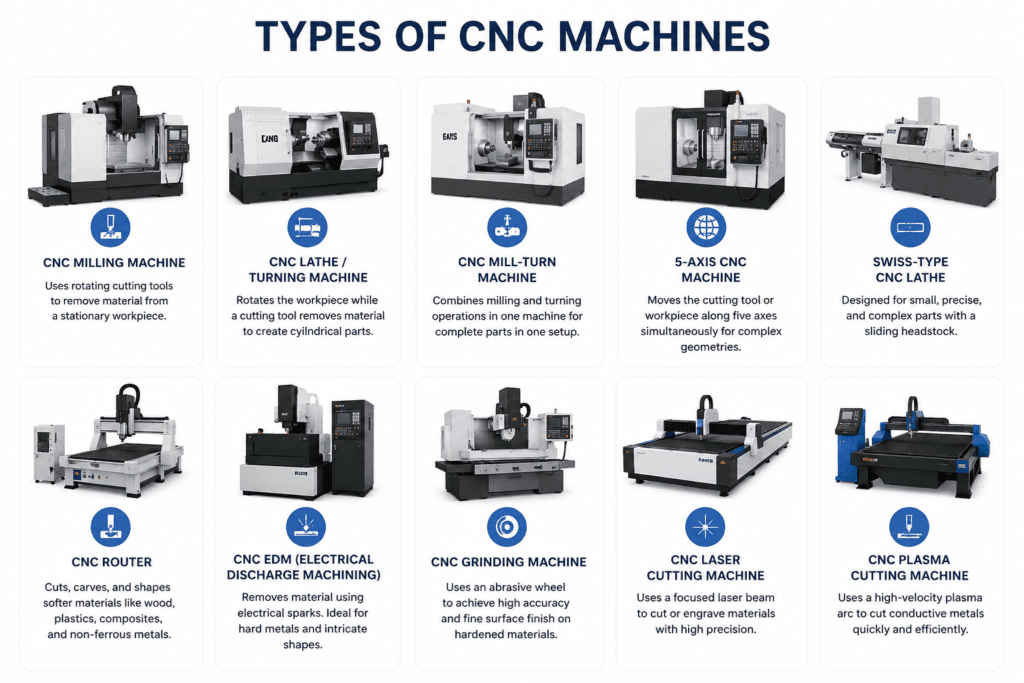
CNC is not a single machine type. Here are the most important categories:
1. CNC Milling Machine
Uses a rotating multi-point cutting tool that moves across a stationary workpiece. Produces flat surfaces, slots, pockets, contours, and complex 3D shapes.
- 3-axis milling: Moves in X, Y, and Z — standard for most parts
- 4-axis milling: Adds rotation around one axis for side features without repositioning
- 5-axis milling: Two additional rotational axes enable complex aerospace parts, turbine blades, and medical implants in a single setup
Ruiyi operates dedicated 4-axis CNC machining and 5-axis CNC machining services for geometries that 3-axis setups cannot reach efficiently.
2. CNC Lathe / Turning Machine
Rotates the workpiece while a stationary cutting tool removes material. Produces shafts, pins, bushings, threads, and flanges. Modern turning centers include live tooling for drilling and milling operations in the same setup.
Explore our CNC turning services for the full scope of lathe-based capabilities.
3. CNC Milling and Turning Machine (Mill-Turn)
Combines milling and turning in a single machine, reducing setups and improving accuracy for complex prismatic-plus-rotational parts.
4. 5-Axis CNC Machine
Operates along five axes simultaneously — three linear (X, Y, Z) and two rotational (A and B or C). Essential for complex aerospace components, impellers, and medical implants where traditional 3-axis setups require multiple operations.
5. Swiss-Type CNC Lathe
Uses a sliding headstock and guide bushing to support the workpiece very close to the cutting tool during rotation. Produces small, long, slender parts — watch components, medical pins, dental screws — with exceptional precision.
6. CNC Router
Cuts, carves, and shapes softer materials — wood, plastic, non-ferrous metals, foam, composites. Widely used in woodworking, signage, and prototyping.
7. CNC EDM (Electrical Discharge Machining)
Removes material using controlled electrical sparks between an electrode and the workpiece. Used for hardened metals and complex geometries such as sharp internal corners and narrow slots that cutting tools cannot reach. See our guide on what EDM is for a detailed explanation.
8. CNC Grinding Machine
Uses an abrasive wheel to achieve extremely tight tolerances and fine surface finishes on hardened materials. Used for precision bearing surfaces, cutting tool blanks, and hardened steel components.
9. CNC Laser Cutting Machine
Focuses a laser beam to cut or engrave with high precision. Produces clean edges with minimal material waste. Suitable for thin metals, acrylic, and composites.
10. CNC Plasma Cutting Machine
Uses a high-velocity plasma arc to cut electrically conductive materials. Ideal for cutting thick steel, aluminum, and other metals quickly and economically.
Complete CNC Machine Types Reference Table
CNC Machine Type | Primary Use | Typical Industries |
CNC Milling (3-axis) | Flat surfaces, slots, contours | General manufacturing, tooling |
CNC Milling (5-axis) | Complex geometries, single-setup | Aerospace, medical, energy |
CNC Lathe / Turning | Cylindrical parts, shafts, threads | Automotive, general engineering |
Swiss-Type CNC Lathe | Small precision parts | Medical, watchmaking, electronics |
Mill-Turn Center | Prismatic + rotational combined | Aerospace, energy, general |
CNC Router | Wood, plastic, composites | Furniture, signage, prototyping |
CNC EDM | Hard metals, intricate cavities | Tooling, mold making |
CNC Grinding | Fine finish, tight tolerance | Tooling, bearings, hardened parts |
CNC Laser Cutting | Thin materials, clean edges | Electronics, sheet metal |
CNC Plasma Cutting | Thick conductive metals | Construction, heavy fabrication |
CNC Waterjet Cutting | Heat-sensitive materials | Composites, ceramics, stone |
Types of CNC Machining Processes
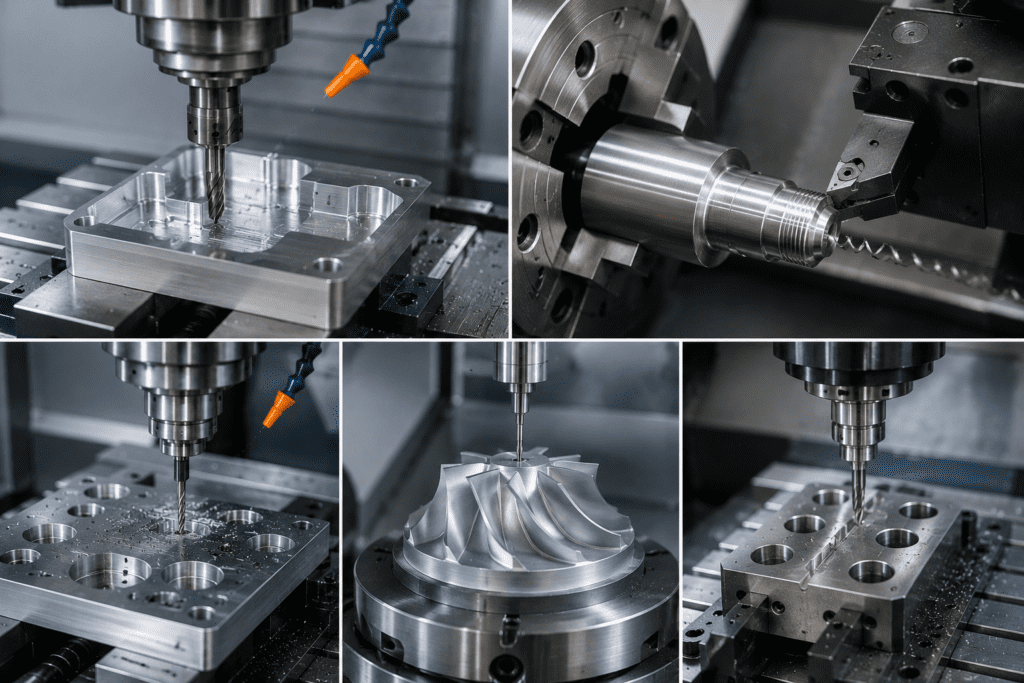
1. Turning
A lathe rotates the workpiece while a cutting tool removes material to create cylindrical features — shafts, rods, threads, and flanges. High precision and smooth finishes characterize well-executed turning operations.
2. Milling
A rotating multi-point cutter removes material from a fixed workpiece. Produces slots, pockets, flat surfaces, contours, and complex 3D shapes. The most versatile CNC process.
3. Drilling
A rotating drill bit cuts round holes into solid material with precise depth and diameter control. Often the first operation before tapping or remaining.
4. Tapping
A tap tool creates internal threads inside a drilled hole — either by cutting material or by displacing it. CNC machines synchronize spindle speed and Z-axis feed to achieve correct thread pitch every time.
5. Boring
A single-point cutting tool enlarges an existing hole to a precise diameter with superior straightness and finish compared to drilling alone. Used for engine bores, bearing housings, and precision fits.
6. Reaming
A reamer refines a drilled hole to an exact diameter and superior surface finish. Used for dowel pin holes and close-tolerance fits where drilling alone is insufficient.
7. Grinding
A rotating abrasive wheel removes small amounts of material to achieve tight tolerances and fine surface finishes. Essential for hardened parts and bearing surfaces.
8. Broaching
A toothed tool moves across or through a workpiece to remove material in stages. Used for keyways, splines, and internal profiles. Very fast for high-volume production.
9. EDM (Electrical Discharge Machining)
Controlled electrical sparks remove material from conductive metals without mechanical contact. Used for complex mold cavities, narrow slots, and materials too hard to cut conventionally.
10. Waterjet Cutting
A high-pressure stream of water (often with abrasive particles) cuts through material without generating heat. Preserves material properties in heat-sensitive applications — composites, ceramics, tempered glass.
What Materials Can CNC Machines Cut?
One of the great strengths of CNC machining is material versatility. The process is compatible with virtually any engineering material.
Metals
Material | Key Properties | Typical Applications |
Aluminum 6061 | Excellent machinability, good strength-to-weight ratio | Aerospace frames, automotive brackets, electronics housings |
Aluminum 7075 | Higher strength than 6061, good fatigue resistance | Aircraft structural components, high-performance parts |
Stainless Steel 304 | Corrosion resistant, food-safe | Medical equipment, food processing, marine |
Stainless Steel 316 | Superior corrosion resistance, especially to chlorides | Marine, pharmaceutical, chemical processing |
Mild Steel 1018 | Easily machinable, weldable | Structural parts, machine bases, fixtures |
Alloy Steel 4140 | High strength, good toughness | Gears, shafts, high-stress components |
Titanium (Grade 5) | Biocompatible, high strength-to-weight | Aerospace, medical implants, motorsport |
Copper | Excellent electrical conductivity | Electrical connectors, bus bars, heat sinks |
Brass | Easy to machine, corrosion resistant | Fittings, valves, decorative parts, plumbing |
Inconel 718 | High-temperature strength | Jet engine components, gas turbine parts |
Aluminum is the most frequently machined metal in CNC shops worldwide. It offers excellent machinability, low weight, good strength, and responds well to anodizing for corrosion protection and color.
Engineering Plastics
Material | Key Properties | Typical Applications |
Delrin (Acetal/POM) | Low friction, excellent dimensional stability | Gears, bushings, mechanical parts |
PEEK | High-temperature resistance, biocompatible | Medical devices, aerospace, chemical handling |
Nylon (PA6/PA66) | Tough, wear-resistant | Structural components, gears, housings |
ABS | Easy to machine, good surface finish | Prototypes, enclosures, consumer products |
Polycarbonate (PC) | Transparent, impact-resistant | Optical components, protective covers |
PTFE (Teflon) | Chemical resistant, very low friction | Seals, gaskets, chemical handling |
UHMWPE | Exceptional wear resistance | Conveyor components, bearing pads |
Composites
- Carbon fiber reinforced polymer (CFRP): CNC routed for aerospace and sports equipment panels. Requires diamond-coated tooling and dust extraction.
- G10/FR4 fiberglass: Used for electrical insulation and circuit board machining.
CNC Machining Tolerances and Accuracy
Accuracy is one of the defining advantages of CNC machining over manual methods.
Standard Achievable Tolerances
Feature | Standard Tolerance | Tight Tolerance |
Linear dimensions | ±0.127 mm (±0.005 in) | ±0.025 mm (±0.001 in) |
Hole diameter | ±0.05 mm | ±0.005 mm |
Surface finish (Ra) | 1.6 to 3.2 µm | 0.4 µm or better |
Thread pitch | ISO 6H/6g | Custom class |
Flatness | 0.05 mm | 0.010 mm |
Roundness | 0.010 mm | 0.002 mm |
Is CNC Machining More Accurate Than Manual Machining?
Yes, by a significant margin. Here is why:
- Sensors monitor tool position up to 100 times per second, continuously verifying location against the digital blueprint
- High-precision ball screws with backlash compensation maintain positioning that manual equipment physically cannot match
- Human eyes cannot reliably detect deviations below 0.1 mm during a manual cut; CNC systems routinely hold ±0.005 mm
- Thermal expansion is managed through automated coolant and temperature compensation software
- Fatigue does not affect a CNC machine: the 1,000th part is as accurate as the first
For medical implants, aerospace structural components, and precision instruments, this level of accuracy is not optional, it is the minimum acceptable standard.
CNC Machining vs Manual Machining
Factor | CNC Machining | Manual Machining |
Precision | ±0.005 mm to ±0.025 mm | ±0.1 mm typical |
Repeatability | Identical parts every cycle | Varies with operator skill and fatigue |
Production speed | High, especially for complex parts | Slow for complex features |
Labor requirement | 1 operator can manage multiple machines | 1 operator per machine, continuous attention |
Complex geometry | Handles intricate 3D shapes | Limited to simpler features |
Setup time | Higher for first part | Lower for simple one-off parts |
Best for | Batches of 1–100,000+ | Simple repairs, single one-off simple parts |
Cost at volume | Low cost per part | High cost per part |
Manual machining remains useful for simple one-off repairs and basic mechanical parts where precision requirements are relaxed. For anything requiring consistency, complexity, or production volume, CNC is the standard.
CNC Machining vs Other Manufacturing Processes
CNC Machining vs 3D Printing
CNC Machining | 3D Printing | |
Part strength | Full material strength | Anisotropic, often weaker |
Tolerances | ±0.025 mm or better | ±0.2 mm typical |
Surface finish | Excellent (Ra 0.4–3.2 µm) | Requires post-processing |
Material range | Metals, plastics, composites | Plastics, some metals |
Best for | Functional end-use parts, metal parts | Early-stage prototypes, complex internals |
Cost at low volume | Higher per part setup | Lower for first prototype |
For functional parts in metal or engineering plastics, CNC machining wins on mechanical performance. 3D printing excels for geometry validation of early-stage prototypes.
CNC Machining vs Injection Molding
CNC Machining | Injection Molding | |
Tooling cost | None | $5,000–$100,000+ for mold |
Per-part cost | Higher at high volume | Very low at high volume (50,000+) |
Best volume | 1 to ~5,000 parts | 10,000+ parts |
Lead time | 3–14 days | 4–12 weeks for tooling |
Design changes | Easy, no tooling to modify | Expensive if mold needs recutting |
CNC machining is also used to manufacture the injection molds themselves.
CNC Machining vs Die Casting
Die casting produces complex internal shapes and thin walls efficiently at high volume. However, cast parts typically require secondary CNC machining for tight-tolerance features — so the two processes are often used together.
Applications of CNC Machining by Industry
Aerospace Industry
Aerospace is among the most demanding applications for CNC machining. Components include structural airframe brackets, engine mounts, landing gear parts, and satellite housings. Materials are typically aluminum alloys, titanium, and nickel superalloys (Inconel). Tolerances are extremely tight and full material traceability is mandatory.
5-axis machining is essential here : turbine blades, impellers, and complex structural castings cannot be produced efficiently any other way.
Automotive Industry
Automotive manufacturers machine engine blocks, cylinder heads, transmission housings, brake caliper bodies, and EV battery enclosures. High-volume production demands consistent quality across thousands of identical parts. CNC automation supports both prototype development and full-scale production.
Medical Industry
Medical device manufacturing imposes strict requirements: specific surface roughness values for biocompatibility, full material traceability, and compliance with ISO 13485. CNC machines produce surgical instruments, orthopedic implants, spinal components, and diagnostic device housings from stainless steel, titanium, and medical-grade PEEK.
Ruiyi holds ISO 13485 certification, enabling us to serve medical device manufacturers with the documentation and quality standards their customers require.
Electronics Industry
Electronics manufacturers machine heat sinks, antenna mounts, connector housings, and structural chassis for industrial electronics. Aluminum and copper parts require clean, precise cuts that CNC delivers consistently. Compact product designs demand tight tolerances on every feature.
Defense Industry
Defense contractors produce firearm components, armored vehicle parts, and communication hardware. Durable materials (hardened steel, titanium, aluminum alloys) require stable, controlled cutting parameters. Dimensional consistency is non-negotiable for mission-critical equipment.
Energy Sector
Energy companies machine turbine shafts, valve bodies, pump impellers, and drilling components from nickel superalloys, stainless steel, and alloy steels. Heavy-duty materials demand rigid machining setups. Both renewable energy (wind turbine hubs) and conventional energy (oil/gas wellhead components) depend on precision CNC machining.
Robotics and Automation Equipment
Ruiyi serves engineering teams developing robotic systems and automation hardware, structural frames, actuator housings, precision gear blanks, and gripper components. Tight tolerances ensure correct alignment and smooth mechanical interaction between assemblies.
Rapid Prototyping and Product Development
Engineering teams use CNC machining to convert CAD models into functional physical parts quickly for design validation, fit checking, and performance testing. CNC prototyping bridges the gap between digital design and production-ready parts without committing to expensive tooling.
Ruiyi’s rapid prototyping services are specifically structured for accelerated development cycles, with standard lead times of 3–7 days.
Advantages of CNC Machining
- Higher Precision
CNC machines follow exact programmed coordinates during every operation. The system maintains tight tolerances across large production batches without deviation caused by human positioning errors.
2. Excellent Repeatability
CNC programs repeat identical toolpaths for every unit produced. The 1,000th part is dimensionally identical to the first — a consistency that manual methods simply cannot achieve.
3. Greater Production Speed
Automated tool changes, continuous operation, and optimized toolpaths allow CNC machines to produce complex parts in minutes rather than hours. Shops complete more parts within the same timeframe at lower labor cost.
4. Complex Geometry Capability
CNC machines, especially 5-axis centers manage multi-axis simultaneous movement, enabling intricate 3D shapes, internal cavities, and compound angles that manual methods cannot produce at all.
5. Reduced Human Error
Computer-guided instructions control feed rates, depth of cut, and positioning. The system eliminates common measurement errors, alignment mistakes, and calculation errors.
6. Safer Operations
Enclosed machine designs contain chips and debris during cutting. Operators interact with control panels rather than active cutting zones, dramatically reducing exposure to rotating tools and coolant spray.
7. Scalability
CNC machining scales from a single prototype to thousands of production parts using the same digital program. No tooling investment is required to change quantities.
8. Better Material Utilization
CAM software calculates efficient cutting paths before production begins. Controlled machining limits unnecessary material removal and reduces scrap rates.
How to Choose a CNC Machining Partner
When selecting a CNC machining supplier, particularly for outsourcing to a precision manufacturer — evaluate these criteria:
Equipment capability: Do they have the axis count, work envelope, and machine types your parts require? 5-axis capability matters for complex parts.
Material experience: Have they machined the specific alloy or plastic your application requires? Material-specific expertise affects surface finish, tool selection, and dimensional stability.
Tolerance capability: Can they consistently hold the tolerances on your engineering drawing? Ask for documented evidence, not just claims.
Quality system: Do they hold ISO 9001:2015? ISO 13485 for medical? Can they provide CMM inspection reports, material certificates, and first-article documentation?
DFM feedback: Will they flag design-for-manufacturability issues before cutting, or simply make what is on the drawing regardless of cost efficiency?
Communication and responsiveness: For international buyers, clear English communication, fast quote turnaround, and proactive updates on production status matter as much as machining quality.
Zero-risk policy: At Ruiyi, we operate a “Check First, Pay After” policy, no upfront payment is required. You inspect the parts on receipt and pay only after confirming quality. This removes purchasing risk entirely for new customers.
Why Source CNC Machining from Ruiyi?
Ruiyi Industrial Manufacturer is an ISO 9001:2015 and ISO 13485 certified precision CNC machining facility based in Dongguan, Guangdong, China, serving clients in the USA, Europe, Canada, and worldwide.
Our capabilities include:
- CNC milling (3-axis, 4-axis, 5-axis)
- CNC turning with live tooling
- Sheet metal fabrication
- Mold making
- Rapid prototyping (3–7 day lead time)
- Full surface treatment: anodizing, electroplating, sandblasting, powder coating
Our factory covers 10,000 square meters with more than 200 advanced CNC machines, including 5-axis machining centers and turning-milling composite machines. We serve over 1,500 customers annually across telecommunications, robotics, medical devices, automotive, and automation equipment.
Summary
CNC machining is a computer-controlled subtractive manufacturing process that converts raw material into precision parts by removing material with cutting tools under numerical program control.
Key facts to remember:
- CNC stands for Computer Numerical Control
- The main processes are milling, turning, drilling, EDM, and grinding
- Standard tolerances reach ±0.127 mm; precision tolerances reach ±0.025 mm or better
- Machinable materials include most metals and engineering plastics
- CNC machining is most cost-effective for low to medium production volumes requiring high precision
- The process starts with a CAD model and ends with a dimensionally verified, finished part
Understanding these fundamentals puts you in a stronger position whether you are designing parts for manufacture, evaluating CNC machining service providers, or managing procurement for precision components.
Ruiyi CNC Machining provides precision CNC milling, turning, rapid prototyping, sheet metal fabrication, and mold-making services from our facility in Dongguan, China, to clients across the USA, Europe, Canada, and worldwide. Contact us for a quote on your next project

Solomon Yang is a manufacturing industry professional with extensive experience in electronic, mechanical, and industrial component manufacturing. Having held various positions in American and Taiwanese manufacturing companies, he has developed a comprehensive understanding of manufacturing processes, production management, quality control, and global supply chain operations.
With expertise in business development, sales operations, international trade, customer relationship management, and engineering project support, Solomon bridges technical knowledge with commercial strategy to deliver innovative and cost-effective manufacturing solutions. He is passionate about advanced manufacturing technologies, process improvement, and continuous professional growth, with a strong commitment to creating value for customers and partners worldwide.