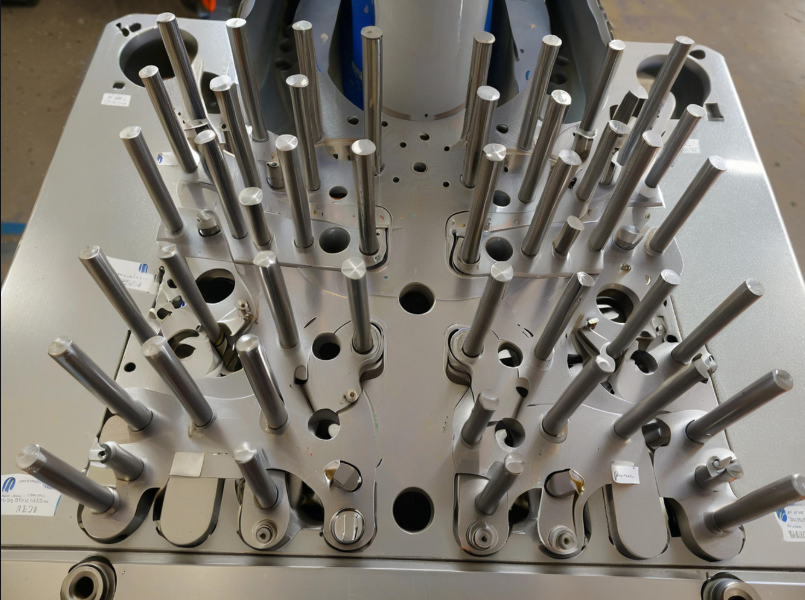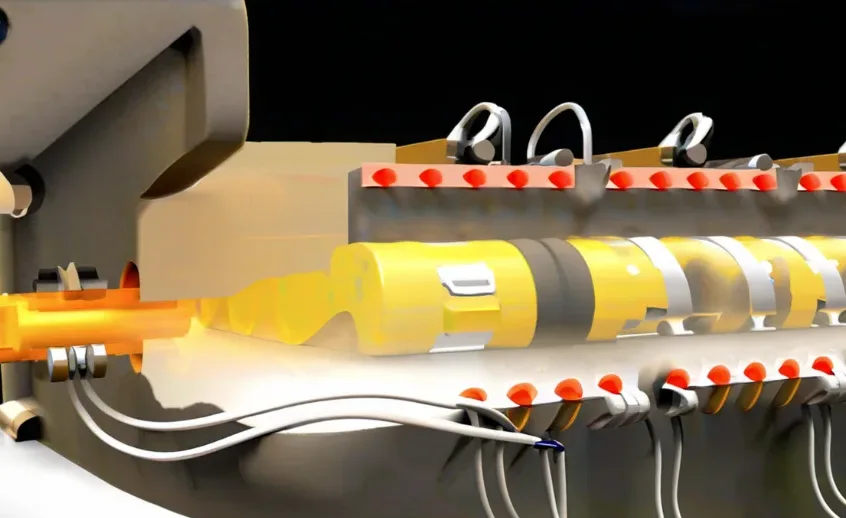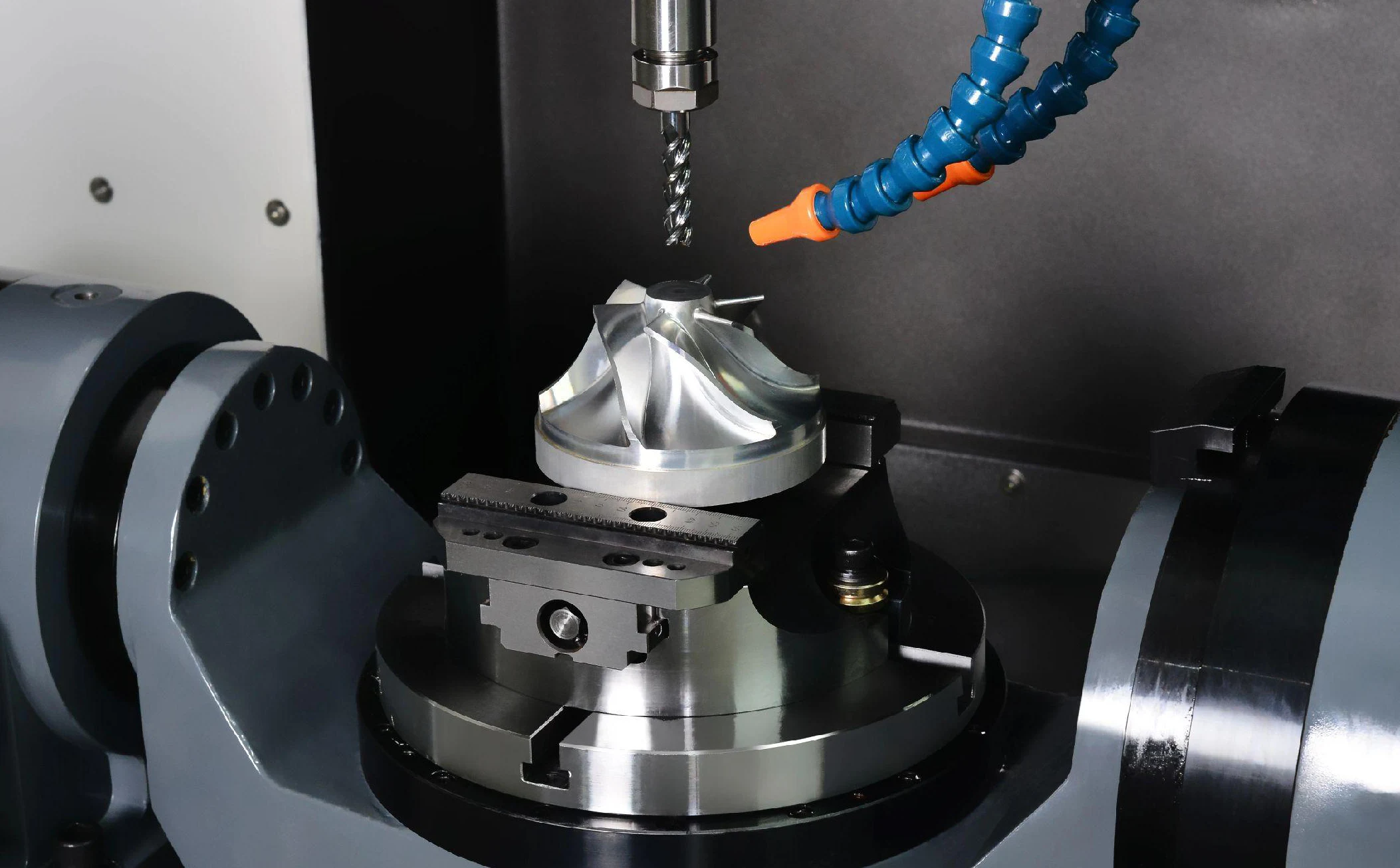
Advanced CNC machining techniques use high-speed, computer-controlled machining systems, intelligent automation, and precision tooling to manufacture complex parts with tight tolerances, superior surface finishes, and high production efficiency.
With the rapid development of industries such as aerospace, high-end equipment, automotive, medical devices, and electronic manufacturing, precision electromechanical components are evolving toward higher precision, greater complexity, lightweight structures, and miniaturization.
This trend places increasingly stringent demands on manufacturing processes, machining accuracy, and production efficiency.
For instance:
- Aircraft engine turbine blades require profile accuracy controlled within ±0.02 mm and surface roughness Ra not exceeding 0.8 μm.
- Smartphone mid-frames must achieve complex surface precision while enabling efficient mass production.
- Medical implants require micron-level tolerances and ultra-smooth surface finishes for long-term reliability.
Traditional machining processes often struggle to meet these demands consistently while maintaining productivity and cost efficiency.
High-speed, high-precision CNC machining integrates high-speed cutting, precision control, intelligent CNC systems, adaptive machining technologies, and AI-driven monitoring. This approach overcomes the efficiency and accuracy limitations of conventional methods and has become a key technology for precision electromechanical component manufacturing.
Precision CNC machining processes integrate high-speed cutting, precision control, intelligent automation, adaptive toolpath optimization, and thermal compensation technologies. They overcome the efficiency and accuracy limitations of conventional machining methods and have established themselves as key technologies for manufacturing high-precision parts across aerospace, medical, automotive, electronics, and industrial sectors.
Based on this, this article explores the application of high-speed, high-precision CNC machining processes in rough machining, finish machining, and complex shape machining. The focus is on precision electromechanical components. Optimization strategies are proposed from the perspectives of equipment, cutting tools, machining parameters, CNC programming, and intelligent manufacturing systems.
Quick Summary
- Advanced CNC machining improves machining accuracy, productivity, and surface finish quality.
- High-speed CNC machining increases material removal efficiency while reducing cutting force fluctuations.
- Five-axis CNC machining enables efficient production of complex geometries and precision components.
- Intelligent CNC systems dynamically optimize machining parameters in real time.
- AI-driven manufacturing improves process stability, tool life, and machining consistency.
- Closed-loop monitoring systems help reduce machining errors and improve production reliability.
What Is High-Precision CNC Machining?
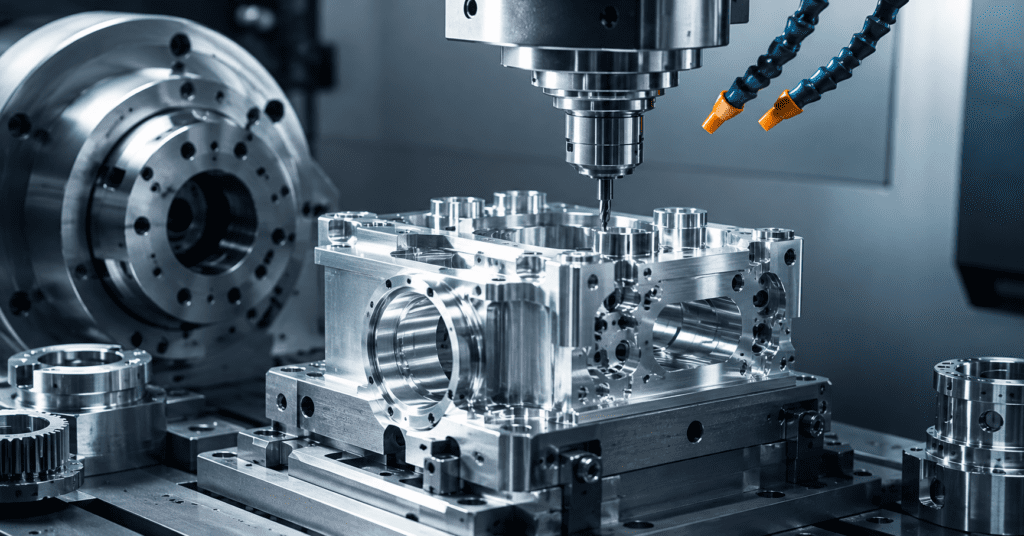 High-precision CNC machining is an advanced manufacturing process that uses computer-controlled machine tools, intelligent automation, optimized cutting strategies, and adaptive machining technologies to produce complex precision parts with extremely tight tolerances and superior surface finishes.[/caption]
Modern precision CNC machining combines:
- High-speed machining
- Five-axis CNC machining
- CAD/CAM software integration
- Intelligent CNC programming
- Adaptive feed rate control
- Real-time thermal compensation
- Closed-loop manufacturing systems
These technologies improve machining precision, production efficiency, and manufacturing consistency. You can also learn more about CNC turning and milling services for precision part manufacturing.
Overview of High-Speed, High-Precision CNC Machining Processes
High-speed, high-precision CNC machining processes represent advanced manufacturing technologies widely used in modern industrial production. They achieve high cutting speeds, high feed rates, and high-precision machining on CNC equipment by optimizing machine tool performance, tool paths, and machining parameters.
Its core characteristics include:
Machining Capability | Performance |
Spindle Speed | Exceeding 10,000 RPM |
Feed Rate | 20–100 m/min |
Machining Accuracy | Within ±5 μm |
Surface Roughness | Below Ra 0.8 μm |
The technological framework encompasses hardware support, such as high-speed CNC machine tools, super-hard cutting tool materials, high-precision CNC systems, intelligent spindle systems, and multi-axis machining platforms. To understand more about how these systems are structured, see our overview of the functions of modern CNC systems and common CNC machine tools.
It also includes advanced process strategies, such as cutting parameter optimization, smooth tool path planning, adaptive machining, minimal quantity lubrication, and intelligent process monitoring.
These technologies form the foundation of modern precision CNC manufacturing. Manufacturers increasingly rely on 5-axis CNC machining services to produce complex geometries with superior precision and reduced setup time.
Application of High-Speed, High-Precision CNC Machining Technology
Application in the Rough Machining Stage of Components
The core of rough machining lies in establishing a process balance between “efficient material removal and stable residual allowance.” Technologically, this involves precisely regulating cutting energy to achieve synergy between material removal efficiency and machining stability.
High-speed, high-precision CNC machining combines high rotational speeds (15,000–30,000 RPM) with large feed rates (20–50 m/min), enabling cutting line speeds that surpass traditional process limits. Parameter matching is not a simple combination of rotational speed and feed rate values. Instead, it is a systematic energy dispersion strategy based on material cutting mechanisms.
This strategy distributes cutting energy across more material units per unit time, increasing material removal rates while simultaneously controlling peak cutting forces at lower levels. This fundamentally reduces fluctuation in allowances caused by workpiece deformation under stress.
Manufacturers focused on rapid production often integrate rapid CNC machining processes to improve productivity and shorten lead times.
Benefits of High-Speed Rough Machining
Benefit | Result |
Faster material removal | Reduced production time |
Adaptive load control | Lower tool wear |
Stable cutting forces | Better dimensional stability |
Intelligent feed correction | Improved machining consistency |
The dynamic response capability of intelligent CNC systems is the key enabler for achieving this goal. The load adaptive mechanism, based on model predictive control algorithms, dynamically corrects feed rates within milliseconds by analyzing cutting force characteristics in real-time through spindle current signals.
Its core logic establishes a mapping relationship between cutting force and material allowance. Upon detecting sudden changes in allowance or fluctuations in material hardness, it proactively adjusts feed parameters to suppress load fluctuations (amplitude not exceeding 5 μm). This approach prevents abnormal tool wear caused by overload while ensuring uniformity in blank allowance.
Thermal Error Compensation and Dynamic Adaptation
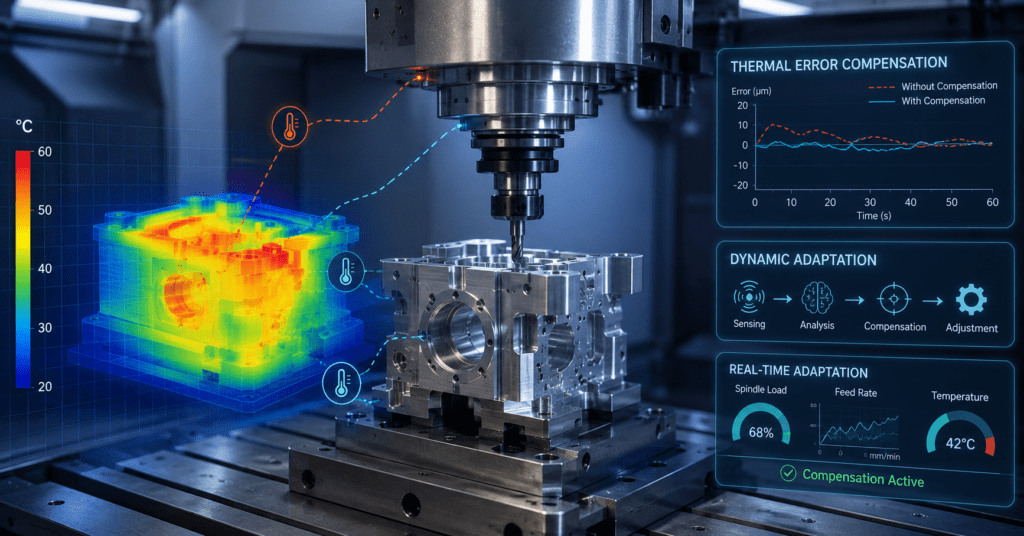
Its technical value lies not only in minimizing thermal deformation but also in establishing a repeatable machining environment. Compensating for thermal errors requires moving beyond simple linear temperature-deformation relationships. This is achieved by constructing three-dimensional temperature field models for spindles and guideways through multi-point temperature acquisition, combined with dynamic correction using thermal deformation coefficients under varying operating conditions.
This correction is not a static parameter substitution but a dynamic adaptation based on real-time temperature gradients. The core challenge is capturing the nonlinear mapping relationship between the temperature field and the deformation field. For a deeper look at high-speed cutting technology, including its status, advantages, and development trends, see our dedicated guide. These advanced thermal compensation technologies are especially important in aerospace machining, medical manufacturing, and high-performance industrial applications.
Application in the Precision Machining Stage of Components
Precision control in finishing operations involves error tracing and compensation under multi-physics interference, with the key lying in quantifying error sources and implementing targeted corrections. High-speed, high-precision CNC machining achieves stable dimensional accuracy within ±5 μm by establishing a closed-loop system of “measurement-modeling-compensation.”
From a kinematic perspective, positioning errors in machine tool feed systems result not from a single factor but from the coupling of initial positioning errors, thermal errors, load errors, vibration effects, and tool wear variations. For a thorough understanding, read our guide on CNC machining process quality control.
Manufacturers can further improve machining consistency by following proper CNC machining design guidelines during product development.
Surface Quality Control and Tool-Lubrication Strategies
Controlling machined surface quality requires understanding the tribological mechanisms at the tool-workpiece interface. Combining super-hard tools (hardness 3,500–4,500 HV) with micro-lubrication technology, tool edge parameters like radius and rake angle are matched to workpiece material hardness.
Recommended Cutting Tool Materials
Workpiece Material | Recommended Tool |
Aluminum Alloy | Polycrystalline Diamond (PCD) |
Titanium Alloy | Cubic Boron Nitride (CBN) |
Hardened Steel | Ceramic or Carbide Tools |
The selection of super-hard tools addresses tool wear resistance during high-speed cutting. For guidance on choosing the right materials for your parts, see our alloy steel vs stainless steel comparison guide.
Micro-lubrication technology forms a continuous lubrication barrier in the cutting zone through atomized oil mist particles. This barrier alters the friction coefficient between the tool and chips, suppressing adhesive wear and diffusion wear while stabilizing surface roughness Ra below 0.4 μm.
For face machining, a constant linear speed control strategy ensures the dynamic accuracy of CNC machine tools. This strategy dynamically adjusts spindle speed based on cutting diameter to maintain constant cutting edge speed. This counteracts cutting force fluctuations caused by diameter variations and fundamentally prevents surface chatter. For more on resolving spindle-related issues, see our article on solving abnormal spindle speed in CNC machining centers.
To better understand machining materials and performance, read our guide on machinist operations in CNC machining.
Application in Machining Complex-Shaped Components
In machining complex-shaped components, five-axis simultaneous technology overcomes spatial constraints by establishing precise mapping between multi-degree-of-freedom motion and intricate geometric features. Five-axis CNC machines dynamically adjust tool orientation through combined rotational and linear axis movements, ensuring cutting forces consistently align with the workpiece’s principal stiffness axis. This fundamentally eliminates interference issues inherent in traditional three-axis machining while controlling distortion errors on curved surfaces to ±0.02 mm.
Traditional CNC vs Five-Axis CNC Machining
Feature | Traditional CNC | Five-Axis CNC |
Setup Complexity | Multiple Setups | Single Setup |
Machining Accuracy | Moderate | Ultra-High |
Surface Finish | Standard | Superior |
Tool Accessibility | Limited | Excellent |
Production Efficiency | Lower | Higher |
Toolpath planning must align with the machine’s dynamic characteristics. The continuous interpolation strategy based on B-spline curves reduces vibration caused by motion impacts by controlling the rate of curvature change. Intelligent parameter adjustment dynamically modifies tool axis vectors and feed rates for weak-rigidity areas such as thin walls and sharp corners. For machining thin-walled parts specifically, see our article on thin-walled parts CNC milling process investigation.
This achieves stable geometric tolerance control for complex-shaped parts while overcoming traditional machining limitations. You can also explore our detailed guide on five-axis CNC pump body machining and our case study on optimizing machining for deep and narrow cavity parts.
Need Precision CNC Machining Services?
RuiYi provides high-precision CNC machining services for aerospace, automotive, medical, electronics, and industrial applications. Our advanced multi-axis CNC machining capabilities ensure exceptional accuracy, fast turnaround times, and consistent production quality.

Solomon Yang is a manufacturing industry professional with extensive experience in electronic, mechanical, and industrial component manufacturing. Having held various positions in American and Taiwanese manufacturing companies, he has developed a comprehensive understanding of manufacturing processes, production management, quality control, and global supply chain operations.
With expertise in business development, sales operations, international trade, customer relationship management, and engineering project support, Solomon bridges technical knowledge with commercial strategy to deliver innovative and cost-effective manufacturing solutions. He is passionate about advanced manufacturing technologies, process improvement, and continuous professional growth, with a strong commitment to creating value for customers and partners worldwide.